| | In today’s edition: UAE’s message to Iran, Aramco results preview, and much love for Dubai.͏ ͏ ͏ ͏ ͏ ͏ |
| |  | Gulf |  |
| |
|
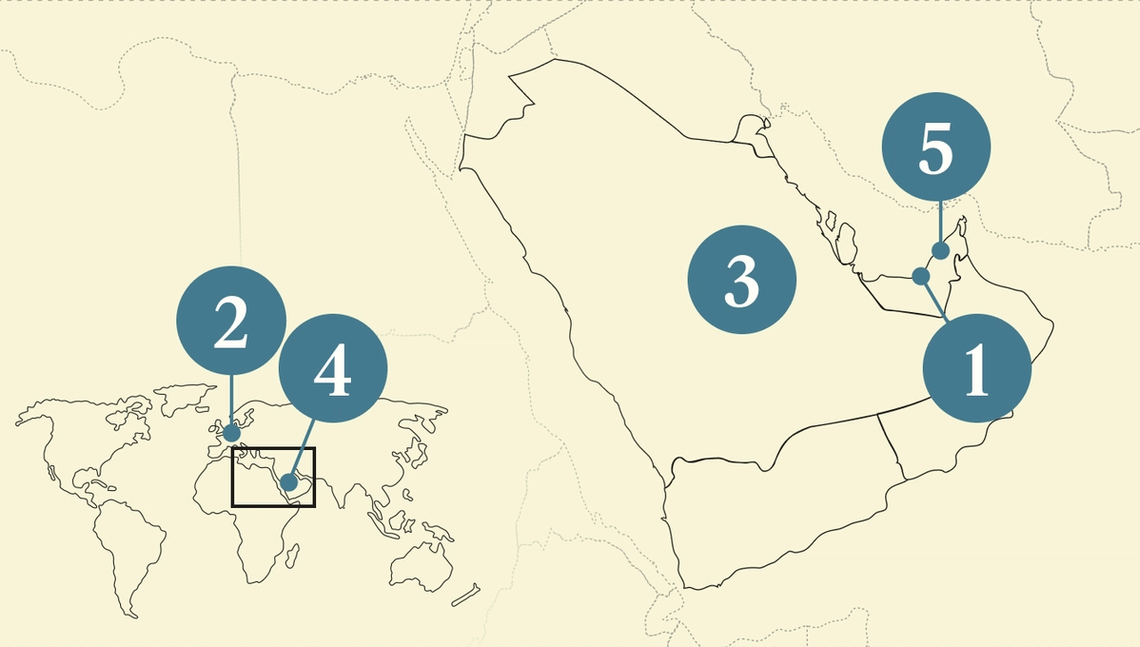 - Gulf stands up to Iran
- Doubts on Iran regime change
- Aramco results preview
- Oil storage calculus
- Dubai love letters
 A Patriots jet for repatriating Americans. |
|
 Gulf states have amassed around $5 trillion from oil surpluses over the past few decades, while institutions like Abu Dhabi’s Mubadala, Qatar Investment Authority, and Saudi Arabia’s Public Investment Fund have been fêted by the world’s biggest dealmakers and corporate bosses. That has, in turn, helped the governments that control them wield influence across the globe, but particularly in the US: When President Trump visited the Gulf last year, sovereign wealth funds played a major part, making trillion-dollar promises to invest in America. How those funds respond to this crisis could go several ways, but a recent scenario analysis by GlobalSWF suggested the most likely outcome sees them play an even bigger role in years to come. The forecast assumes that when the Strait of Hormuz reopens, oil prices remain high as investors fret about risks in the region, leading to a surge in cash for Gulf states. That will enable them to pay for rebuilding damaged infrastructure, restocking depleted militaries, and still directing surplus cash to investment vehicles around the world, reinforcing a reputation as a top source of funding for global dealmakers. Yet GlobalSWF’s model also warns of other, far more disruptive potential outcomes. A prolonged halt to shipping through the Strait of Hormuz would damage government finances, leading them to call on sovereign funds to help fund deficits. An escalation in the conflict and damage to key infrastructure could lead to oil price spikes, but limit Gulf states’ ability to capitalize on them. Governments may need to call on rainy day funds to help bolster defense spending and make up for shortfalls in tourism and other non-oil industries. The potential for a swift return to the status quo of last month is possible, but seems like a long shot. |
|
UAE president: ‘We are no easy prey’ |
 UAE President Sheikh Mohamed bin Zayed. Courtesy of Ministry of Foreign Affairs. UAE President Sheikh Mohamed bin Zayed. Courtesy of Ministry of Foreign Affairs.Into the second week of an expanding war with the US and Israel on one side and Iran on the other, Gulf states have been the collateral damage. But a common thread is emerging with Tehran: The region is not buckling under the pressure. Despite refusing to allow the US to use their territory to strike Iran, and urging de-escalation and diplomacy, Gulf states have been under constant attack from Iranian missiles and drones. Yet air defenses are holding, and regional disputes are being swept away. UAE President Sheikh Mohamed bin Zayed Al Nahyan toured hospitals and met with citizens and residents over the weekend. In a brief interview, he warned “enemies of the UAE” not to be misled by the country’s peaceful appearance, which masked a much harder, Bedouin core: “The UAE has thick skin and bitter flesh — we are no easy prey.” Iran, for its part, has also remained defiant. Its president promised to halt attacks on its neighbors — a pledge that was swiftly ignored by the country’s real power centers that named Mojtaba Khamenei, a son of the recently killed supreme leader, as his father’s successor. Little is known about the new leader, but a Bloomberg investigation in January revealed the cleric has around $140 million in luxury real estate and bank accounts in London and Switzerland, which suggests close links to the corruption network governing the Islamic Republic. — Mohammed Sergie |
|
EU official doubts Iran regime change |
 Thomas Peter/Reuters Thomas Peter/ReutersKajsa Ollongren, the EU’s special representative for human rights, expressed doubt that the US-Israeli war in Iran will result in regime change in the country, in an interview with Semafor’s Morgan Chalfant. “There doesn’t seem to be a plan in place for a regime change, and we also know from other countries that regime changes are extremely difficult if they don’t come from within,” she said. She’s not alone in that view: A classified US intelligence assessment concluded that large-scale war would be unlikely to result in regime change, The Washington Post reported. Ollongren, who held meetings with State Department officials and US lawmakers in Washington last week, also warned of the deteriorating security situation in the Middle East. |
|
Aramco earnings clouded by Hormuz pressure |
 Saudi Aramco will have to show whether it can keep oil flowing with the Strait of Hormuz remaining closed when it reports its 2025 earnings tomorrow. When Aramco facilities were hit by drones in 2019, knocking out half of Saudi Arabia’s export capacity, the company didn’t miss a shipment to international customers. Maintaining that reputation may be harder this time. Iranian attacks have targeted oil fields and processing facilities while Tehran has effectively blocked the Strait of Hormuz, creating a nightmare scenario for the company’s ability to export crude. Saudi Arabia’s east-west pipeline can take some oil from the Gulf, but its capacity is limited. The wartime surge in oil prices has lifted Aramco’s stock to its highest in the past year. Yet a consensus of analyst estimates projects a 3% year-on-year fall in Aramco’s net income: Producers won’t be able to take advantage of higher prices if they cannot get crude to market. If exports stall, Saudi Arabia’s state oil company may be forced to follow the lead of Iraq, Kuwait, and the UAE, who have all cut production because they have nowhere to send their oil. — Matthew Martin and Manal Albarakati |
|
View: Trapped barrels test Gulf exporters |
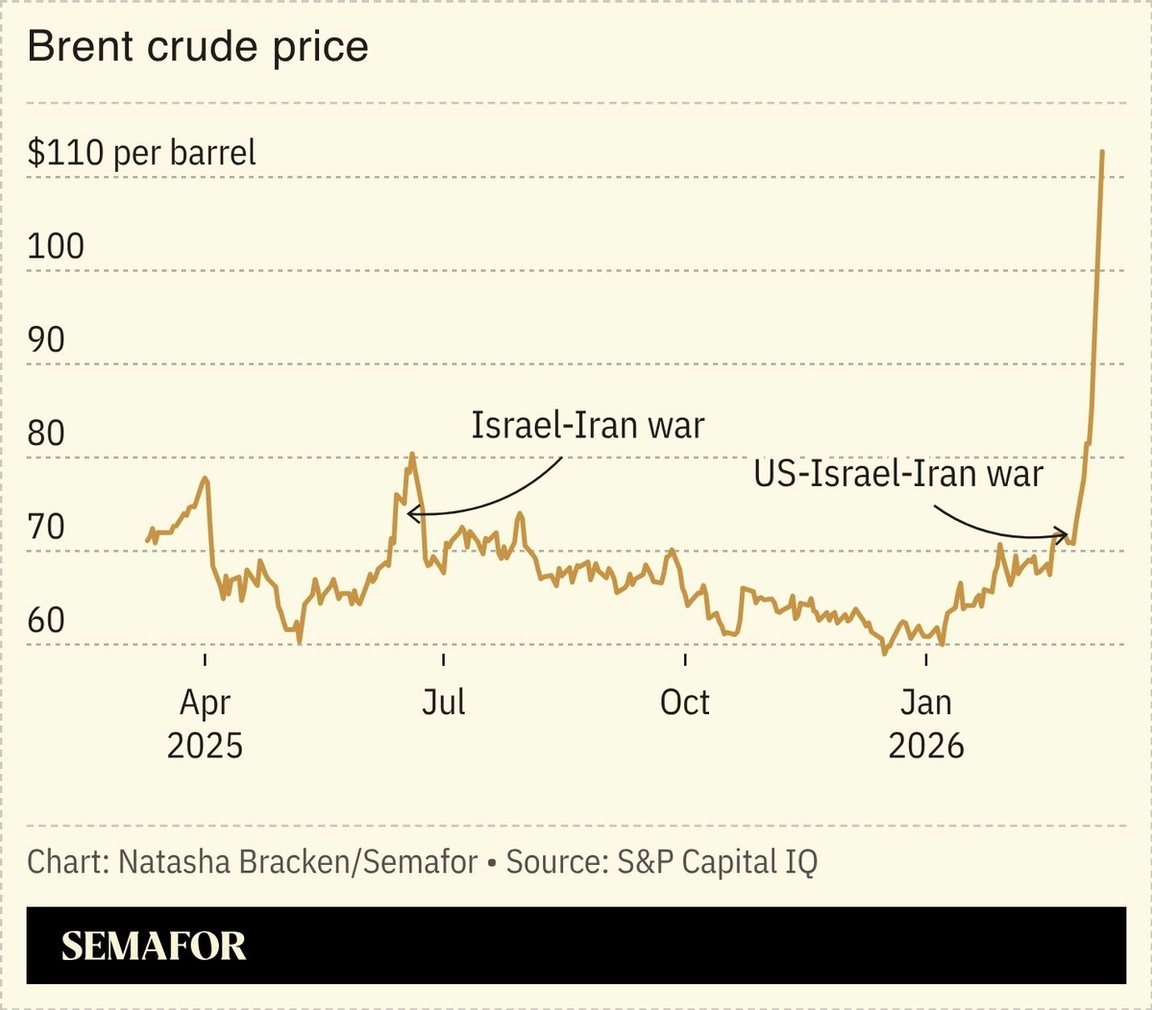
 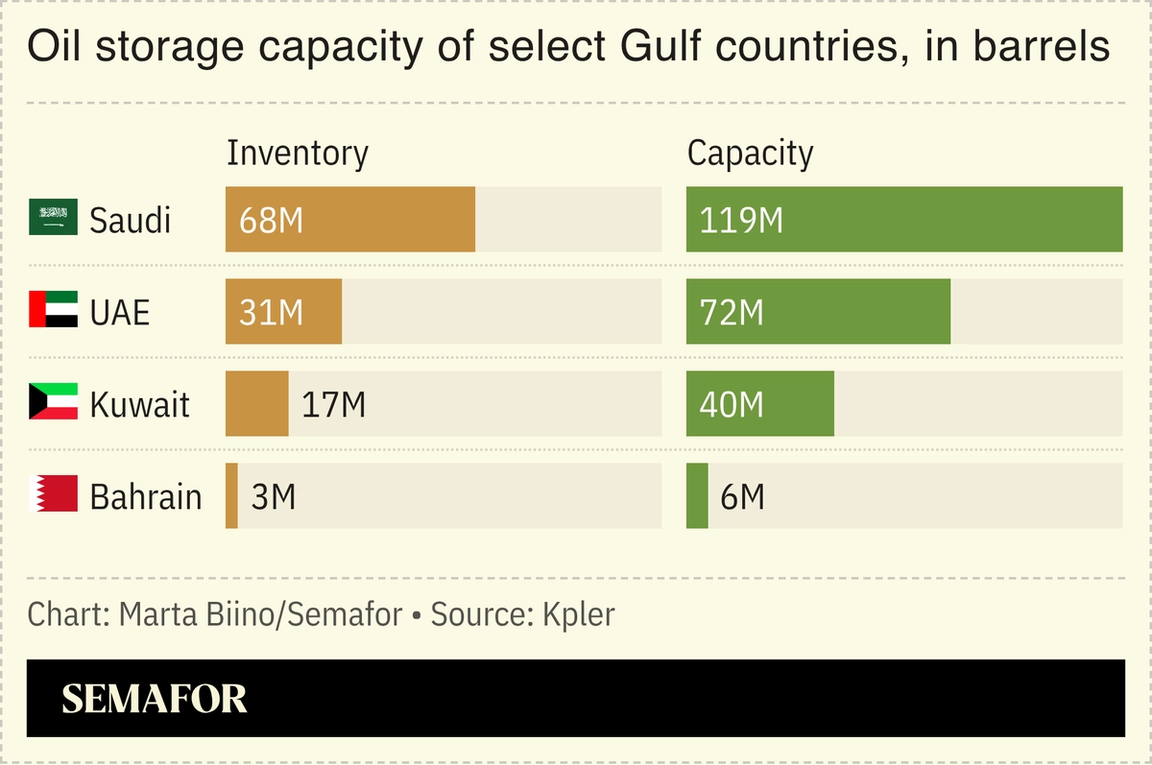 The US-Israel war on Iran has quickly evolved from a regional military confrontation into a global energy shock which could test the resilience of the international energy system in ways not seen for decades, writes Amena Bakr, head of Middle East energy and OPEC+ research at Kpler, in a column for Semafor. Prices rose to nearly $120 a barrel on Monday and Qatar’s energy minister has warned that prices could reach $150 within weeks if tankers can’t transit the Strait of Hormuz. “As with most shocks, there are winners and losers,” Bakr wrote. “Saudi Arabia, the UAE, and Iran have options to bypass the chokepoint. Bahrain, Iraq, Kuwait, and Qatar do not.” |
|
 People watch the sun set over Dubai. Amr Alfiky/Reuters. People watch the sun set over Dubai. Amr Alfiky/Reuters.Schadenfreude has tinged some international coverage of wartime Dubai (looking at you, Daily Mail), but love letters to the UAE have provided an antidote to the derision. The essays have offered an alternative to the “Dubai-knockers [who] have it down as an airhead’s paradise,” as Janan Ganesh put it in the Financial Times. The city is, in fact, a “blank slate” where its 4 million residents can build (or rebuild) a life, including “the newly middle-class Indian, the sanctions-avoiding Russian, the Uzbek barista, the white-collar economic migrant,” he wrote. The Wall Street Journal’s chief foreign affairs correspondent, who has lived in Dubai since 2015, evoked his hometown of Kyiv; he was there when Russia invaded in January 2022. Similar to that day, Yaroslav Trofimov wrote, “I felt a sense of personal insult as Iranian missiles started raining.” Disbelief from the West is what’s painful to others: “That millions of residents genuinely trust the country they live in appears to some observers too inconvenient to consider,” wrote one columnist in The National, arguing that resilience will outlast the skepticism. Journalist Frank Kane — a longtime Dubai resident and unofficial dean of its foreign correspondent corps — expressed his affection by keeping calm, a glass of malbec in hand. |
|
 - Bloomberg: In an interview, scholar Bernard Haykel explains Tehran’s current thinking, the possible consequences of regime collapse, and how Saudi Arabia’s crown prince views the war.
- Bloomberg: South Asians will continue to flock to Dubai to work for its companies, construction sites, and restaurants, but the illusion of safety has been shattered for millions, writes columnist Mihir Sharma.
- Baker Institute: An exploration of how — by attacking airports, hotels, and ports — Iran is drawing the Gulf into a conflict the region wants no part of, and why such strikes may convince the region’s leaders to apply pressure on Washington.
- Carnegie Endowment for Peace: Türkiye wants two things from Washington. The first is obvious: That the US war on Iran does not cause security concerns in Ankara. Second, that Israel does not confront it as a rival.
- International Crisis Group: A look at the sprawling conflict and possible responses by Gulf states, as well as others like Iraq, Lebanon, and Yemen.
- Princeton Alumni Weekly: Shaikh Nawaf al-Sabah, CEO of the Kuwait Petroleum Corporation, recounted his surprise over the closure of the Strait of Hormuz — and Kuwaitis’ outrage over Iran’s attacks — to his alma mater.
- The Wall Street Journal: The Iranian regime is facing an unprecedented crisis that makes the unlikely possible, especially because the domestic protest movement persists, according to historian and author Ali Ansari.
|
|
The US State Department chartered a jet owned by the New England Patriots football team to evacuate American citizens from the Gulf, according to a State Department official. Team owner Robert Kraft is a friend of President Donald Trump and has previously used the aircraft for humanitarian trips in the offseason.  @ASDylanJohnson/X @ASDylanJohnson/X |
|
|


