What matters in U.S. and global markets today

Get full access to Reuters.com for just $1/week. Subscribe now.


Morning Bid U.S.

Morning Bid U.S.

A Reuters Open Interest newsletter

What matters in U.S. and global markets today


By Mike Dolan, Editor-at-Large for Finance and Markets

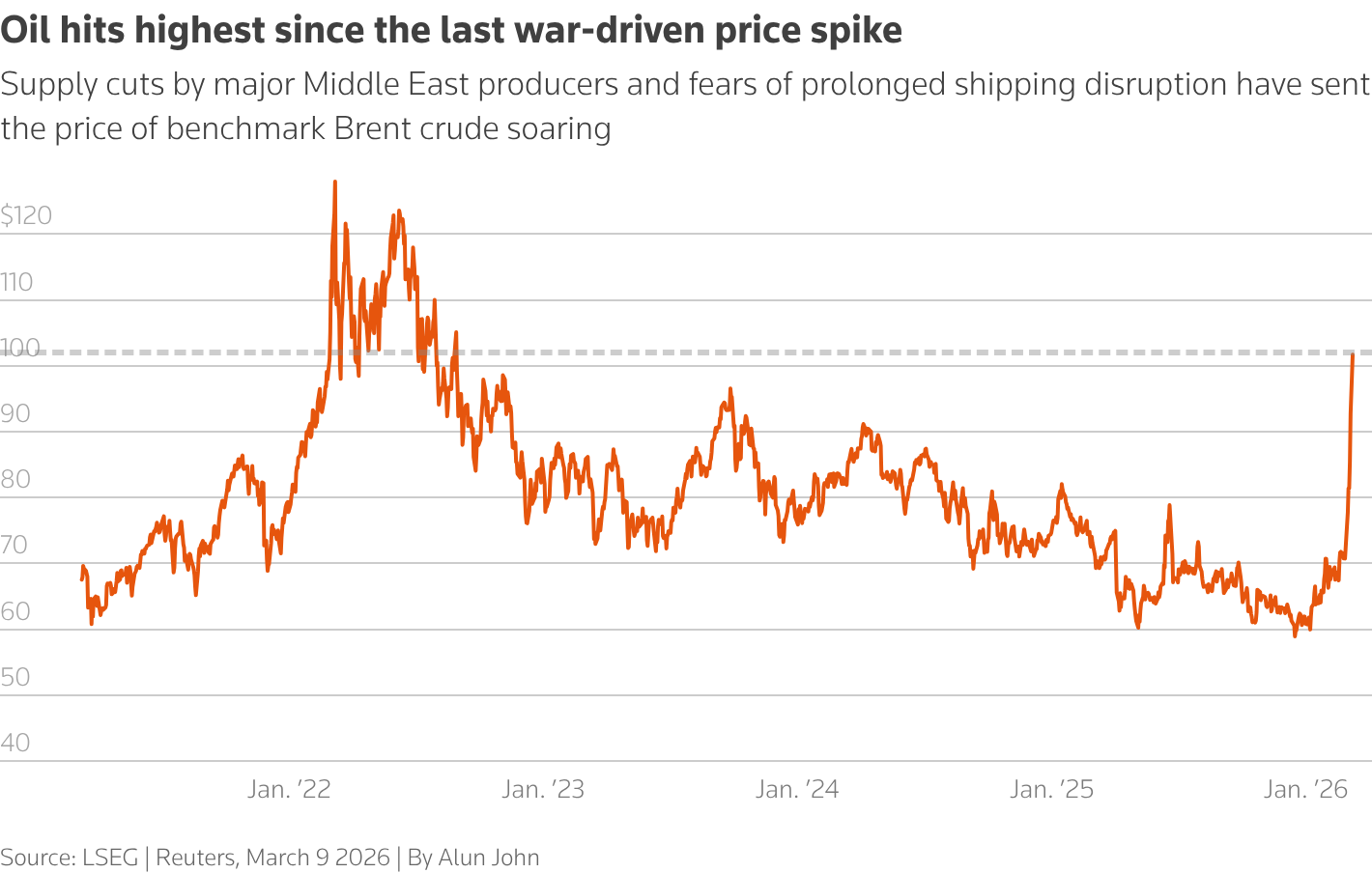
The fog of war remains thick. Crude oil prices have become wildly volatile this week, with intraday swings exceeding $30 per barrel - some of the biggest one-day moves on record.

After soaring as high as $120 early Monday - the highest in four years - oil prices then slumped back below $100 later in the day after President Trump once again teased the prospect of a short-lived conflict with Iran, saying the war was “very complete”.

I’ll get into that and more below.

But first, check out my latest column on why inflation isn't the only risk keeping central bankers up at night as the conflict in Iran continues.

And listen to the latest episode of the Morning Bid daily podcast where I discuss how headline‑driven oil swings are rewiring stocks, bonds and rate expectations.

Subscribe to hear Reuters journalists discuss the biggest news in markets and finance seven days a week.


Data refreshes every time you open this email. For more U.S. market news, click here. Please send any feedback to morningbid@thomsonreuters.com.


Today's Market Minute

  • Iran's Revolutionary Guards said on Tuesday they would not allow "one litre of oil" to be shipped from the Middle East if U.S. and Israeli attacks continue.
  • Oil prices fell on Tuesday after hitting an over three-year high in ‌the prior session as U.S. President Donald Trump predicted the war in the Middle East could end soon.
  • Investors are now seriously considering the possibility that war in the Middle East could create a stagflationary shock, just as it did 50 years ago, when disruption to global energy supplies sent inflation surging, and battered growth.
  • The surge in the spot price of LNG has dragged coal prices higher, but only for the higher quality grades, writes ROI Asia Commodities and Energy Columnist.
  • An air of complacency hangs over Wall Street despite the Middle East war. We’ll soon find out whether that was an efficient market at work or wishful thinking, writes ROI Markets Columnist Jamie McGeever.
 

Oil's combustible calm

Trump’s apparent about-face on Monday not only calmed oil prices but also the complex of world stocks and bonds that had shivered after oil's triple-digit price spike. Wall Street stocks closed up on Monday, while on Tuesday South Korea’s KOSPI index regained nearly 6% and Japan’s Nikkei climbed nearly 3%.

Meantime, U.S. Treasury yields tumbled and the dollar took a breather on Tuesday, steadying against major currencies, helping gold edge up in turn. U.S. stock futures were up ahead of the bell, having remained remarkably calm amid yesterday's tumult.

Many will say this is the TACO (“Trump always chickens out”) trade par excellence, but there are few signs that Trump’s optimistic turn is playing out on the ground, with Iran’s Islamic Revolutionary Guard Corps still asserting that no oil will be exported as long as U.S.-Israeli attacks continued.

Responding to that over social media, Trump threatened further retaliation against Iran if it continued to disrupt oil flows through the Strait of Hormuz. So, for now, the tit-for-tat looks set to continue.

Through all of this, oil prices held above $90 per barrel - a level that would have seemed frightening only last month. And pass-through to fuel costs is already being felt in the U.S., where a comfortable majority of Americans now believe prices will worsen over the next year.

In the background, G7 finance ministers on Monday mulled a possible joint release of their oil reserves to calm the horses, though they stopped short of doing so now, with a G7 official telling Reuters that the decision was “just about timing”.

Elsewhere, China reported a spectacular surge in its trade surplus for the first two months of the year, with exports up more than 20% year-on-year. While that certainly supports its new growth target of just under 5% and comes despite falling bilateral trade with the U.S., it also predates this month’s spike in oil prices.

Later in the day, after the bell, Oracle is set to report earnings, with traders likely to be on the lookout for signs of a payoff from spiralling capex as it ploughs billions into AI data center expansion.

With that, onto today's column.


How oil shock and financial stress can feed each other

Central banks are clearly watching the Iran war oil shock like hawks. But even if inflation is their main concern, it's not the only one - and a worst case for some top policymakers is that the crude price surge proves a breaking point for multiple financial stress fractures.

The surge in oil prices, driven by supply disruption from more thana week of war in the Middle East, is already challenging central banks' stretched mandates.

An age-old question is whether oil spikes that lift inflation and inflation expectations ultimately crimp household and business finances so much that they depress demand and prices. And then there's the toxic scenario in which they do both, leaving policymakers with ‌a conundrum of whether to prioritize taming inflation or supporting consumers and jobs.


Graphics are produced by Reuters.

Read the full column