Quality Payment Program Small Practices Newsletter: March 2026
Quality Payment Program Small Practices Newsletter: March 2026
The Quality Payment Program (QPP) Small Practices Newsletter is a monthly resource that provides small practices (15 or fewer clinicians) with program updates, upcoming QPP milestones, and resources to support their continued participation and success in QPP, including the Merit-based Incentive Payment System (MIPS). The newsletter is disseminated on the second Tuesday of each month.
Please share this newsletter with your fellow clinicians and practice staff and encourage them to signup to receive this monthly resource.
At-a-Glance: Required and Recommended Activities for Successful Participation in QPP
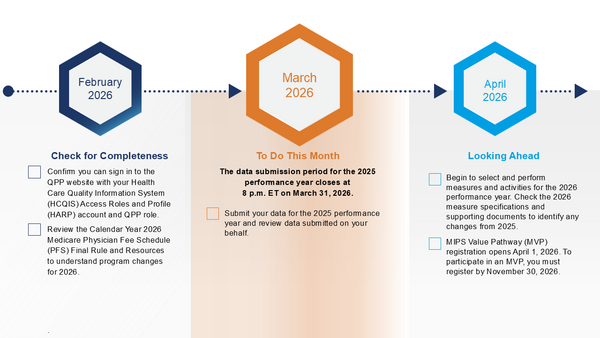
Each month, we share required and recommended activities for small practices to support their successful participation in QPP. The activities follow a rolling quarter approach, letting you see activities for the previous month, the current month, and the following month.
The Centers for Medicare & Medicaid Services (CMS) has opened data submission for the 2025 performance year of the Quality Payment Program (QPP). Data can be submitted and updated until March 31, 2026, 8 p.m. ET.
Submit your data for the 2025 performance year or review the data reported on your behalf by a third party. (You can’t correct errors in your data after the submission period, so it’s important to make sure the data submitted on your behalf is accurate.)
Submission resources have been uploaded to the QPP Resource Library. Helpful resources for data submission include:
Enter your 10-digit National Provider Identifier (NPI) in the QPPParticipation Status Tool and review your final 2025 and preliminary 2026 MIPS eligibility status.
Your final 2025 MIPS eligibility status determines whether you need to submit the data you collected last year.
Your preliminary 2026 eligibility status informs whether you need to collect data this year.
In the 2026 Medicare Physician Fee Schedule Final Rule, CMS finalized that Measure 141 – Primary Open-Angle Glaucoma (POAG): Reduction of Intraocular Pressure (IOP) by 20% OR Documentation of a Plan of Care –would receive the defined topped-out measure benchmark when reported through Medicare Part B claims. However, we’ve since determined that the measure doesn’t fully meet topped-out criteria for the 2026 performance period and will therefore receive a historical benchmark based on 2024 performance.
The QPP Service Center frequently receives inquiries about the Preventive Care and Screening: Tobacco Use: Screening and Cessation Intervention Quality Measure (Quality ID 226) from small practices who reported the measure via Medicare Part B claims.
This measure has 3 submission criteria, and we’ve found that practices have requested help understanding which submission criteria are used for measure evaluation, when the measure will count for scoring, and how to report the measure’s quality data codes (QDCs) correctly.
How we evaluate the measure for MIPS reporting:
We evaluate Submission Criteria 1 for data completeness and case minimum.
We evaluate Submission Criteria 2 for scoring; Submission Criteria 2 is a subset of the population reported for Submission Criteria 1.
We don’t evaluate Submission Criteria 3 for scoring purposes. While encouraged, it isn’t required for small practices reporting this measure by Medicare Part B claims, however, it is included in the data publicly reported in downloadable files on data.cms.gov. (Submission Criteria 3 is a comprehensive look at overall tobacco screening and cessation intervention.)
For this measure to appear in your performance feedback:
You must have a denominator-eligible population for Submission Criteria 2 (at least 1 patient you screened for tobacco use during the measurement period must have been identified as a tobacco user when you reported Submission Criteria 1) AND
You must report at least 1 QDC for Submission Criteria 2.
If none of your patients are smokers, you should look for an alternate measure to report because non-smokers aren’t evaluated for performance or scoring in Submission Criteria 2.
Next Steps for Clinicians Reporting Quality ID 226 through Medicare Part B Claims:
Review your practice’s workflows to ensure the proper QDCs are added to your Medicare Part B claims when reporting this measure.
Review the 2026 Medicare Part B claims measure specification for detailed coding information when reporting this measure: the codes that identify the patients who qualify for the measure and the codes you report to indicate the quality action performed.
Share your feedback on what you like most about the Small Practices Newsletter, what can be improved, and/or what topics you would like to see addressed. Please include “Small Practices Newsletter” in the email subject line.
Contact the QPP Service Center by email at QPP@cms.hhs.gov, by creating a QPP Service Center ticket, or by phone at 1‑866‑288‑8292 (Monday – Friday, 8 a.m. – 8 p.m. ET).
To receive assistance more quickly, please consider calling during non-peak hours — before 10 a.m. ET and after 2 p.m. ET.
People who are deaf or hard of hearing can dial 711 to be connected to a Telecommunications Relay Services (TRS) Communications Assistant.
This email was sent to NP7epxb8a@niepodam.pl using GovDelivery Communications Cloud 7500 Security Boulevard · Baltimore MD 21244