|
 |
Trump’s Surgeon General Pick Needs a Spine Implant
A recent exchange revealed a troubling lack of political courage—but the job practically demands it.
|

| ||||||||||||


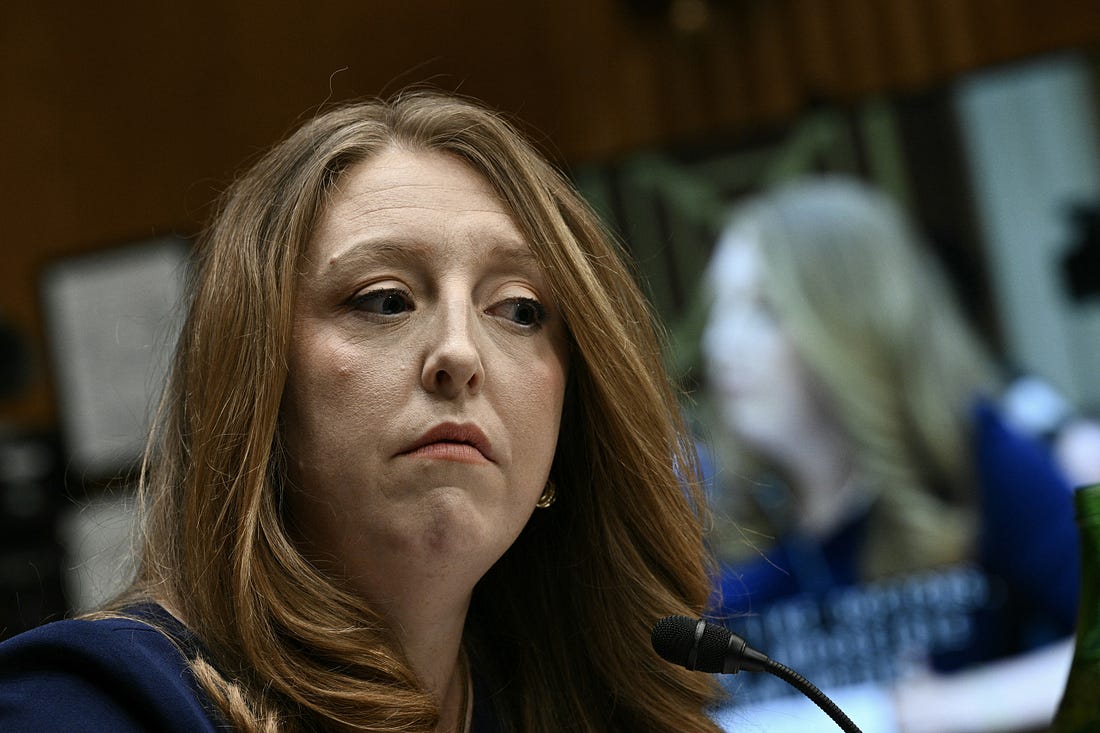 |
CASEY MEANS IS DONALD TRUMP’S NOMINEE to be surgeon general, a position that would, in theory, make her the nation’s most important doctor. If you want a glimpse of how she would approach the job—and a sense of why her nomination has become so controversial—consider a key moment from her confirmation hearing before the Senate Health, Education, Labor, and Pensions (HELP) committee two weeks ago.
The moment came when Means, a Stanford-medical-grad-turned-wellness-influencer, got a question about vaccination for seasonal influenza—that is, the flu shot. The senator asking, Virginia Democrat Tim Kaine, wanted to know whether Means agreed with her would-be boss, Health and Human Services Secretary Robert F. Kennedy Jr., who had claimed in January that there’s no evidence to show the vaccine is effective.
Initially, Means declined to answer, saying she hadn’t heard Kennedy’s statement directly. Fine, Kaine said, forget about Kennedy’s comments and stick to the science. “Do you believe,” the senator asked, “that there’s no evidence that the flu vaccine has efficacy in reducing serious injury and hospitalization?”
Still Means wouldn’t answer. Instead, after a pause and some stammering, she said that she would endorse CDC guidelines, whatever they are, and that she personally believes vaccination in general saves lives. Those two statements were versions of platitudes that she had offered previously in the hearing. Notably, neither revealed what she thought of the flu shot.
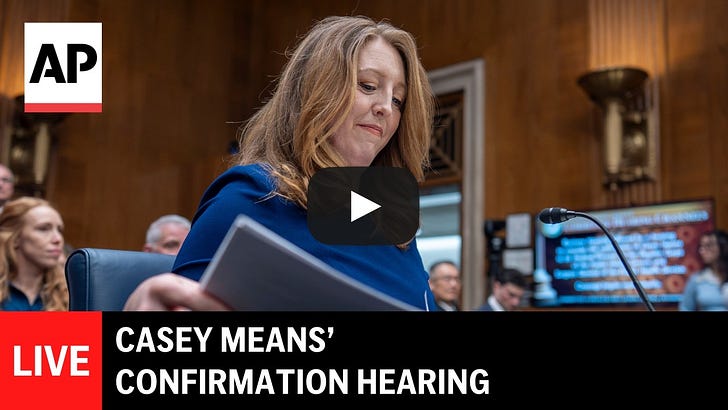
Only after this had gone on for more than two minutes—and only after Kaine asked for what was the eighth time—did Means concede that evidence showed the vaccine to be effective “at the population level.” Kaine acknowledged the response, such that it was, adding with exasperation that “this was not a hard question.”
It certainly should not have been. There are literally dozens of high-quality, peer-reviewed studies showing that if you get the flu shot, you’re significantly less likely to become severely ill or need hospitalization. That is no small thing given that flu in the United States leads to hundreds of thousands of hospitalizations every year, and tens of thousands of deaths.
So why wouldn’t Means give a straight answer? One possibility is that Means shares Kennedy’s skepticism of the shot, but was trying to downplay her feelings because recent polling has shown the public turning against Kennedy’s anti-vaccine crusade.
Relatedly, Means might have been nervous about holding on to support from key Republicans on the committee—like chairman Bill Cassidy, a Louisiana physician—who have been outspoken supporters of vaccination despite their support of Kennedy’s nomination.
Another possibility is that Means knows the flu vaccine research and accepts its validity, but didn’t want to undermine Kennedy—or, at least, didn’t want to anger leaders of the MAHA movement who are still crusading to stop government support of vaccines. Her confirmation hearing came right after the White House issued a controversial decision on pesticides that infuriated many in the MAHA movement. It’s not hard to imagine why she’d be nervous about alienating those activists further.
Those are three different reads, obviously. But they have one key thing in common. They all suggest Means was tailoring her statements to avoid political blowback, to an extent that past surgeons general have not. That’s a big warning sign on a nomination where the lights were already blinking bright red.
ON PAPER, THE SURGEON GENERAL of the United States does not have a lot of power. The primary line authority of the office is to oversee the U.S. Public Health Service, a uniformed group of roughly 6,000 health professionals who work alongside other public employees at federal health agencies like CDC and NIH, with occasional call-ups for special initiatives and emergency duty.¹ The work is vital, but it’s part of a much broader federal health enterprise over which the surgeon general has no administrative responsibility.
The real power of the surgeon general comes from the chance he or she has to shape the national conversation about health care, as then-Surgeon General Luther Terry famously did with his 1964 report declaring that smoking was “causally” related to lung cancer. That report is widely believed to have played a critical role in launching the war on tobacco that, since the 1960s, has reduced smoking in the United States by about 75 percent and almost certainly saved millions of lives.
The surgeon general’s reach was just as visible two decades later, when C. Everett Koop issued a groundbreaking report on AIDS and produced a brochure on the disease that went out to every American household. The plain-language, eight-page document not only offered practical advice on prevention, including the importance of condoms, it also played a pivotal role in transforming the AIDS fight from a moral controversy into a public health crusade, fueling research, prevention, and treatment efforts that likewise saved millions.