|
 |


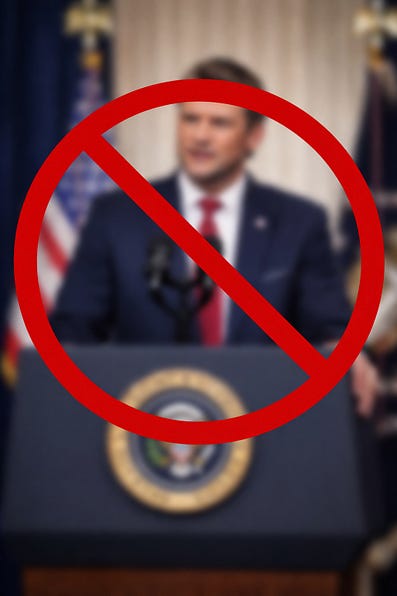
The Defense Department announced is barring press photographers from the briefings it holds on the war in Iran. Why? According to “two people familiar with the decision who spoke on the condition of anonymity out of fear of retaliation,” it’s because the press has published photos of the self-proclaimed Secretary of War Pete Hegseth that “his staff deemed ‘unflattering.’” The Pentagon has excluded photographers from Hegseth's last two briefings on the war and hasn't offered an on-the-record explanation for the change.
 |
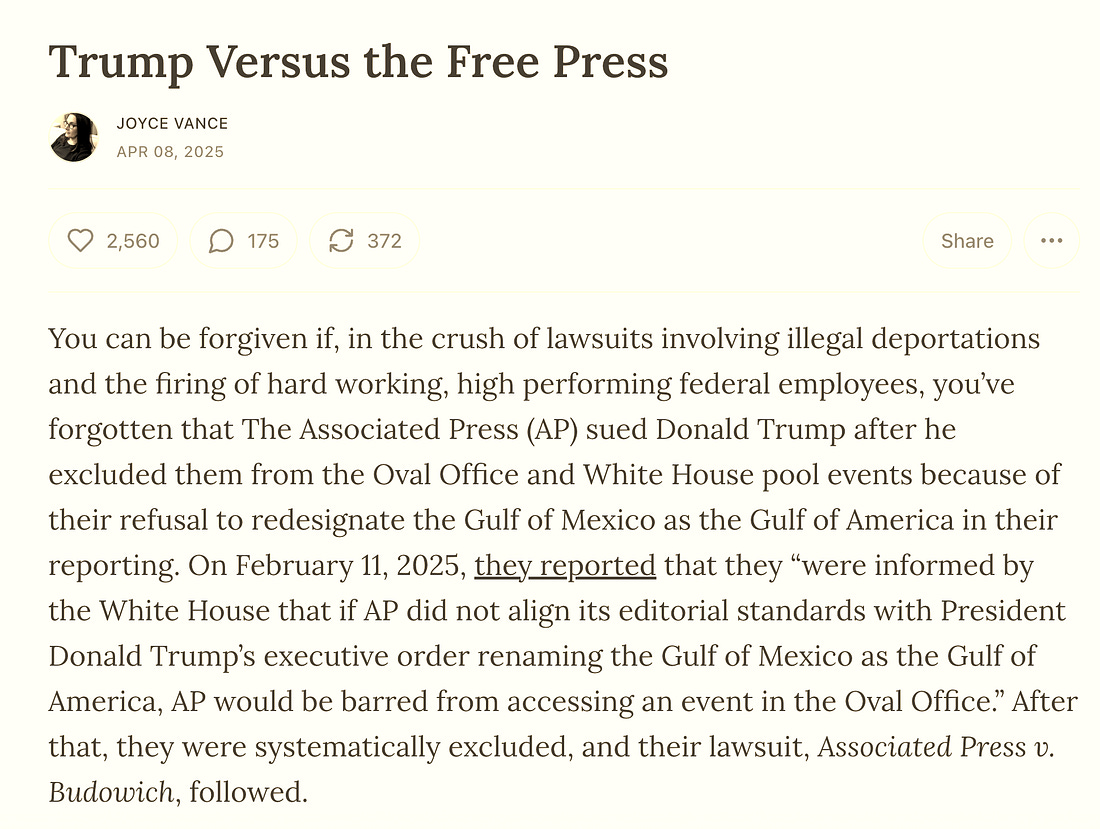
A year ago, the administration banned the AP from events other reporters were permitted to attend, including a briefing at the White House and an Air Force One flight. They did it because the AP continued to refer to the Gulf of Mexico by its internationally recognized name after the President redesignated it as the Gulf of America. This led to a lawsuit, of course, Associated Press v. Budowich. The administration argued that covering the president was a privilege and that they could decide who could and who couldn’t have access.
District Judge Trevor N. McFadden, a Trump appointee, ruled that the Trump administration’s reason for barring AP reporters mattered:
“[T]he Court simply holds that under the First Amendment, if the Government opens its doors to some journalists — be it to the Oval Office, the East Room, or elsewhere — it cannot then shut those doors to other journalists because of those viewpoints. The Constitution requires no less.”
That encapsulates the idea of what lawyers call “viewpoint discrimination,” the principle that the government can’t treat speech differently based on the point of view it represents. We discussed the theory of the case at length here.
 |
Viewpoint discrimination is a well established basis courts use to find a First Amendment violation. In 1943, Justice Robert Jackson wrote that “If there is any fixed star in our constitutional constellation, it is that no official, high or petty, can prescribe what shall be orthodox in politics, nationalism, religion, or other matters of opinion or force citizens to confess by word or act their faith therein.”
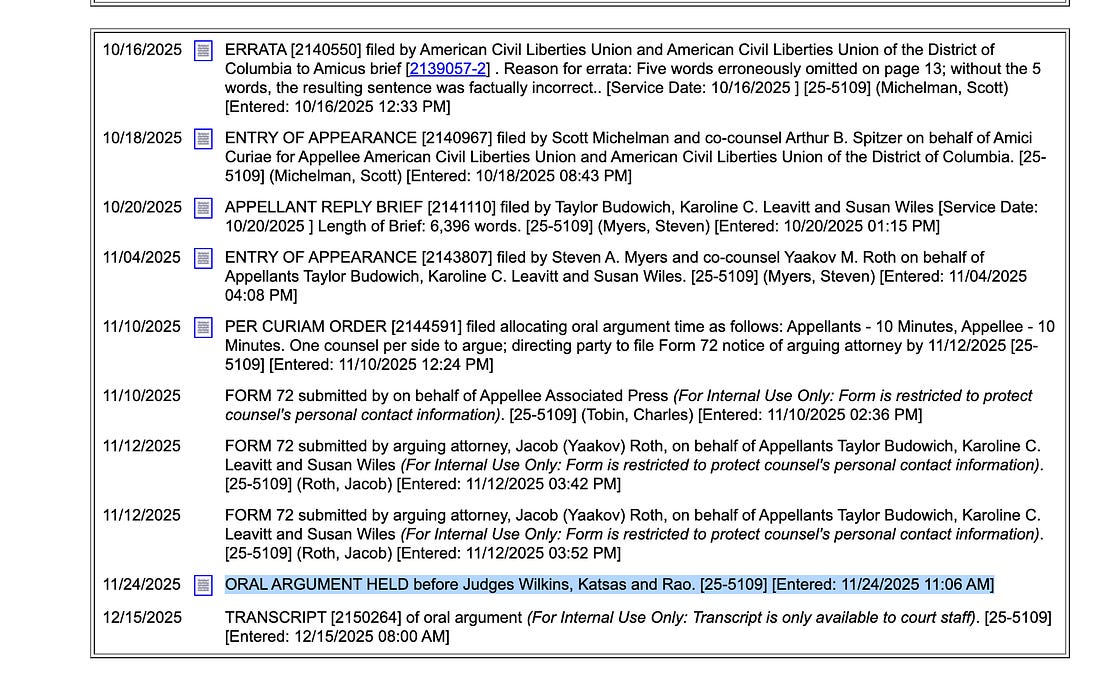
In Budowich, Judge McFadden stayed his order so the administration could appeal his ruling. The appeal was briefed and argued before a three-judge panel in the court of appeals late last year, with lots of participation from amici, who filed “friend of the court” briefs. The decision is still pending, although a delay of months between argument and opinion is not especially unusual. But we still don’t know what the AP’s fate is, and perhaps more importantly, how much of an ability the administration has to punish “offending” journalists, which there is every reason to believe they would push to the limits and likely beyond.
 |
Whether it turns out to be the prevailing view or not, Judge McFadden would seem to have the best of it: “The Constitution requires no less.” If the government can stop all photographic coverage of press conferences during a war because it doesn’t like how the Secretary looked, who are we?
Maybe the President should take that up with his cabinet secretary and tell him to clean up a little? Americans are entitled, because of the First Amendment and our profound tradition of freedom of the press that stems back to the clear intent of the Founding Fathers, to robust reporting on what our government is up to—who did what, when, and why they did it, if that can be discerned. In this very visual era, that should include photographs and videos of what happens. There is no legitimate excuse for keeping the public from viewing what it’s paying for in settings, like public press conferences, that don’t compromise national security.
The AP ban came after calls from the President and Elon Musk (back when DOGE was still a thing) to defund NPR. But that wasn’t enough for this administration. Major news outlets that millions of Americans rely on for coverage of the Pentagon were ejected from their office space, making it more difficult to report contemporaneously on what was happening there. And reporters who ask tough questions, or even just logical ones, are dismissed without answers. “Quiet, Piggy.”
There is context. There is a trajectory here. This is an administration whose rules make it more difficult for the press to tell Americans what’s happening, instead of encouraging a free flow of information and ideas.
Writing about the Gulf of America debacle as it was happening in the Wall Street Journal, the AP’s Washington Bureau Chief Julie Pace commented, “For anyone who thinks the Associated Press’s lawsuit against President Trump’s White House is about the name of a body of water, think bigger. It’s really about whether the government can control what you say.”
She asked, “If we don’t step up to defend Americans’ right to speak up freely, who will? Today the U.S. government wants to control the AP’s speech. Tomorrow it could be someone else’s.” It could be yours.
What’s the press to do? The Washington Post, after publicly abandoning it at the start of Trump 2.0, quietly readopted the tagline “Democracy Dies in Darkness.” Those words, which first graced the Post’s masthead in 2017, still ring true, despite their on-again, off-again usage. As the people who pay Hegseth’s salary, we’re entitled to know enough to give him performance reviews, and the media should be able to provide us with the information that makes that possible.
It’s an understatement to say that we are living through upheaval in the fourth branch of government, the press. It has been a struggle ever since the internet knocked out the business model. Now, much of the press faces a full-blown crisis of public confidence, as do so many of our institutions. Americans have the hard work ahead of them of becoming discerning, engaged evaluators of information. But what role will the press play?
In 2019, Freedom House, which tracks freedom of the press internationally and is viewed by media bias checkers as center-right in its orientation, argued that “Elected leaders in many democracies, who should be press freedom’s staunchest defenders, have made explicit attempts to silence critical media voices and strengthen outlets that serve up favorable coverage. The trend is linked to a global decline in democracy itself: The erosion of press freedom is both a symptom of and a contributor to the breakdown of other democratic institutions and principles.”
Those are sobering words, especially having been written in 2019, not primarily about this country, and with so much more having happened since then.
On October 2, 2018, Jamal Khashoggi, a Saudi journalist and permanent U.S. resident, went to the Saudi consulate in Istanbul to pick up some documents. After initial denials from the White House, the CIA