|
 |


Nothing like casual threats to free speech on a Saturday morning in America. Brendan Carr, the Chairman of the Federal Communications Commission, saw Donald Trump’s Truth Social post and hurried to salute.
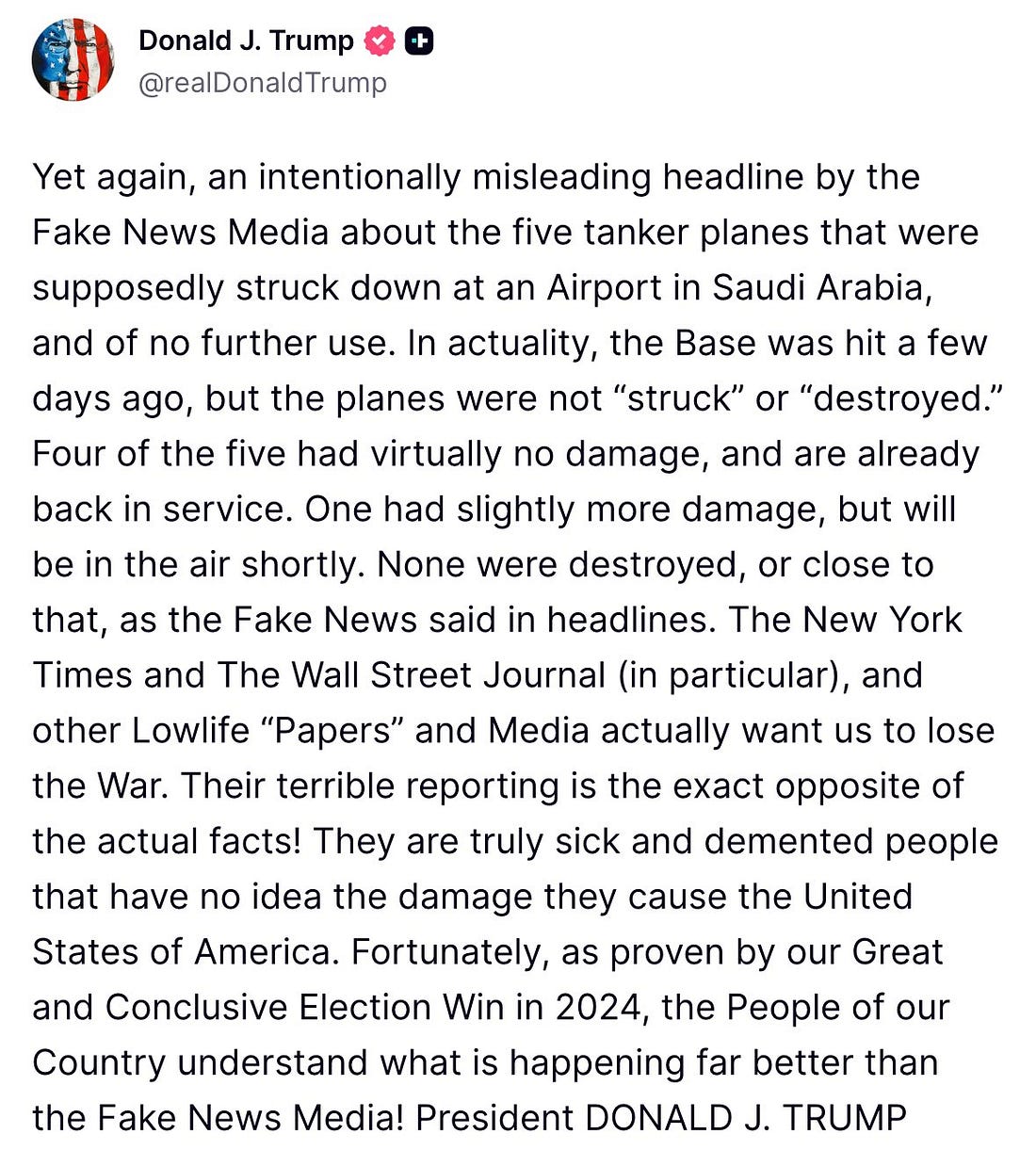 |
Trump complained about media coverage of damage reports to American tanker planes. He called out the New York Times, the Wall Street Journal, and what he characterized as other “Lowlife ‘Papers’ and Media.” Trump claims the reporting is tantamount to wanting the U.S. “to lose the War,” and called the reporters “sick and demented people.”
How do presidents handle reporting they honestly believe is inaccurate? There’s an apparatus in the White House for that. Reporters are actually eager to receive accurate information and the White House media shop is more than capable of delivering it. Deriding accurate reporting as “fake news” and using invective to describe journalists is quite simply painting a bullseye on their backs, in an era when we’ve repeatedly seen people take this kind of language as marching orders.
The deference presidents show to the First Amendment, both out of respect for first principles and because they can afford to, is dead with Trump. He doesn’t seem to realize that inaccurate reporting has its own price—the inevitable need for correction and the loss of reputation that comes with it. The same is true when it’s the president who is putting out false information, and in any event, it’s reprehensible for a president to accuse the press of being un-American when it’s just doing its job.
In case Trump’s feelings about the press weren’t clear enough in the first post, he followed up an hour later with this:
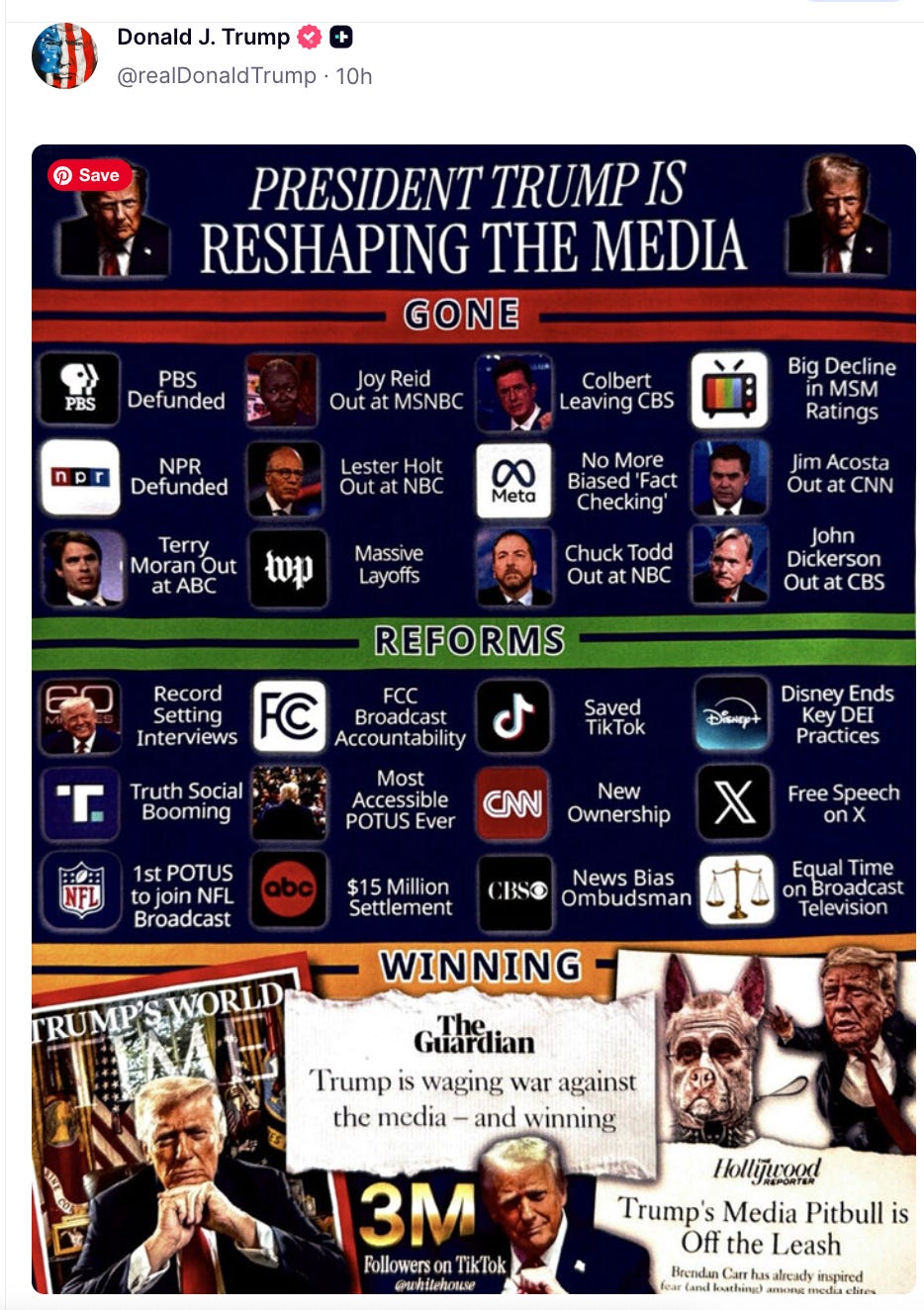 |
The President of the United States touted defunding PBS and NPR. He gloated about anchors who were “out”: Chuck Todd at NBC, Jim Acosta at CNN, Joy Reid at MSNBC, and others. And more, most of it indicative of a desire to have state-controlled media instead of a free press.
“FCC Broadcast Accountability” came under the label of “Reform.” That takes us back to Brendan Carr, now the head of that agency under Trump. By lunch time, he had a tweet of his own.
“Broadcasters that are running hoaxes and news distortions - also known as the fake news - have a chance now to correct course before their license renewals come up,” he wrote. “The law is clear. Broadcasters must operate in the public interest, and they will lose their licenses if they do not.” There’s the threat: Cross this administration and lose your ability to stay on the air.
Where have we heard that kind of threat before? The law firms that Trump tried to put out of business with his executive orders? To Anthropic last week? With colleges, universities, political leaders, students, and others, ever since this administration came to power. This is an administration that cannot tolerate dissent. And dissent is essential to the American tradition. It is who we are. It is embodied in the First Amendment.
Carr had more to say, “The American people have subsidized broadcasters to the tune of billions of dollars by providing free access to the nation’s airwaves. It is very important to bring trust back into media, which has earned itself the label of fake news.” Of course, the subsidized stations are PBS and NPR, two of the most highly regarded and widely listened to sources of news and other programming in the country.
”Time for change!” he concluded.
This is not the first time we have encountered Mr. Carr and his efforts to implement the President’s anti-free speech agenda from his perch at the FCC. It started with Project 2025. He’s been threatening to take away licenses from stations that won’t bend the knee for at least that long.
Carr wrote the Project 2025 chapter on the FCC. We’ve discussed that here, in November of 2024, as Carr’s name surfaced for the FCC, we noted his claim that “bipartisanship on the FCC is a matter of tradition, not law,” and his suggestion that he could do away with it. He characterized it as “make life more difficult” for entities the FCC regulates: radio, television, wire, satellite, and cable networks.
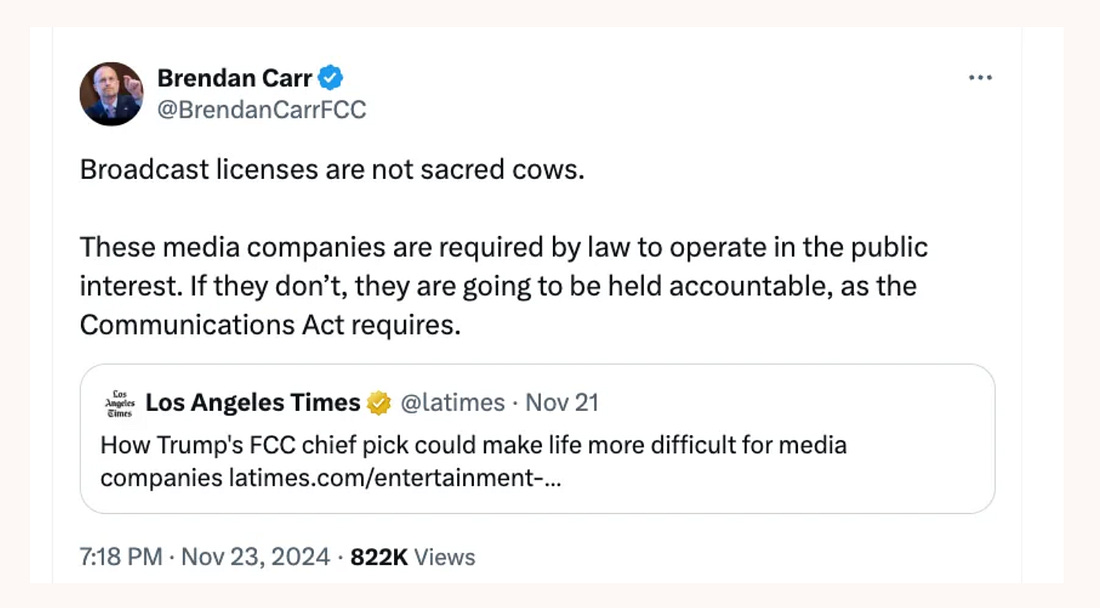 |
It’s cut and dry. Saying you’ll take away broadcast licenses from stations that refuse to toe the line for a presidential administration is just another way of saying you want to move toward an authoritarian form of government. Carr tried to create window dressing for it, characterizing media companies that believe in freedom of the press as companies that don’t “operate in the public interest.” But we could all see what was going on here and it’s manifesting now, as Trump faces increasing opposition. If the President has a case to make for the war in Iran, then let him go to Congress and make it in compliance with the Constitution and the War Powers Act. Let him sell it to the public. Attacking the press is just a sign of weakness.
Last September, Carr pushed for Jimmy Kimmel’s removal after Kimmel criticized the litmus test reaction to Charlie Kirk’s brutal murder, saying of Trump, “This is not how an adult grieves the murder of someone he calls a friend. This is how a four-year-old mourns a gold fish." Carr called what Kimmel said “the sickest conduct possible,” adding that the FCC could move to revoke ABC affiliate licenses as a punishment. When the network took Kimmel off the air briefly, Trump “congratulated” them “for finally having the courage to do what had to be done.” The attack on the free press was free flowing. But Kimmel is back on the air. The First Amendment survives.
The threats and epithets about false news are nothing new. Around the time of the Kimmel incident, Trump claimed that 97% of some network coverage was negative toward him. “They give me only bad publicity or press,” Trump said. “They’re getting a license, I think maybe their license should be taken away. It’s up to (Federal Communications Commission head) Brendan Carr.”
At the time I wrote, “The idea that Trump views the news, factual reporting by the press, as ‘bad publicity’ pretty much says it all. It captures so much of what is wrong. This isn’t 1984, and Trump is not Big Brother, entitled to acclaim from all. If you don’t want bad press, don’t do bad things.” But Trump continues to do bad things and attract legitimate criticism for it. The First Amendment protects the press that reports that legitimate criticism and the politicians and public who express it. The First Amendment and our ability to use it have outsmarted Trump on more than one occasion, and Carr and Trump haven’t always fared so well when they try to do battle with it.
Just a few weeks ago, Stephen Colbert shared that the network’s lawyers told him he couldn’t have Texas Democrat James Talarico, who is running for the U.S. Senate, on his show because of Federal Communications Commission (FCC) rules that require broadcasters to give “equal time” to opposing political candidates. So, Colbert