|
 |



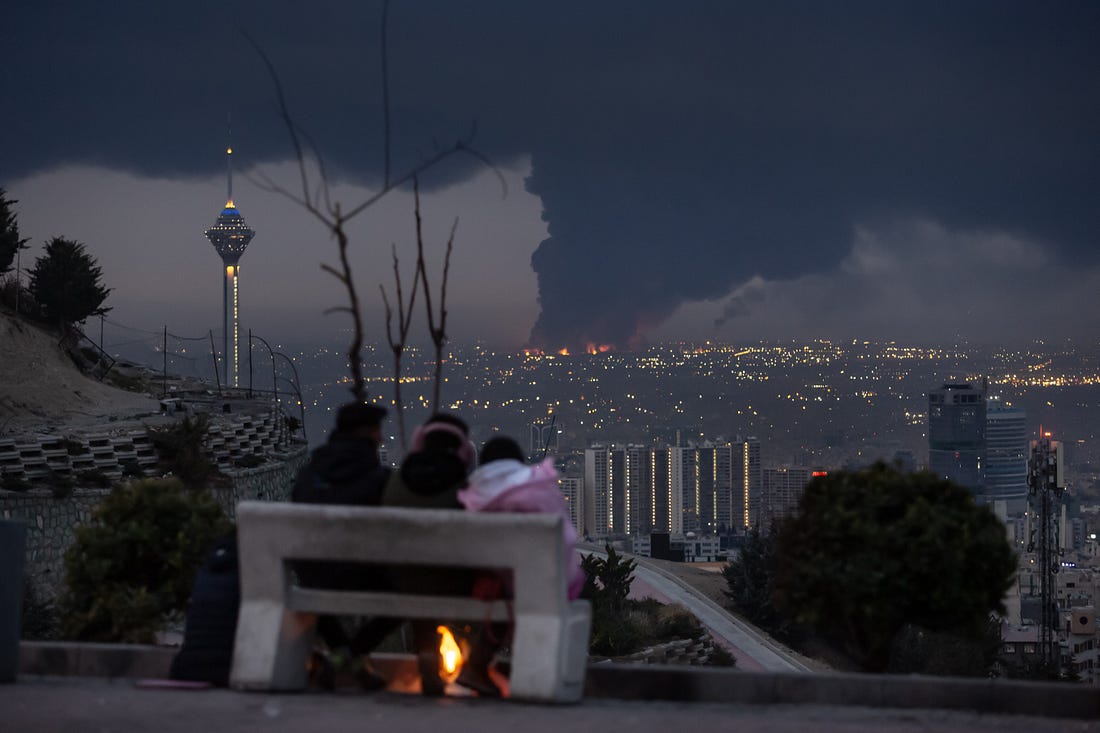
Leading the New York Times this morning: Israel is stepping up its ground attacks against the Iranian proxy Hezbollah in Lebanon, while other nations appear to be shrugging at Trump’s demand that they send warships to reopen the Strait of Hormuz. All perfectly standard procedure for a war that, as the White House keeps telling us, will be ending any minute now. Happy Monday.
 |
It’s Worse Than It Looks
by William Kristol
On Bulwark on Sunday yesterday, my guest, the historian Robert Kagan, explained the broad implications of the Iran war as well as anyone I’ve seen. I thought his remarks were helpful and important enough that I’m going to devote this space to some of his key points.
Kristol: Give me your read on where we stand in the war and what its geopolitical implications are so far.
Kagan: The outcome of the war is in doubt. We can’t really foresee what’s going to happen, partly because we don’t know what Donald Trump is going to do. He has a huge choice to make: either go all-in and really deal with this problem once and for all, which also implies a huge long-term American military commitment (you can’t just go in and do that and then run out), or try to find some way to bug out and declare victory. Until he makes that choice, I don’t think we’re going to know how this war turns out.
But even before knowing the outcome, we can see some of the repercussions in terms of the rest of the world. The top-line, big-picture result is that one undoubted effect of the Iran war has been to drive a deeper wedge between the United States and pretty much all of its traditional allies—in Europe, in Asia, and potentially even in the Middle East.
* * *
Kristol: Let’s go through those in order. Start with Europe.
Kagan: For the Europeans, they face an existential threat from Russian aggression right now. From the Europeans’ perspective, this war has been a real strategic disaster, for two main reasons. First, oil prices have skyrocketed, and even before Trump lifted sanctions on Russia—over the unanimous objection of the other G7 leaders—that was going to increase Russian income. It’s a real lifeline to Putin.
Second, American forces are—perhaps unexpectedly—burning through major stocks of weaponry, particularly Patriot and other interceptors that Ukraine depends on heavily to defend its cities from Russian attacks. So on both ends—helping Russia and hurting Ukraine—this has been a major setback for Europeans.
And it’s clear that the Trump administration couldn’t care less about the effect on Europe. They didn’t consult the Europeans before the war.
* * *
Kristol: And Asia?
Kagan: Very few countries in the world are more dependent on Middle East oil than Japan. The Japanese were not consulted. The skyrocketing oil prices are really damaging our allies. On top of that, the Japanese will notice that the United States has sent significant forces that are dedicated to the defense of Japan and critical to any response to a Chinese attack on Taiwan, to the Middle East.
The Chinese can also see that in order to conduct this war against a much lesser power, the U.S. has had to strip the Western Pacific of significant forces dedicated to a potential China threat. I don’t see why China should be more worried about the U.S. after this than before it.
* * *
Kristol: The Middle East?
Kagan: The Gulf States in particular are wondering whether they’ve joined the right team. They thought they had a pretty good arrangement with the Iranians: a kind of live-and-let-live agreement. So they didn’t favor the war and were overruled. And now it turns out the United States can’t really protect them. They’ve been targets; they’ve lost money on oil. They had—with tremendous cooperation from the Trump family and social circle—been working to make themselves an attractive destination for investment in AI and other sectors, hosting data centers for major companies, positioning themselves as a hub for investment and tourism. This war is devastating for all of that.
And now Trump is calling on China to help keep the strait open. It’s not hard to see how that pushes certain Gulf states toward viewing China as an equally reliable partner—or maybe more reliable—than the United States has turned out to be.
* * *
Kristol: The big picture?
Kagan: At the largest level, whatever outcome we eventually get, however decent, it will be because the United States brought enormous power to bear. And history shows it’s not enough to bring that power to bear to secure a victory. You have to keep it there to sustain the victory. The United States won a big victory in World War I, totally transformed the balance of power in Europe in a way favorable to peace, then pulled out—and then the balance of power got refashioned in ways that didn’t sustain peace, and we ended up in World War II. Something similar could happen in the Middle East if the U.S. brings great power to bear to create a certain situation but isn’t willing to keep it there.
That’s why Trump is at a fork in the road. It seems to me Trump faces one of two choices: establish a long-term, large American military presence to sustain whatever gains the war has made, or pull back and let things take whatever course they take. I find both highly problematic. But splitting the difference won’t solve anything.
And as every expert I’ve read says, the only way to guarantee keeping the strait open is to control the Iranian coastline from which most of the