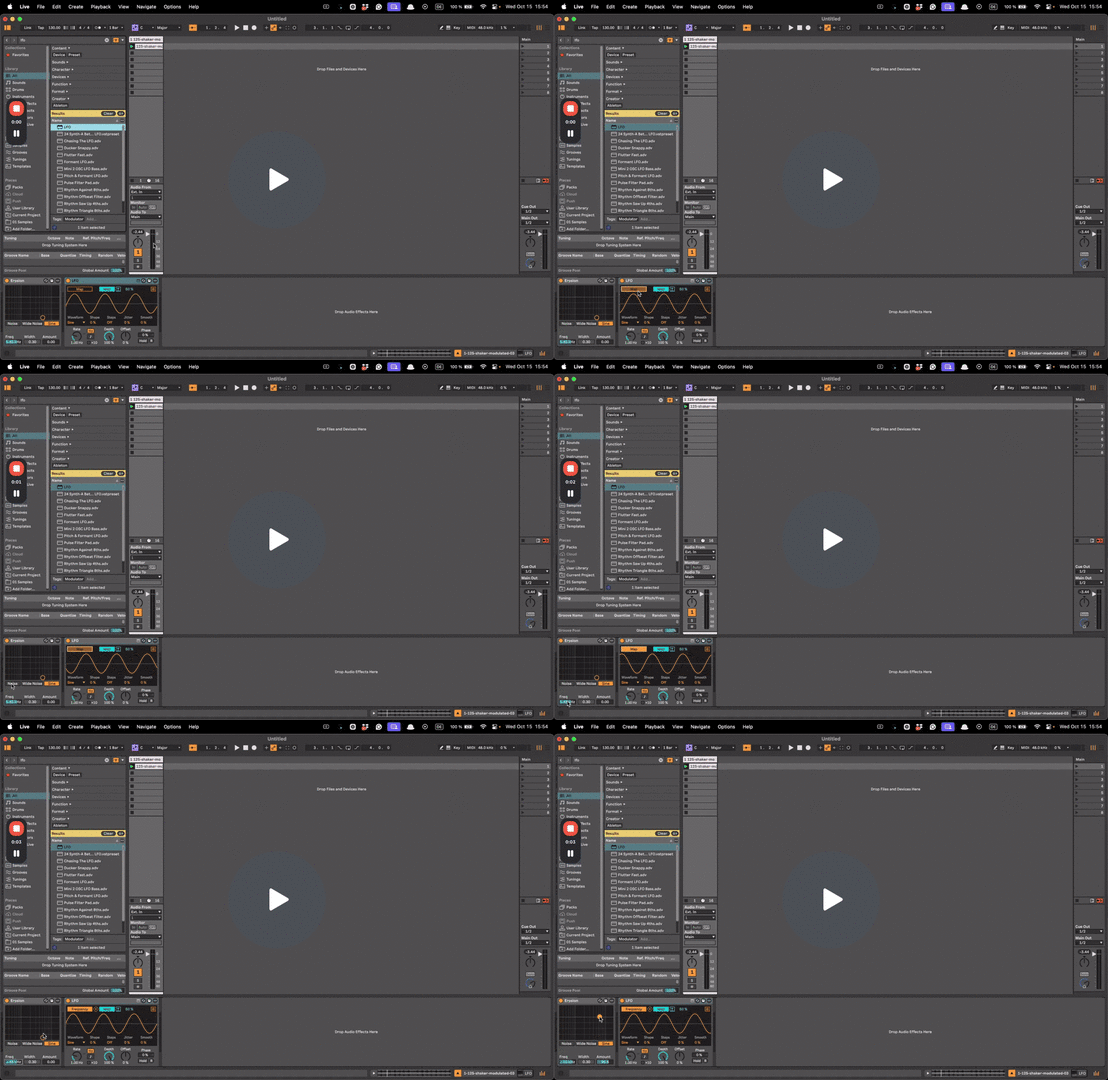
What are micromodulations?
Think of them as the tiny, almost imperceptible movements happening inside your sounds.
Not the obvious filter sweeps or dramatic breakdowns. Those are macro changes.
I'm talking about the subtle shifts that make static loops feel less robotic:
A lead synth that slowly morphs between two wavetables over a few bars.
A bass filter getting gently pushed into saturation, adding textured overtones that come and go.
Percussion elements that drift slightly in tone and timbre, never quite settling into mechanical repetition.
Once I started doing this, my loops stopped feeling stuck. They actually went somewhere.
My three rules for micromodulations
Here's how to use this technique without overdoing it:
Rule 1: Stay subtle
These movements should be felt, not heard.
If someone listening to your track can point out the modulation ("oh, that filter is opening"), you've gone too far.
The goal is to create a subconscious sense of evolution. Your listener shouldn't know why the loop feels better, just that it does.
Save the dramatic modulations for transitions between sections. That's where you want obvious change.
Rule 2: Dare to use free-running LFOs
This is the secret weapon most producers miss.
Sync your LFO to tempo and you get predictable, repeating patterns. Safe, but boring.
Use a free-running LFO (not synced to your project tempo) and something different happens.
The modulation drifts in and out of phase with your rhythm. Sometimes it aligns, sometimes it doesn't.
This creates that loose, organic feeling that separates professional productions from the rest.
Rule 3: Modulate the modulators
Want to get really interesting? Map one LFO to control another LFO, then use that second LFO to modulate your parameter.
Sounds complicated, but it's not.
You're creating a modulation chain where the movement itself is constantly evolving.
The result: Textures that repeat but never sound repetitive. Patterns that feel familiar but impossible to predict.
This is my go-to technique for creating evolving atmospheres that hold attention without demanding it.
Try this on your next session
Pick your current loop. The one you're stuck on.
Choose one element. Just one.
Add a free-running LFO to something subtle. Filter cutoff. Wavetable position. Saturation amount.
Set the LFO rate slow. Really slow. Like 0.3 Hz or even slower.
Keep the modulation depth gentle. Start at 10-20% and only increase if you literally can't hear it yet.
Now loop your 8 bars and listen for a few minutes.
You'll hear it. That breathing quality. That sense of something actually moving.
That's the difference between a static loop and something worth finishing.
Your music matters. Let's make it count.
Philip
|