|
|
|
|
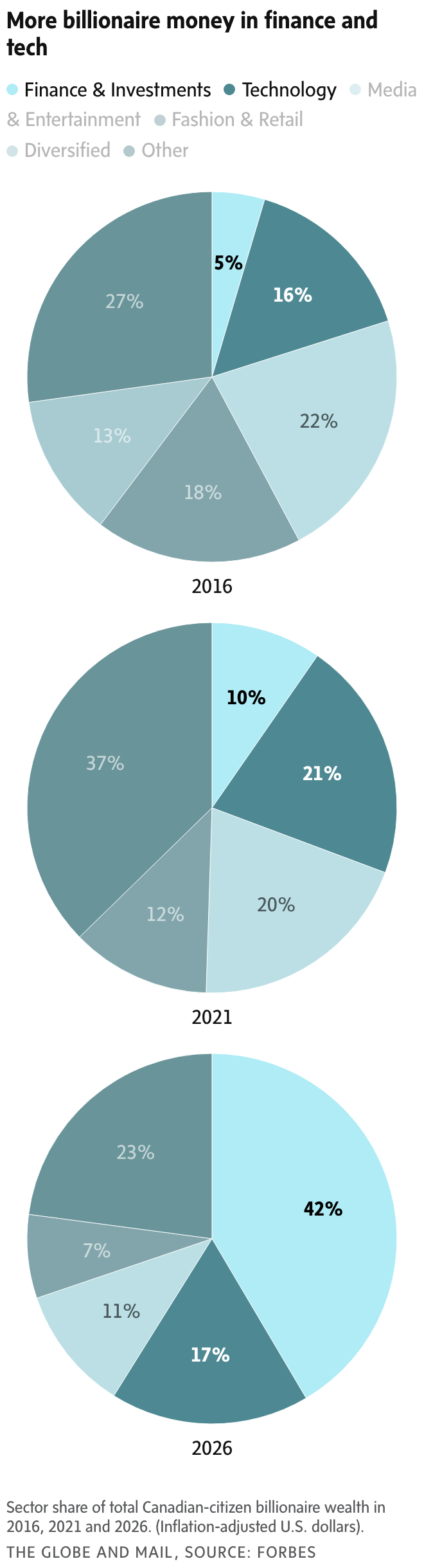
Good morning. Entrepreneur Stephen Smith’s plans to buy a minority stake in The Economist Group is bringing a spotlight to a new class of Canadian billionaires – now larger, more global and increasingly driven by tech and finance. |
|
|
|
|
|
|
|
|
|
|
|
|
|
|
|
|
Energy: LNG Canada has accelerated exports to Asia this month, spurred by reduced global supplies for liquefied natural gas after the virtual shutdown of the Strait of Hormuz. |
|
|
|
|
Retail: Activewear retailer Lululemon Athletica Inc. announced it has appointed a new independent director, former Levi Strauss & Co. chief executive Chip Bergh to its board of directors, as it faces pressure to reinvigorate its brand. |
|
|
|
|
Finance: CIBC boosted pay for CEO Victor Dodig in 2025 as profits jumped. Raymond James Canada named
Peter Moores as its new CEO after a six-month search. |
|
|
|
|
Happening today: The Bank of Canada and the U.S. Federal Reserve are both expected to hold their key lending rates steady. Investors are also looking to comments from Fed chair Jerome Powell on the conflict in Iran and its implications for interest rates and the broader economy. |
|
|
|
|
|
|
|
|
|
|
|
|
|
|
|
Stephen Smith, photographed in 2023, is seeking a sizeable stake in The Economist Group. Christopher Katsarov/The Globe and Mail
|
|
|
|
|
|
|
|
|
|
|
The new economics of being a billionaire |
|
|
|
|
In today’s world of wealthy Canadians, Stephen Smith is something of an anomaly. |
|
|
|
|
|
|
|
|
Long a commanding presence on Bay Street, the financier has remained largely low‑profile beyond it, building one of the country’s most valuable private empires without the global footprint that defines a growing portion of today’s Canadian billionaires. |
|
|
|
|
Smith’s plans to buy more than a quarter of The Economist Group, owner of the prestigious magazine and media outlet, captured headlines around the world – an expected if slightly uncharacteristic spotlight for an entrepreneur who created a corporate universe rooted in Canada, dating back to his co-founding of mortgage lender First National Financial Corp. nearly four decades ago. |
|
|
|
|
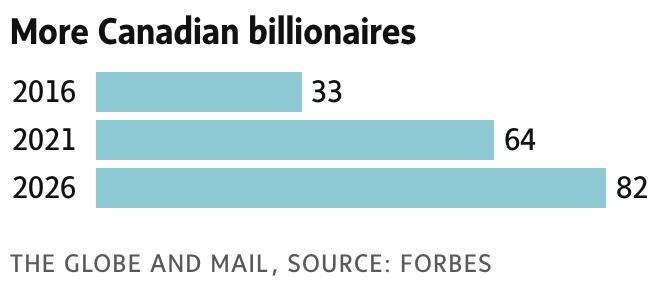
In Forbes’ annual list of billionaires, published last week, Smith’s estimated net worth lands him at No. 567 – about 10 spots back from Stephen Spielberg and tied with fellow Canadian David Thomson, whose family’s private investment firm Woodbridge Co. Ltd. owns The Globe and Mail. There are 80 other Canadians on this year’s rankings, a contingent that has grown by about 150 per cent over the last decade. |
|
|
|
|
|
|
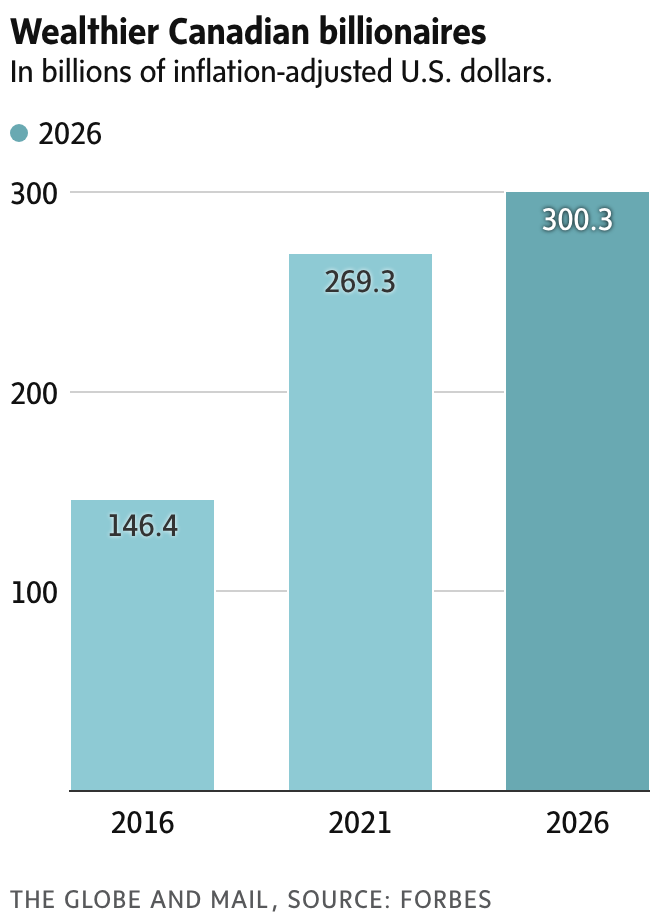
That period has been marked by wild stock market swings and geopolitical shocks. Yet, the total net worth of today’s billionaires continues to climb, propelled in some cases because of those shocks – the pandemic generated a lot of wealth for entrepreneurs catering to home-based work and digital infrastructure, for example – and most recently driven by artificial intelligence. |
|
|
|
|
The rapid pace of technological advancement has also helped to create a deeper and more wealthy pool of Canadian billionaires. In 2025, the combined net worth of the top 40 on that list was higher than the gross domestic product of many countries, including Finland and South Africa, Oxfam Canada said in a January report. |
|
|
|
|
Weeks before the war in Iran intensified concerns over a recession, a cost-of-living crisis and rising food prices, the humanitarian organization called for progressive wealth taxes that would help bring a measure of equality to a sputtering Canadian economy. |
|
|
|
|
|
|
The debate over whether a wealth tax would even the playing field or scare away businesses and founders has been a polarizing one. But much like recent fights over capital‑gains changes that drew the ire of industry leaders, it doesn’t fully reflect the deeper, longer‑running shift emerging in the makeup of Canada’s billionaire class. |
|
|
|
|
Most of the big Canadian fortunes of the past decade come from companies designed to scale across borders, hire globally and sell into international markets. Nothing obligates billionaires to build where they live, but the firms they create attract capital, train workers and generate new companies, influencing where future founders emerge. |
|
|
|
|
Smith is part of the broader shift toward finance-driven wealth, but his holdings – from First National to Canada Guaranty Mortgage Insurance to Home Trust and Fairstone Financial – are almost entirely rooted in Canadian credit markets, making him something of a domestic outlier in a globalizing billionaire landscape. |
|
|
|
|
The Globe’s Andrew Willis, who wrote about the deal yesterday, said Smith “managed to be the big fish in a relatively small pond.” |
|
|
|
|
“If you’re still a resident of Canada, you’re paying tax,” Willis told me. “The bigger issue is: Where do you employ people? Where is your intellectual property residing? That, I think, is the key.” |
|
|
|
|
|
|
|
|
|
|
|
|
|
|
|
|
|
|
 |
Pores are normal. They’re not doors. They don’t open and close. I think we’ve been fooled by filters and makeup on social media. — Dermatologist Julia Carroll |
|
|
|
|
|