| | In today’s edition: Both sides in the war appear set for escalation, the UAE offers support for its ͏ ͏ ͏ ͏ ͏ ͏ |
| |  Abu Dhabi Abu Dhabi |  Kuwait City Kuwait City | Bir Lehlou |
 | Gulf |  |
| |
|
 - Shift in Gulf’s Iran posture
- US firms reap oil rewards
- Saudi’s anti-corruption push
- UAE tax and bank relief
- Iran’s African proxy
 Vodka, pills, and ayatollah shrines: a bizarre Kuwait police video. |
|
 The victors of wars are usually the side that has the upper hand on logistics. At its most basic, the transfer of energy from a bullet or rocket into enemy territory is a logistics story: weapons assembly, delivery, mounting, firing, and tracking. There’s no question of US and Israeli superiority, but Tehran is proving it can throw that ballet off balance. The biggest shock is the effective closure of the Strait of Hormuz, crimping energy export revenues for Gulf countries and Iraq and constraining the flow of goods needed to sustain their populations. Freight rates are up fourfold and some firms are abandoning cargo rather than risk missile and drone strikes. Oman and Saudi Arabia are offering land-based options, but neither can replicate the scale of maritime trade. 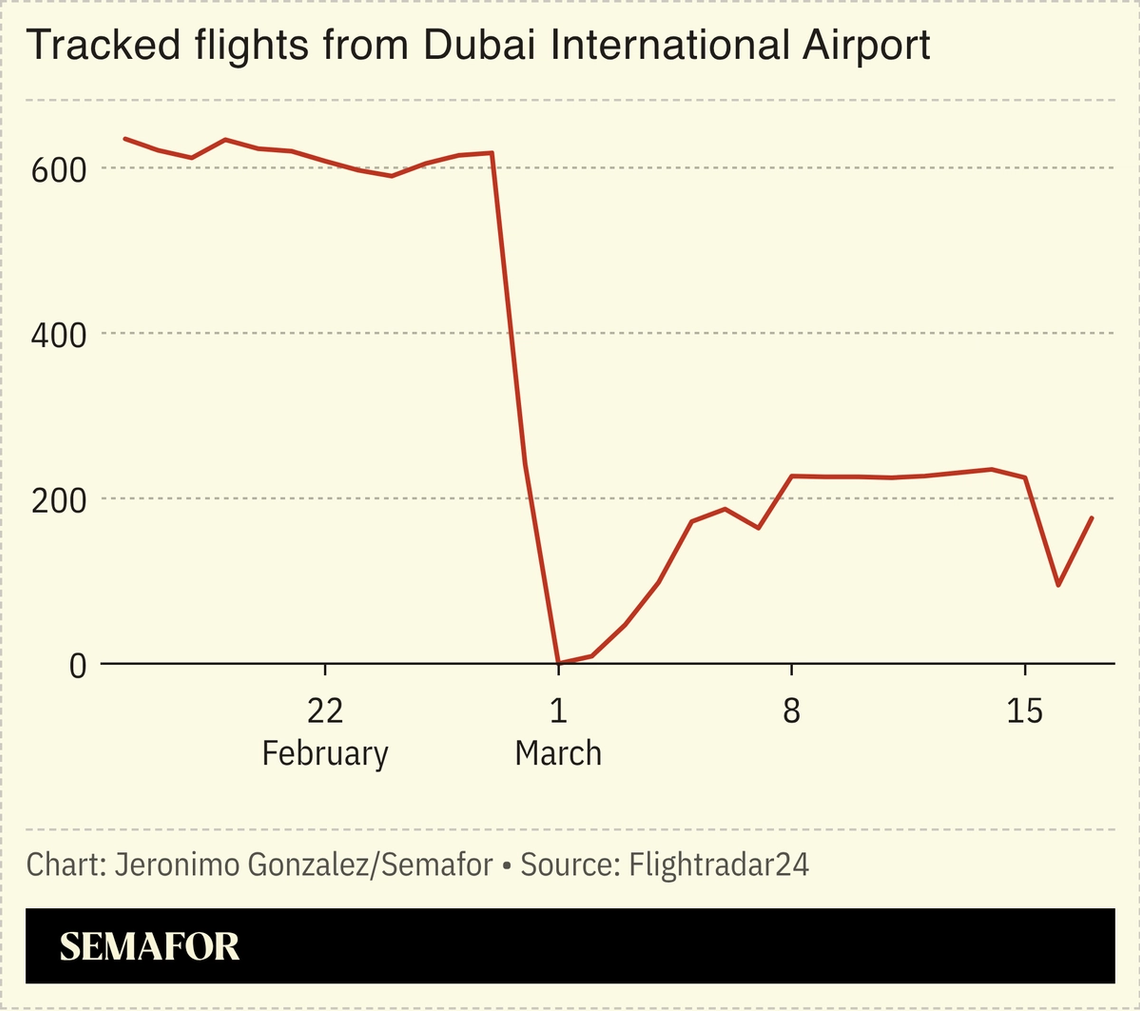 Aviation has taken a big hit. Gulf hubs that typically handle a third of European flights to Asiaare operating at limited capacity, providing an opening for European carriers to win back market share. The Middle East air corridors aren’t a luxury: Closing them affects workers, families, patients, and business travelers. It’s a global human-logistics squeeze. Even the so-called last mile is feeling the strain. GPS jamming and spoofing — meant to confuse drones and missiles — are rerouting drivers in the UAE endlessly. It may be a minor problem compared to the alternative of air strikes landing, but that doesn’t entirely ease the pain of an epidemic of soggy fries across the land. |
|
All sides harden their stance |
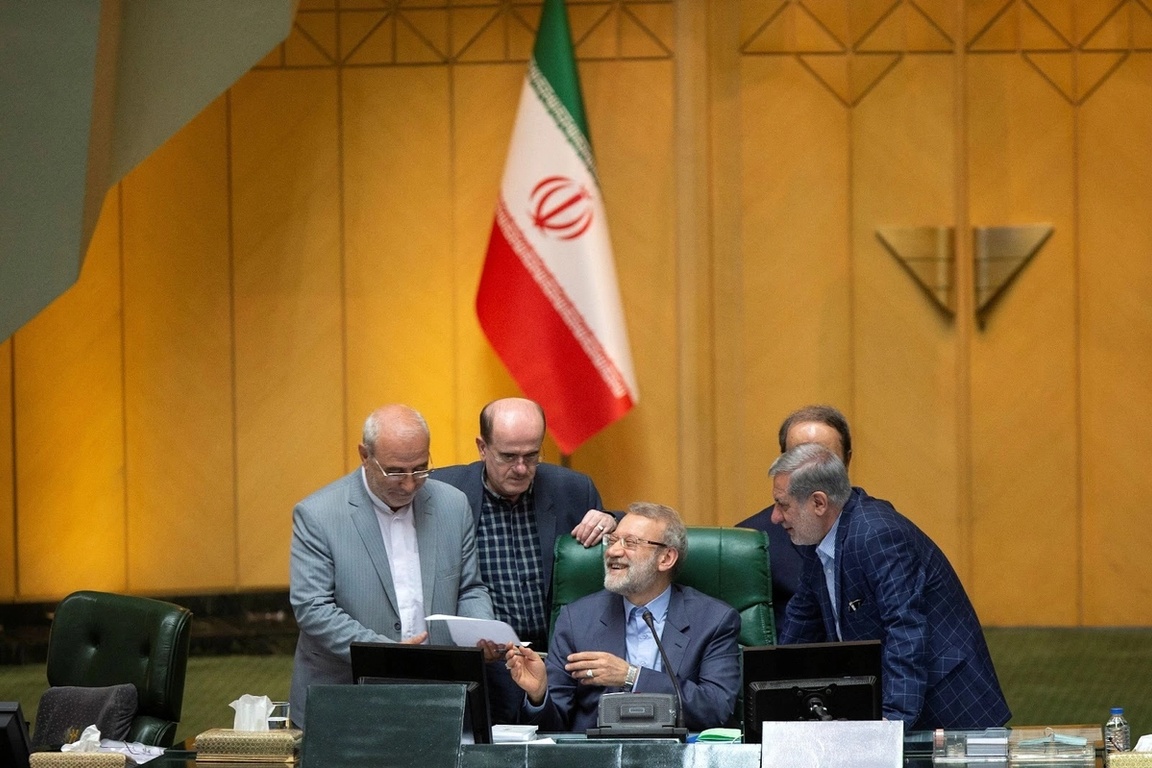 Ali Larijani, seated, during a parliamentary session. Nazanin Tabatabaee/WANA/File Photo/Reuters. Ali Larijani, seated, during a parliamentary session. Nazanin Tabatabaee/WANA/File Photo/Reuters.The war is climbing the escalation ladder. The killing of veteran Iranian politician Ali Larijani — seen by some as a potential, palatable negotiator — may have strengthened hardliners in Tehran (who were never weak or restrained to begin with). Attacks are intensifying across the region, including strikes on Gulf civilian and energy infrastructure, and the Strait of Hormuz remains closed to almost all traffic. Tehran is showing it can inflict sustained pain. It has aimed at oil and gas fields in the UAE and Saudi Arabia, targeted ports and refineries across the Gulf, and attacked ships. Analysts say Iran still has room to escalate further, through drones that are difficult to intercept, fast and agile patrol boats, and cyberattacks. Neither side wants to return to the prewar status quo. Anwar Gargash, diplomatic adviser to UAE President Sheikh Mohamed bin Zayed, said Abu Dhabi could join a US-led effort to secure Hormuz. Sultan Al Jaber, ADNOC’s CEO and UAE minister of industry and advanced technology, placed ballistic missiles and Tehran’s proxies among the threats that must be addressed in any “long-term political settlement” with Iran, The Wall Street Journal reported. |
|
Energy’s security premium |
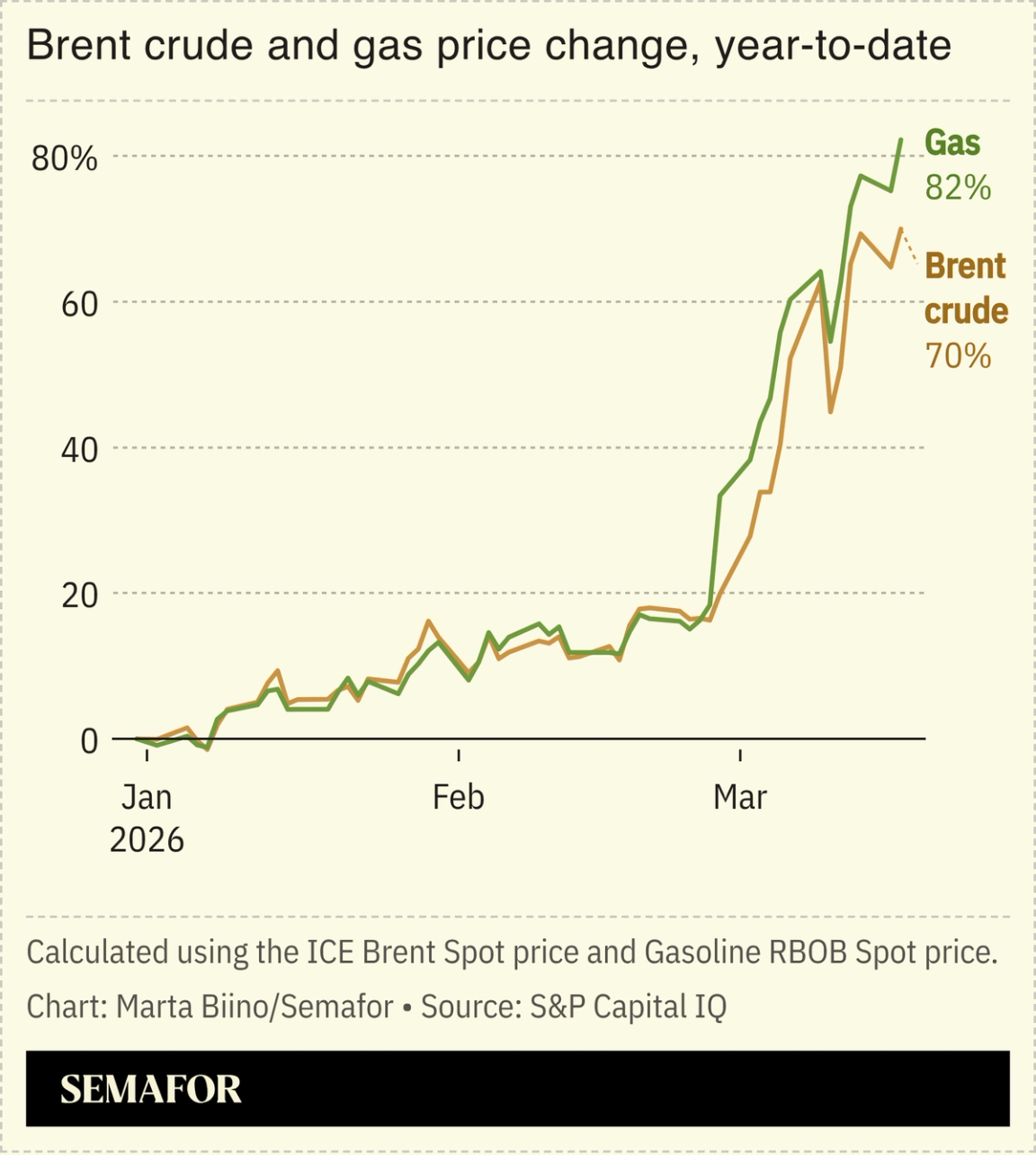 The Iran war has pushed oil prices to their highest level in years and many energy majors are set for windfall profits. These are the short-term effects; there will be long-term market impacts too. Daniel Yergin — author of the definitive oil history The Prize — told Semafor’s Tim McDonnell that “we’re going to see people willing to pay more of a price for security.” Among other things, that’s likely to involve investment in new pipeline networks and far-flung storage facilities to hedge against future disruptions to maritime trade. The vulnerability of the Strait of Hormuz has been obvious for decades, Yergin said, but there was a sense of complacency about how costly any disruption would be; that will now be priced in. While the war continues, Oman is in a good position to profit, given it lies outside the Strait — this week its crude grade rose above $150 a barrel for the first time. Longer term, there will still be buyers for other Gulf producers’ oil and gas, but customers will likely want a more diverse supply base. That could mean “a lasting shift toward US supplies as the preferred, lower-risk alternative,” said Henry Hoffman, co-portfolio manager of the Catalyst Energy Infrastructure Fund. |
|
Saudi ramps up graft probes |
| |  | Matthew Martin |
| |
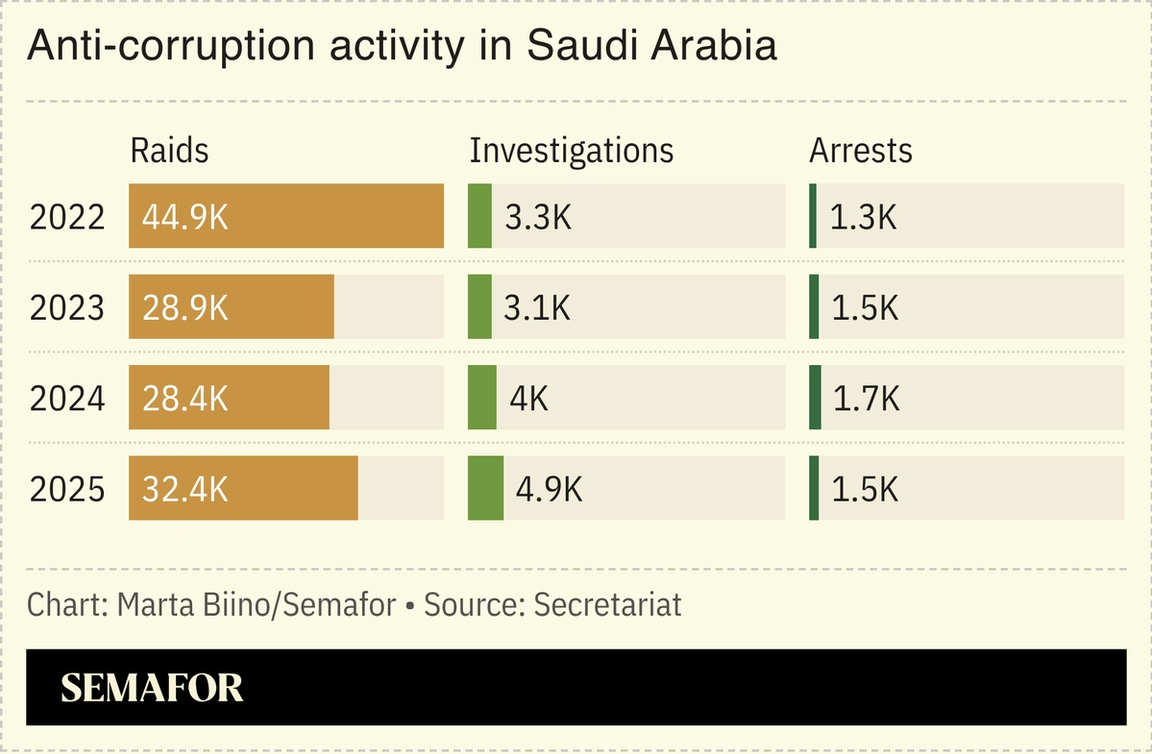 Corruption investigations in Saudi Arabia rose last year to the highest level on record, as the government reviewed spending and scrapped some of its most ambitious projects. The anti-corruption watchdog Nazaha also conducted the most unannounced raids since 2022, according to data compiled by corporate intelligence firm Secretariat and shared with Semafor. Crown Prince Mohammed bin Salman made a splash in 2017 with the dramatic arrests of princes, former ministers and billionaires on graft charges; they were detained at the Ritz-Carlton hotel in Riyadh, in some cases for months, before reaching settlements. While that was widely considered to be as much about MBS consolidating power and neutering opposition to his rise, the drive to stamp out misuse of state funds has continued in a lower-profile way ever since. The fact that Nazaha continues to arrest around 100 people every month hints at the scale of the problem. “The whole system was totally corrupt and the culture had to change,” said Bernard Haykel, professor of Near Eastern Studies at Princeton. “It’s just not that easy to do.” |
|
 Amr Alfiky/Reuters Amr Alfiky/ReutersThe UAE is taking steps to shore up its banking sector and reputation as a tax haven. On Tuesday, its central bank approved an emergency support package to let banks draw down reserves, ease liquidity requirements, and delay classifying loans as non-performing for customers hit by the current crisis. The central bank also emphasized its $270 billion in foreign exchange reserves, aiming to ward off worries about its currency peg to the US dollar. The UAE’s Federal Tax Authority is also considering relaxing rules so that expats can spend more time abroad without losing their tax status, as the country tries to incentivize residents who fled the Iran conflict to return, the Financial Times reported. People who have left are likely to be given leniency over the minimum number of days they need to spend in the UAE to qualify as tax residents, at least temporarily. The steps are among the first by a Gulf state to bolster its economic resilience to the war. — Kelsey Warner |
|
An African front may open in the Iran war |
 Polisario Front soldiers in the Western Sahara. Zohra Bensemra/Reuters. Polisario Front soldiers in the Western Sahara. Zohra Bensemra/Reuters.As the war in Iran presses on, there’s a push for the US to recognize a new Iranian threat far from the Gulf: The Polisario Front, which has been agitating for independence for Western Sahara from Morocco since the 1970s. In a column for Semafor, Jason Greenblatt, a Middle East envoy in the first Trump administration, argued the group is part of Iran’s network of international proxies, alongside Hamas in Gaza, Hezbollah in Lebanon, and the Houthis in Yemen. “The world ignored Iran’s proxy strategy before. It should not make the same mistake again,” he wrote. This month, Republican senators Ted Cruz, Tom Cotton, and Rick Scott introduced a bill to designate the North African group as a terrorist organization, with Cruz claiming the Front is working with Iran to “undermine the national security of the United States and our allies.” Not all agree. In October, the UK government said it “has not seen evidence of Iranian support for the Polisario Front.” |
|
 - Bloomberg: Iranian-American scholar Vali Nasr says Tehran is primed for a prolonged conflict with the US: “They’ve already suffered a lot. I think they’re prepared to suffer more. They want to come out of this war changing the US calculation.”
- CNBC: Wartime Dubai is “a strange mix of normality and quiet tension,” according to one resident who stayed while others fled. “The general atmosphere is one of ‘cautious awareness’ as opposed to ‘panic’,” they added.
- International Energy Agency: The Paris-based organization runs the numbers on the impact the closure of the Strait of Hormuz is having on global energy prices.
- Foreign Affairs: Clearing marine mines — even in peacetime and with maps from those who laid them — is difficult. “It took the United States and its allies 51 days to clear 907 mines off the Kuwaiti coast in 1991,” writes MIT’s Caitlin Talmadge.
- Ray Dalio: The founder of Bridgewater Associates says that if Iran retains control over the Strait of Hormuz the US will be judged to have lost the war.
- The National: From fertilizer to rubber production, how a shutdown at Abu Dhabi’s Shah gas plant may be felt around the world.
|
|
 A Kuwait police seizure. Courtesy of Kuwait’s Ministry of Interior, @Moi_kuw/X. A Kuwait police seizure. Courtesy of Kuwait’s Ministry of Interior, @Moi_kuw/X.Kuwait detained 16 people accused of having links to Hezbollah and plotting to “spread chaos and disrupt public order.” But it’s the interior ministry’s styling of the guns, bullets, and other contraband that’s stealing the show. Small drones, laptops, a lone VHS tape, bows and arrows, axes, pocket knives, and brass knuckles — all laid out alongside pills and rolling papers, three half-filled bottles of booze, and a wooden replica of the twin-pronged sword held by the prophet’s nephew Ali who Shia Muslims consider their first Imam. Everything is arranged in piles, bordered by police tape, and framed by Hezbollah figures and Shia clerics, as if they were shrines. There’s no discounting the threat, but the haul doesn’t give the impression of a highly organized militant cell. In the mug shots, most suspects appear well past 50. — Mohammed Sergie |
|
|


