| | In this edition, the US is turning intro a lifestyle country, and Starbucks CEO Brian Niccol on the ͏ ͏ ͏ ͏ ͏ ͏ |
| |  | Business |  |
| |
|
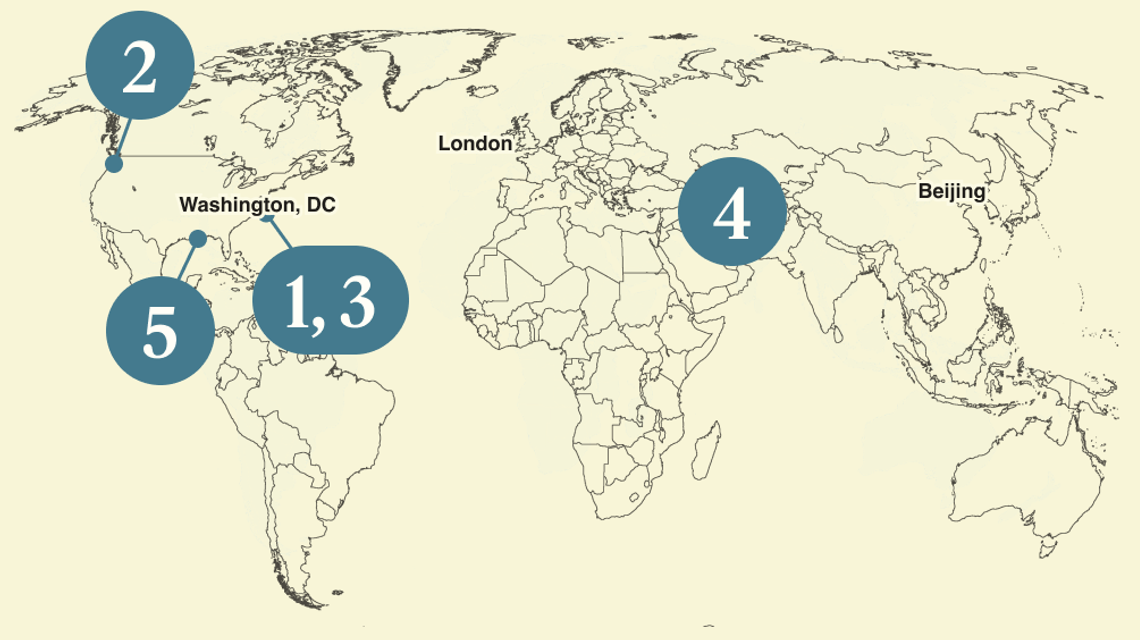 - Fed fears Iran
- Starbucks CEO reboots
- Semafor World Economy
- What’s next for oil
- M&A muddle
 Wall Street’s ‘global head of macro’ ends with a whimper … |
|
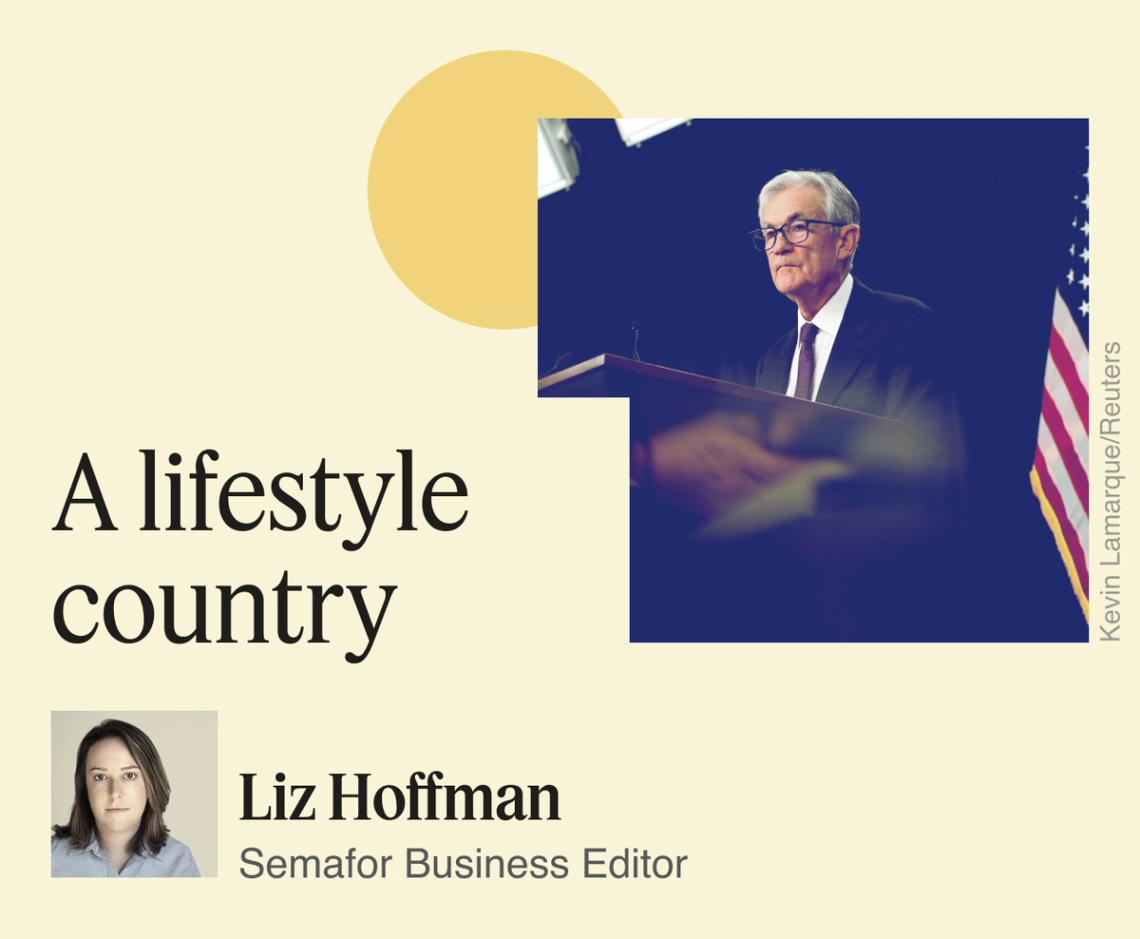 Jerome Powell came in hot yesterday, as central bankers go: Flatlining job growth is “what the economy needs” given “nonexistent growth in the labor force, which we’ve never had in our history,” he said yesterday. “That is balance [but] not a really comfortable balance.” It was a remarkable acknowledgement that the world’s biggest economy is in uncharted territory. Big demographic shifts — an immigration crackdown and declining birth rates — have stalled the traditional engine of “more people, more output.” The US economy is still growing. But if America was a company, it would be a “lifestyle business,” a specific corporate burn that describes a company that exists to sustain its owners rather than to conquer a market. Lifestyle companies aren’t managed for growth. They don’t scale; they just are, making enough money to cover an owner’s costs and maybe mail it in on Fridays. If the US is no longer growing its headcount, it’s running the country for the benefit of the existing shareholders — the current workforce and asset owners — rather than building for a more ambitious future. There’s nothing wrong with lifestyle businesses — just ask Europe — but they don’t work if they’re loaded up with a bunch of debt. (Happy $39 Trillion Day to those who observe.) Servicing that debt, to say nothing of closing the deficit that constantly adds to it, requires massive economic growth. This is, of course, where AI comes in. If you believe the AI optimists, we’re going to get more economic output with fewer people, rewiring that people-to-GDP engine. But if you believe the pessimists, we’re looking at a world of abundance and leisure where the robots make everything cheaply, but nobody has a job. That is also, to use Powell’s phrase, a balance, but not a really comfortable one. |
|
‘Who let the hawks out?’ Trump did. |
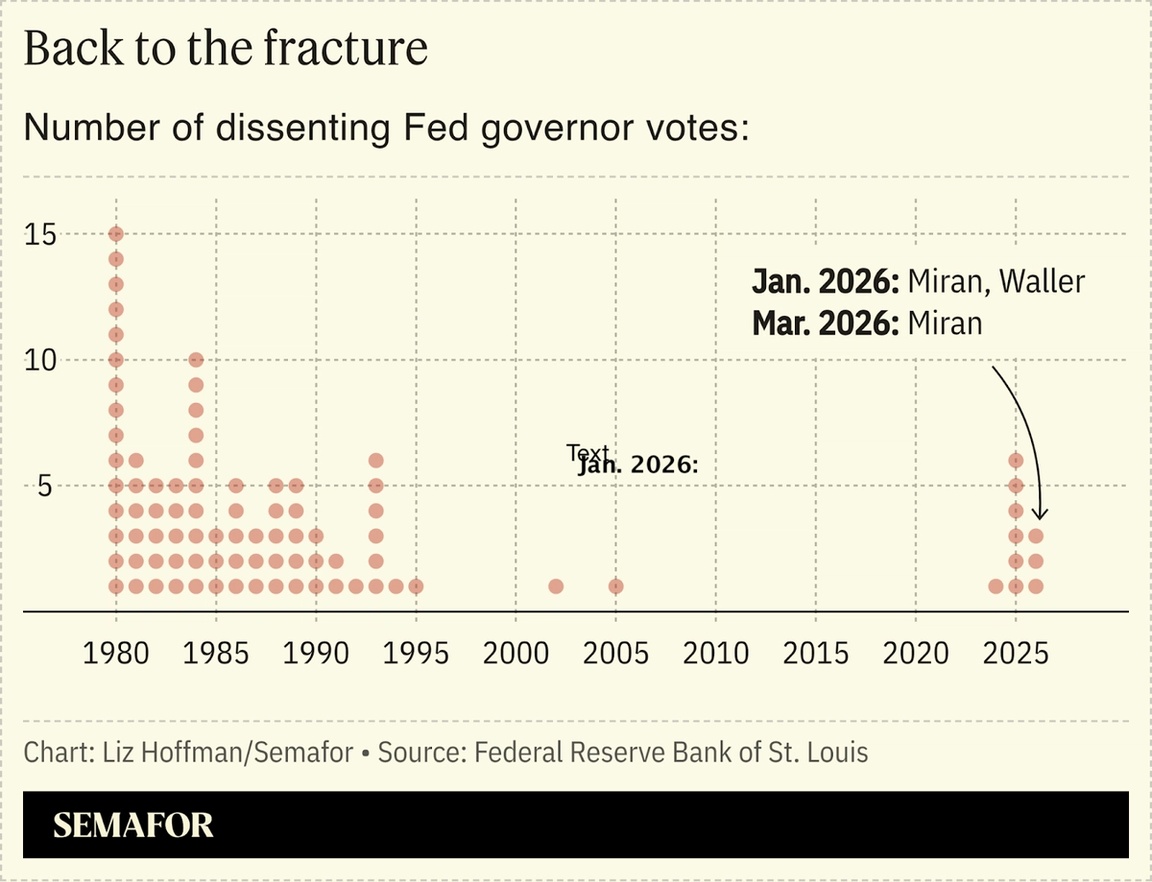 The biggest surprise from the Federal Reserve’s meeting this week was its comity. As many as three governors had been expected to dissent from the decision to hold interest rates steady, but only one did — Stephen Miran, the Fed’s resident super-dove. Govs. Christopher Waller and Michelle Bowman, who had previously pushed for interest-rate cuts, agreed with the majority that the war in Iran and its shock on oil prices raised the risk of higher inflation, which justified leaving rates where they are. “Who let the hawks out?” said Gregory Daco, chief economist of EY-Parthenon. That would be President Donald Trump, who keeps saying he wants interest rates to be lower but then does things that argue for keeping them high, by putting upward pressure on prices. First the tariffs, and now strikes in Iran that briefly sent oil about $110 a barrel again this week. Those concerns were big enough to counteract AI-related jobs fears that, at least on paper, might justify lowering borrowing costs. |
|
Brian Niccol on leading Starbucks’ turnaround |
 Semafor/YouTube Semafor/YouTubeThe tangible signs of Starbucks’ reboot under CEO Brian Niccol are everywhere: The milk bar is back, as are ceramic cups, and charging your laptop is encouraged. Less clear is whether investors are buying his effort to return Starbucks to its “third place” roots. “I said, ‘turn on all the outlets,’” Niccol tells Semafor’s Andrew Edgecliffe-Johnson in the first episode of Semafor’s new CEO Signal show. “What’s the risk in that? People stay? Great. Easy…We’re going to be a coffeehouse. ” After his predecessor reoriented stores and staff toward a pandemic-fueled shift to mobile ordering, Niccol is reversing course. He invested nearly $600 million to boost staffing after taking the job in September 2024. Starbucks shares rose 50% in his first six months on the job, but have drifted sideways since, amid store closures, lackluster sales and intensifying competition from chains like Dutch Bros and China’s Luckin Coffee. “You cannot cost-cut your way to providing great experiences,” Niccol says. Watch the full episode on YouTube. |
|
 Amit Dave/Reuters Amit Dave/ReutersOil prices spiked after Iran targeted a Qatari gas plant that is the world’s largest. This will be a bumper quarter for oil and gas shareholders, but executives — some of whom will meet with Vice President JD Vance today, and many others who will gather in Houston next week at the industry’s big annual conference — look at this moment and see mainly chaos, not profit, Semafor’s Tim McDonnell writes. US shale producers are unlikely to drill more unless coaxed by sustained high prices; brief spikes in response to missile strikes won’t do it. Looking longer-term, extreme oil volatility is a powerful argument for renewable energy. Even today, the world economy is much less reliant on oil than it was during the embargoes of the 1970s, when it used more than twice as much oil per unit of GDP. If it wasn’t, the current situation would be far worse. “I’m watching for signs of this principle in action,” Tim writes. “New deals, new technologies that suddenly look more attractive, new policies to accelerate investment, a new role for, or attitude toward, the Middle East in general.” |
|
 Why is the Pentagon hiring Wall Street bankers? Liz Hoffman joined Ed Elson on the Prof G Markets podcast to discuss her reporting on the Pentagon recruiting Wall Street bankers for a new “Economic Defense Unit.” Watch the episode here. |
|
Preparing for Semafor World Economy |
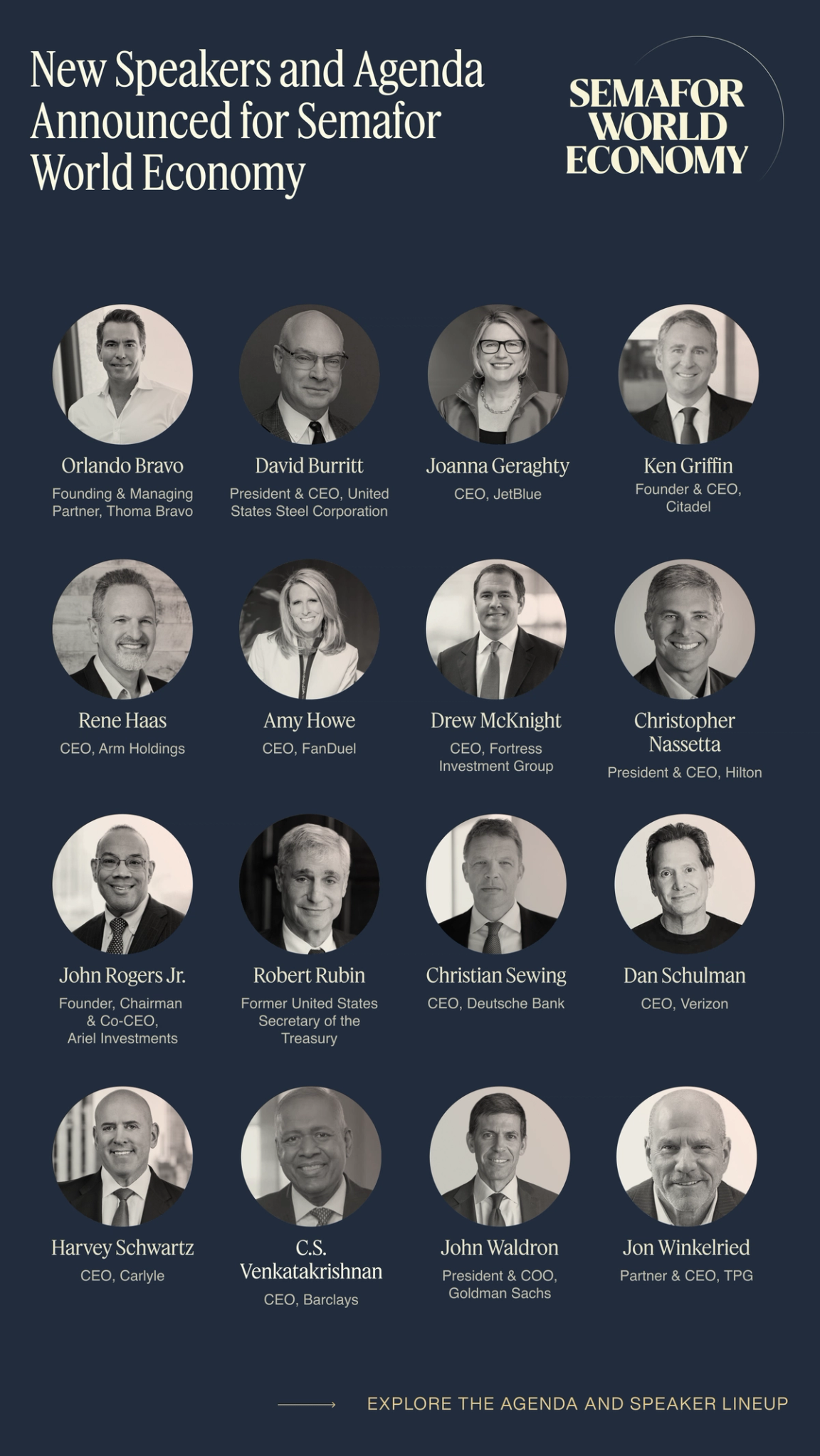 More than 400 CEOs and world leaders will be coming to Semafor World Economy, our (weeklong!) event in Washington, DC, next month. What the global picture will look like by April 13 is anyone’s guess, but the outlook for leaders is alarming: Corporate strategies and investments upended by AI, an uncertain path on interest rates, interventionist governments, restive investors, and geopolitical hot spots cropping up everywhere. I wrote two years ago that the corporate world was exiting its “low-VORP” era, borrowing a baseball stat that measures how much better a starter is over a B-teamer. Contrarianism, zigging where others zagged, rarely paid off in the years of global calm and cheap money. Those days are over, and I’m excited for conversations about the actual decisions that leaders and investors are making in a world of disparate outcomes. — Liz You can see the full speakers’ list here and apply to attend.
|
|
Temp check on Wall Street’s animal spirits |
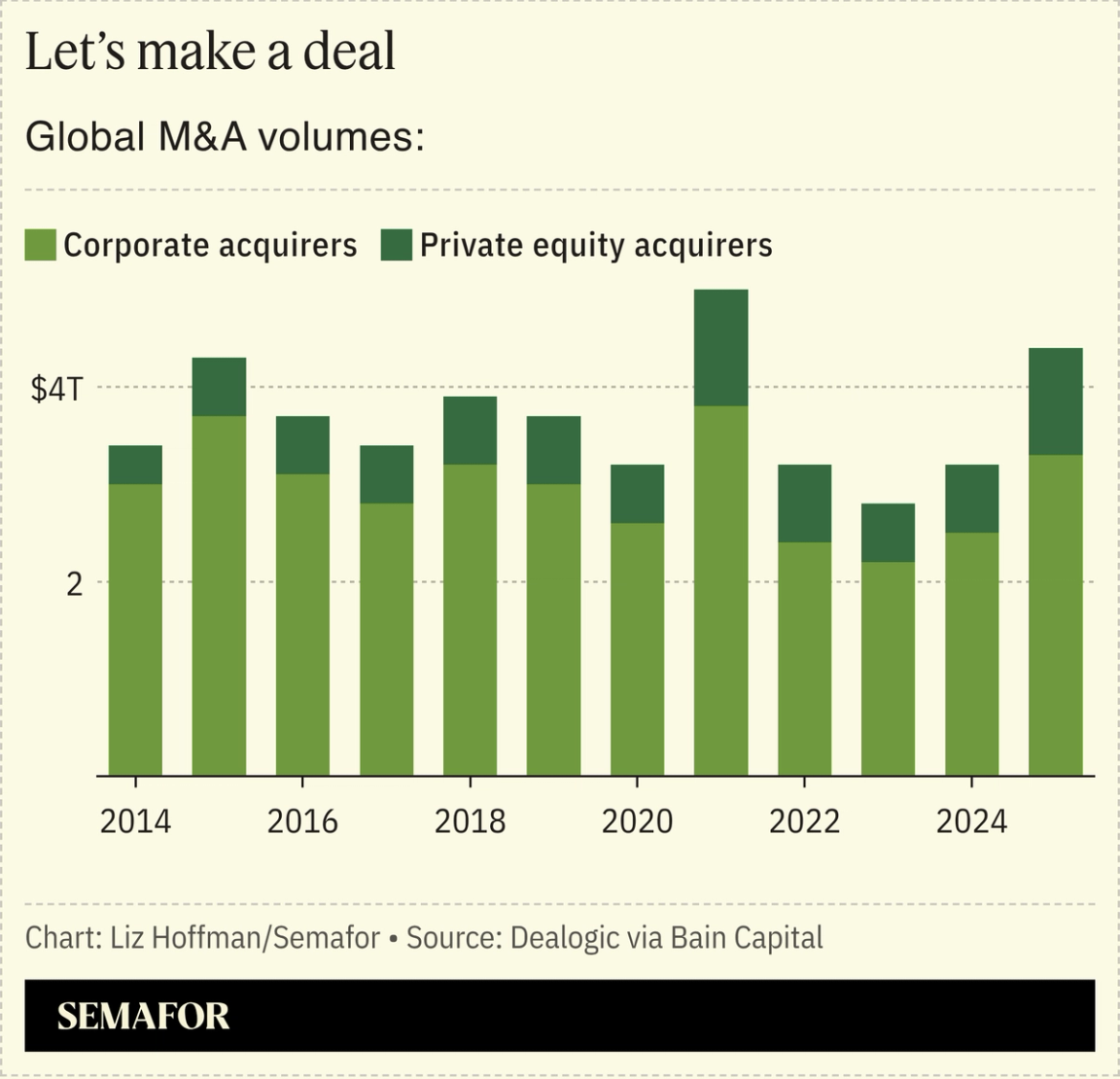 2026 was shaping up to be a bumper year for corporate mergers, with Washington rolling out the welcome mat and AI fears lighting a fire under CEOs. Can those animal spirits survive growing fears of an economic slowdown, higher inflation, war, and continued global chaos? We’ll get a gut check this week in New Orleans at the M&A bar’s annual gathering. Early reports from Semafor’s Rohan Goswami are dour: “Nobody wants to prognosticate or speculate against this backdrop,” one M&A advisor said in the back room at Arnaud’s steakhouse. They’ll do plenty of both anyway later today, as the Tulane conference officially begins. “The good news is that there is a healthy M&A pipeline marked by a lot of strategics that want to get things done in a favorable regulatory environment,” said an M&A partner at White & Case. “But with what’s happening in the world at the moment I think many parties are going to wait until things calm down before striking deals.” Some deals that were in process pre-Iran are going quiet or have collapsed, advisers said. Boards still scarred from tariff drama aren’t eager for more geopolitical exposure. Tulane’s other big contingent, activist investors, have been a bit defanged by AI, which is messing with companies’ strategies and their ability to credibly critique them. But the mood was glum last year, too, and yet, the $4.5 trillion worth of deals ended up being the second-highest tally ever. |
|
➚ BUY: Strait. Iran is moving to monetize its closure of the Strait of Hormuz, considering charging fees for safe passage. ➘ SELL: Curve. Citadel ditched its bearish stance on US Treasury bonds, saying shorter-term government debt could rise no matter the outcome of the Iran war: “We do not see much left to play for.” |
|
 Companies & Deals- Beijing-bound: Nvidia is restarting sales of its H200 chips — medium-advanced, but still extremely powerful — in China, CEO Jensen Huang said Tuesday.
- Money talks: Uber is investing up to $1.25 billion in EV maker Rivian to develop 10,000 self-driving cars. Uber CEO Dara Khosrowshahi told Semafor’s Compound Interest show earlier this month that investing in partners would be “a significant part of our activity going forward.”
Watchdogs- Chain of command: Defense Secretary Pete Hegseth’s war on Anthropic is running into resistance from Pentagon staffers, who don’t want to stop using Anthropic’s Claude because it’s too good, Reuters reports.
- Tokyo miffed: Japanese officials intervened after finding out that SoftBank — leveraging CEO Masayoshi Son’s close ties to Trump — would earn a ¥1 trillion ($6.2 billion) fee from a project included in Tokyo’s $550 billion investment agreement with the US.
- Loosen up: Banking regulators voted to ease capital rules for banks following years of intense lobbying.
|
|
|


