|
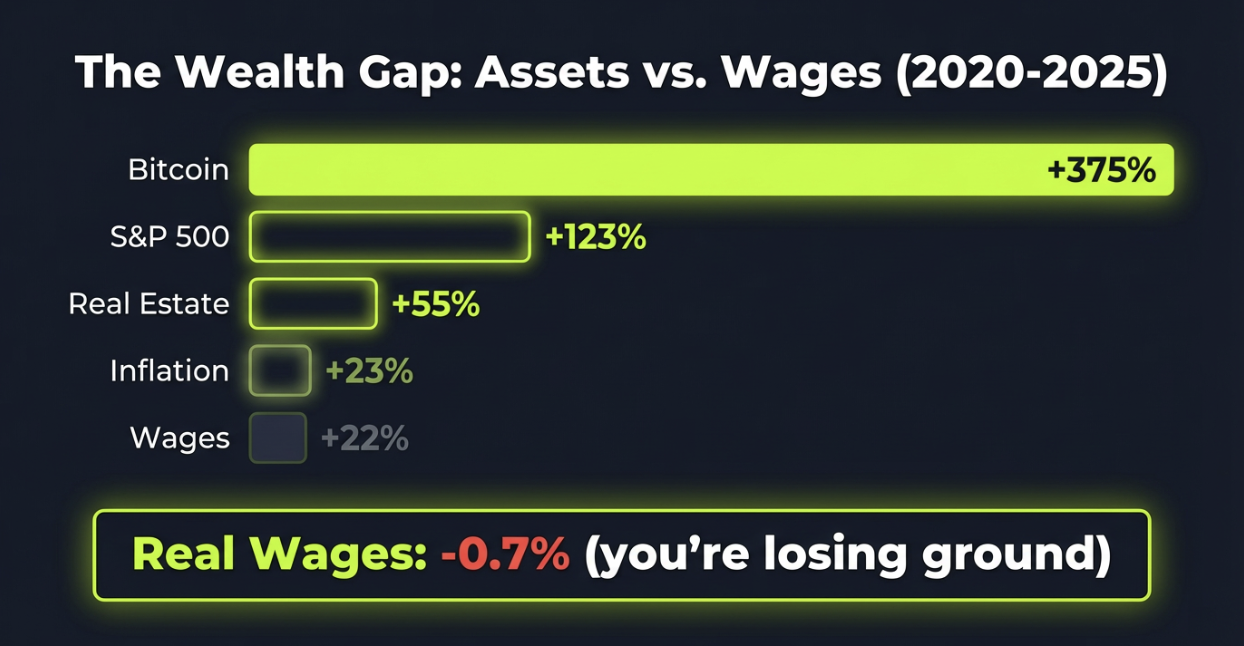
Since 2020, inflation has outpaced wages. The average person is working harder and falling further behind at the same time.
Meanwhile assets have skyrocketed.
Wages go up about 3% a year in normal times. Expenses go up closer to 10%. Assets go up 20% or more. That gap does not close with effort or discipline. It is structural. It is built into the system.
So when I say every asset needs a job, this is the problem that job needs to solve. You are not buying assets to watch numbers move. You are building a system to outpace a game that is structurally stacked against you.
Once you see it that way, the question changes completely. It stops being "will this go up?" and starts being "what role does this play in solving my problem?"
That is the right question. Now let me show you what it looks like in practice.
THE CONCEPT: Every Tool Has One Job
Most people approach investing like they're shopping. They buy things and hope the price goes up. When it goes down, they panic. When it goes up, they sell.
That's not investing. That's gambling with extra steps.
The wealthy think differently. They don't ask "is this going up?" They ask "what job am I hiring this asset to do?"
Once you know the job, price movement stops being terrifying. It's just noise.
Let me show you what this looks like in practice.
TOOL #1: MSTR (Strategy)
The job: Long-term Bitcoin appreciation and collateral to borrow against.
That's it. Two jobs. That's all I need it to do.
So when the price dropped 30%, I ran through the checklist:
- Is MSTR still accumulating Bitcoin aggressively? ✅
- Can I still borrow against it as collateral? ✅
- Do I still believe Bitcoin appreciates long-term? ✅
All three boxes checked. The tool is doing its job.
So why would I panic?
The only reason to reassess is if something changes the thesis, not the price. If Saylor reverses course, if the balance sheet deteriorates, if the borrowing strategy breaks, that's when you reassess.
Price going down doesn't break the thesis. It just means the market disagrees with you temporarily.
Build a thesis. Not a trade.
TOOL #2: Real Estate
The job: Tax depreciation, collateral, and inflation-destroyed debt.
Notice what's NOT on that list: cash flow.
This is where most people get confused. They compare real estate to Bitcoin on a return basis and Bitcoin wins every time. So they think real estate is a bad investment.
That's asking a hammer to do a screwdriver's job.
Real estate isn't in my portfolio to outperform Bitcoin. It's there because of three things it does that nothing else does as well.
1. Depreciation. The IRS lets me write off the "wear and tear" on a property. That depreciation offsets my income and reduces my tax bill. And now with Trump's Big Beautiful Bill, we can get 100% depreciation in year one.
2. Collateral. I can borrow against real estate equity at low rates. That cash gets redeployed into higher-performing assets.
3. Inflation destroys the debt. I take out a 30-year fixed loan today. In 20 years, I'm paying back those dollars with inflated, cheaper money. The bank took the risk, I kept the asset.
The Mental Shift
Stop asking: "Is this a good investment?"
Start asking: "What job do I need done, and which tool does it best?"
Bitcoin doesn't give me depreciation. Real estate doesn't give me Bitcoin's asymmetric upside. MSTR gives me leveraged Bitcoin exposure through a public market structure.
Each one hired for a reason. Each one evaluated on whether it's doing that reason.
That's how the wealthy think about their portfolio. Not as a scoreboard. As a toolbox.
What job are you trying to do right now, and what is the right tool for that job?
|