| | In today’s edition: Saudi Arabia courts Trump in Miami, Gulf leaders focus on reopening Hormuz, and ͏ ͏ ͏ ͏ ͏ ͏ |
| |  | Gulf |  |
| |
|
 - Gulf positions harden on Iran
- An optimistic investor
- China’s Hormuz exposure
- New Saudi-UAE trade route
- A prolonged confidence hit
- Time for an ‘Arab NATO’
 How Dubai stepped in to help entrepreneurs cope with the disruption of war. |
|
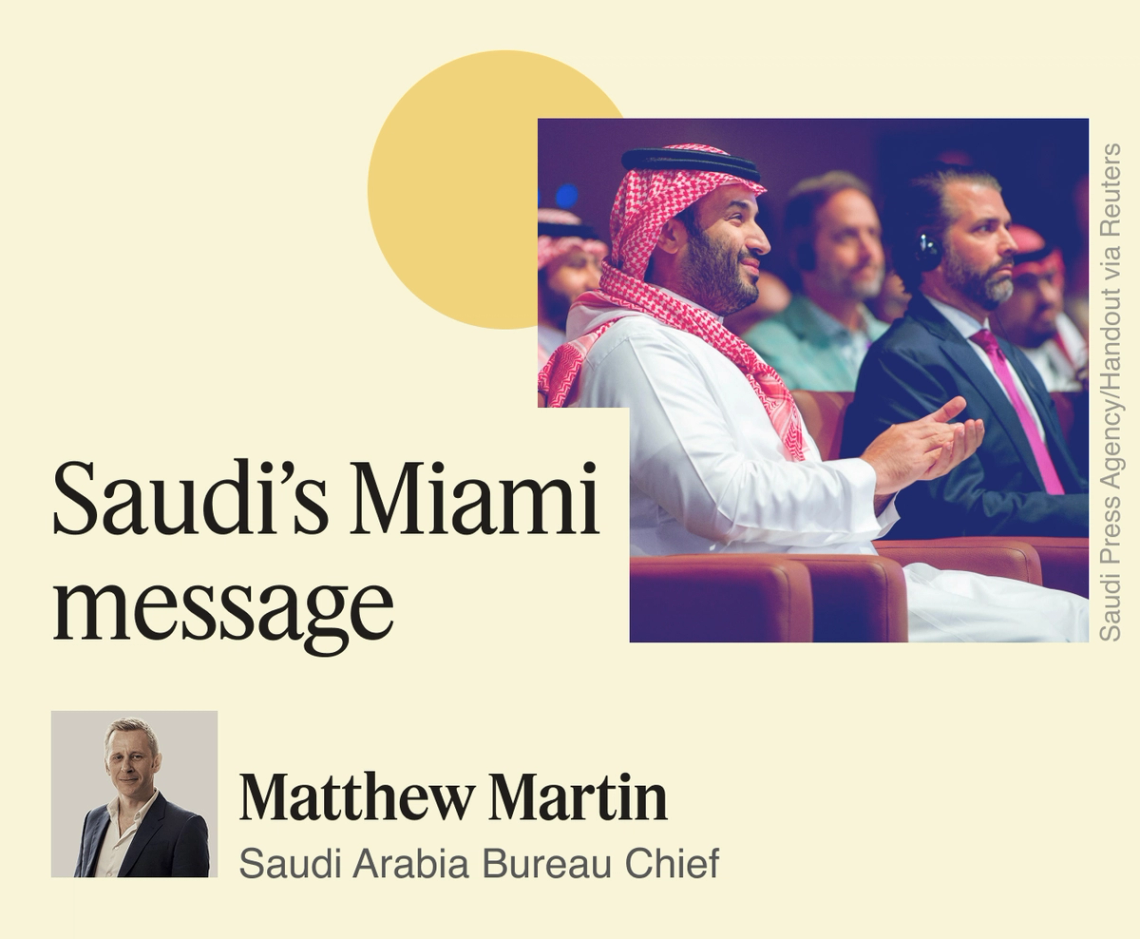 US President Donald Trump will, again, be the headliner at the Saudi sovereign wealth fund’s investment conference in Miami on Friday, but much has changed since he spoke from the same platform a year ago. Then, both sides were keen to tout stronger diplomatic, security, and investment ties. Over the following months, Trump visited Saudi Arabia, and the kingdom’s Crown Prince Mohammed Bin Salman reciprocated with a trip to Washington, pledging $1 trillion of investment across critical minerals, defense, nuclear power, and technology. Now, the backdrop is war. Gulf rulers, who aren’t fans of the regime in Tehran, are worried about ongoing chaos and instability in the region. Surging oil prices may benefit some of them in time, but the conflict has raised serious questions about the oil-for-security pact that underpinned Gulf-US relations for decades. FII Priority Miami, as this week’s event is known, will bring together a senior Saudi delegation — including the head of the nearly $1 trillion Public Investment Fund, the country’s finance minister, and business leaders — alongside US officials, CEOs, Donald Trump Jr., and Steve Witkoff (as well as his son Zach, who runs a crypto business). That will help the kingdom project an image of business as usual, even as Iran lobs missiles and drones on Riyadh and Saudi oil facilities, and blocks its main trading route through the Strait of Hormuz. Saudi Arabia is not distancing itself from Trump. The kingdom may not have wanted this war, but its leaders still see the US as their most important ally, and the conflict has the potential to finally reduce Iranian threats, which have hampered Saudi Arabia’s broader economic ambitions. The outcome of this war may not be clear, but the future of the kingdom’s alliance with the US is. |
|
The Gulf’s top priority is Hormuz |
 US Navy and Marine Corps aircraft parked on an aircraft carrier. US Navy/Handout via Reuters US Navy and Marine Corps aircraft parked on an aircraft carrier. US Navy/Handout via ReutersIsrael and the US began their war on Iran with a muddled set of priorities and, almost a month in, they are still sending mixed signals. Negotiations are taking place, and officials from Muslim-majority countries are looking for a diplomatic off-ramp, but thousands of US Marines are also heading to the region. Gulf countries are making the case that any resolution has to ensure the Strait of Hormuz stays open: Free passage through the chokepoint is crucial to the region’s trade and security. Bahrain circulated a draft UN Security Council resolution authorizing “all necessary means” to protect commercial shipping around Hormuz, with backing from other Gulf states and the US, according to Reuters. While the measure is unlikely to pass, it shows a willingness to use force to strip Iran of control over the strait. Saudi Arabia is reportedly edging closer to direct involvement and has allowed US forces to use King Fahd Air Base, according to The Wall Street Journal. The hardening Gulf line on Hormuz was also delivered to an annual gathering of energy executives. Sultan Ahmed Al Jaber, who heads UAE oil company ADNOC, framed Iran’s blocking of the strait as “economic terrorism” in a speech on Monday. “No country should be allowed to hold Hormuz hostage, not now, not ever.” |
|
Carlyle’s Stavridis touts Iran’s investment potential |
 “The Gulf remains highly investable” despite the Iran war, according to James Stavridis, vice chairman of investment firm Carlyle and a former supreme allied commander of NATO. “Iran could still do damage, they could use terrorism, they could use cyber, they could continue to close the Strait [of Hormuz]. But their capability is reduced to a point where, as an investor, I continue to be comfortable in getting into the region,” he told Semafor’s Liz Hoffman in an interview. Iran itself could turn out to be an investment draw in the years ahead. “I believe firmly that the people of Iran, in the next two or three years, are going to flip this regime ... If that happens, the investment opportunities in a post-conflict Iran are very high,” he said. Before any of that can happen, the conflict needs to end. “My best guess is that we have about a two-in-three chance that the talks do move in a positive direction,” Stavridis said, referring to US-Iran negotiations. “But that’s a one-in-three chance of continuing hostilities.” |
|
China exports vulnerable to Hormuz |
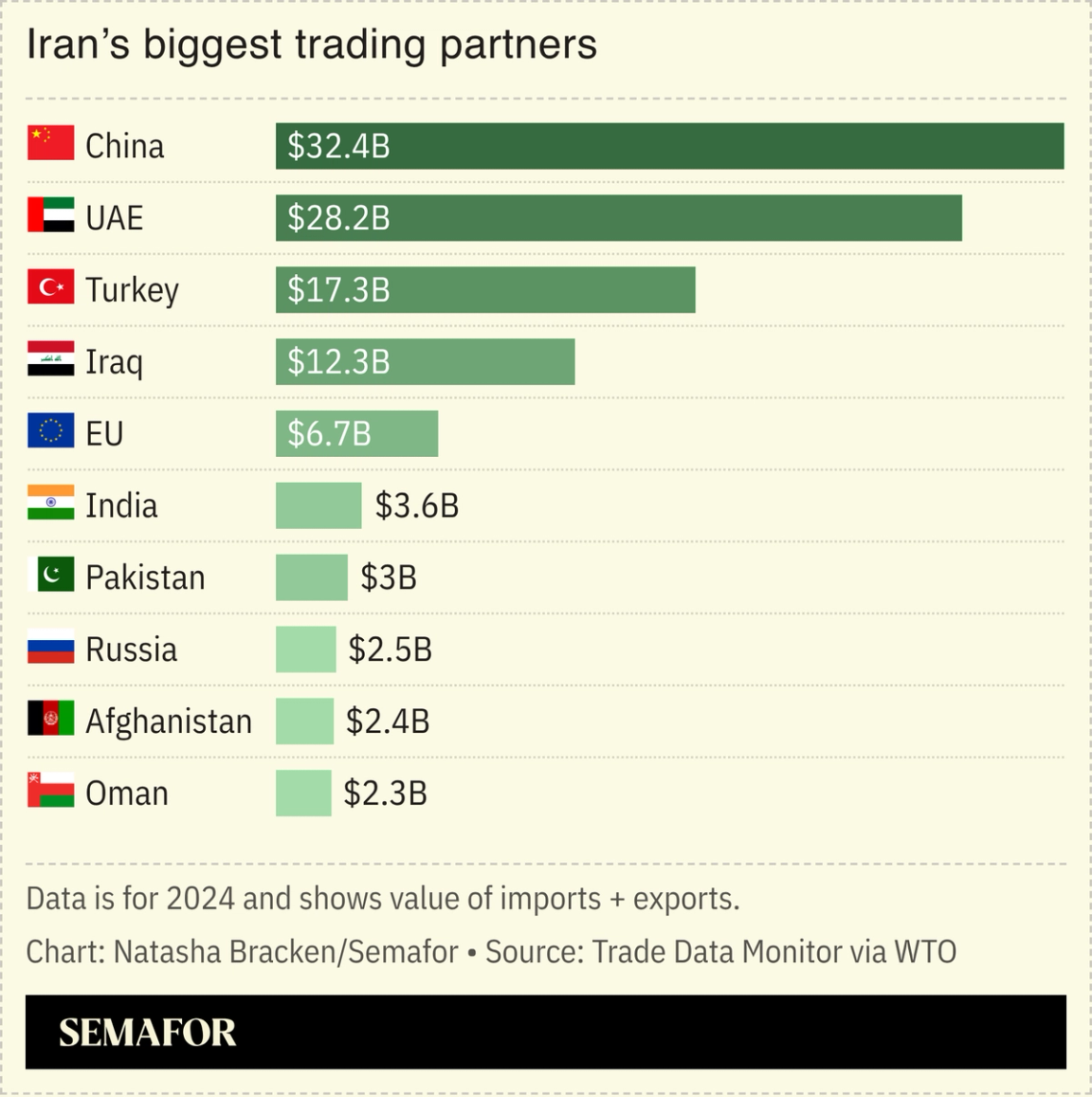
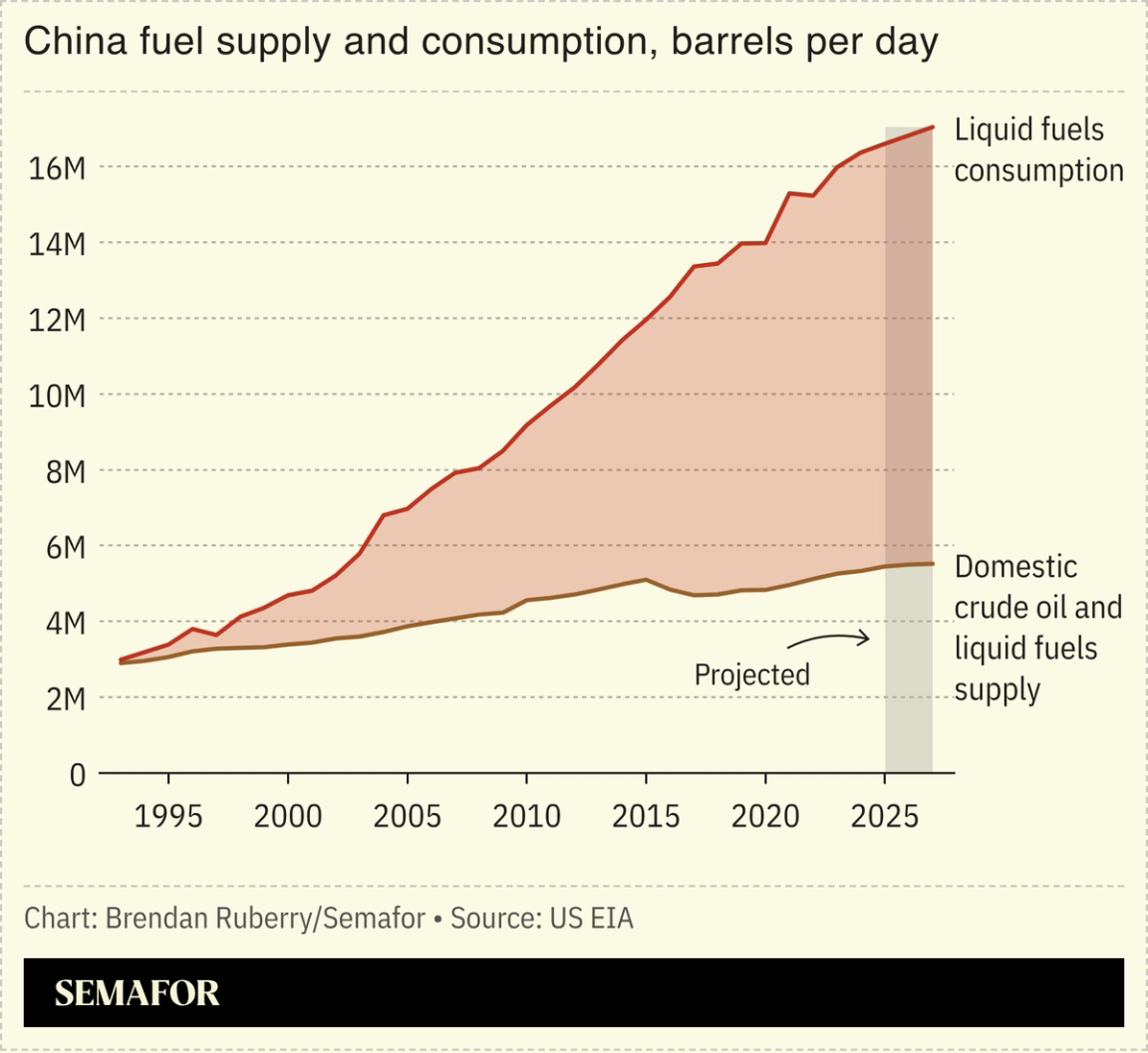 China is vulnerable to a prolonged closure of the Strait of Hormuz — despite its leaders’ insistence to the contrary — because of the knock-on effects on its export markets, a leading analyst argued. The world’s second-largest economy may be resilient to energy shocks in the short term, Alicia García-Herrero, Taipei-based chief economist for French investment bank Natixis, argued in a recent essay, but if the conflict drags on for months China will be uniquely vulnerable because of its dependence on exports. Southeast Asia and Europe, for example, absorb 15% and 13% of China’s products respectively, but both have scant energy reserves. “If we’re looking at a global recession,” she told Semafor’s Clay Chandler, “China has more to lose than anybody.” |
|
Saudi’s supply chain solutions |
 Benoit Tessier/File Photo/Reuters Benoit Tessier/File Photo/ReutersSaudi Arabia has set up a new land and sea trade corridor to the UAE, as the closure of the Strait of Hormuz and airspace restrictions upend cargo movements in the Gulf. The Saudi Ports Authority, known as Mawani, announced a tie-up with the UAE’s Gulftainer to boost connectivity between Dammam in the kingdom’s Eastern province and Sharjah in the UAE. Saudi Arabia has also signed agreements with four international shipping lines to provide capacity of over 63,000 containers between its west coast and regional and international destinations, and exempted some ships from certain documentation requirements. The Saudi Railway Company is also being allowed to operate container trains at more stations. All this could help the kingdom get closer to its aim of becoming a regional trade and logistics hub, which was a key part of its prewar economic diversification strategy. The need to cooperate on logistics is also helping to reset fractured relations with the UAE — just last month the two countries were in a diplomatic spat that threatened to impact trade and investment flows between them. |
|
Gulf tourism grinds to a halt |
 The occupancy of Dubai hotels last week, down from the normal seasonal average of 90%, according to the Financial Times. War has upended the tourism industry in the city, as it has across the Gulf, with hotels shutting floors or entire buildings, cutting staff costs, and offering steep discounts to residents as they prepare for a prolonged slump. The downturn is especially painful for Dubai, long a haven for wealthy tourists who will likely be reluctant to return when the war is over. Hotel operators expect the profile of tourists to shift to lower-budget travelers from Asia and Africa, in what would be a return to the clientele Dubai used to attract before it became a global luxury destination. |
|
View: The moment for an ‘Arab NATO’ |
  Hamad I Mohammed/Reuters Hamad I Mohammed/ReutersWith Iran threatening vital economic lifelines across the Gulf, the idea of collective regional defense structures is gaining ground once again. The concept tends to resurface during crises, when the cost of chaos weighs heavily, but it has always proved too challenging, IMI’s chief international anchor Hadley Gamble writes in a column for Semafor. “The Gulf Cooperation Council, formed in 1981, has struggled to reach consensus on pretty much anything, lagging behind on goals like a common currency and common market,” she writes. Creating a defense alliance is even harder than aligning on economics, but the current reality could help countries to overcome their differences and, in the future, the framework could be extended to Egypt, Jordan, or Syria. |
|
 Private equity and private credit was long a perk for the rich and well-connected. But now Wall Street’s investment giants are pitching their products to everyday Americans, who have piled in — and are now piling out in a panic. Is this democratizing finance or a recipe for disaster? On this week’s episode of Compound Interest, presented by Amazon Business, Liz and Rohan dive into that and more with Alisa Wood, the KKR executive leading the firm’s retail charge. |
|
 - Bloomberg: The Odd Lots podcast talks to real estate expert Hiten Samtani about Gulf investments in the sector and
|
|
|


