|



New Year, New Metrics: Evaluating AI Search in the Agentic Era (Sponsored)
 |
Most teams pick a search provider by running a few test queries and hoping for the best – a recipe for hallucinations and unpredictable failures. This technical guide from You.com gives you access to an exact framework to evaluate AI search and retrieval.
What you’ll get:
A four-phase framework for evaluating AI search
How to build a golden set of queries that predicts real-world performance
Metrics and code for measuring accuracy
Go from “looks good” to proven quality.
Netflix Live Origin is a custom-built server that sits between the cloud live streaming pipelines and Open Connect, Netflix’s Content Delivery Network (CDN). It acts like a quality control checkpoint that decides which video segments get delivered to millions of viewers around the world.
When Netflix first introduced live streaming, they needed a system that could handle the unique challenges of real-time video delivery. Unlike Video on Demand (VOD), where content is prepared in advance, live streaming operates under time constraints. Every video segment must be encoded, packaged, and delivered to viewers within seconds. The Live Origin was designed specifically to handle these demands.
In this article, we will look at the architecture of this system and the challenges Netflix faced while building it.
Disclaimer: This post is based on publicly shared details from the Netflix Engineering Team. Please comment if you notice any inaccuracies.
How the System Works
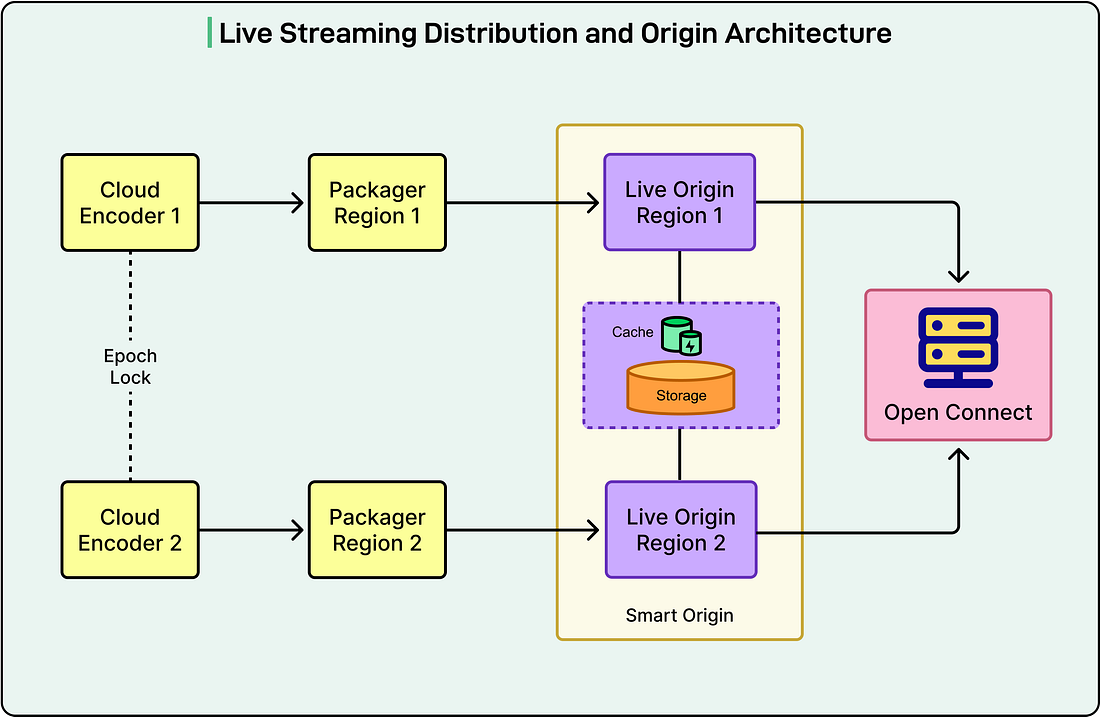
The Live Origin operates as a multi-tenant microservice on Amazon EC2 instances. The communication model is quite straightforward:
The Packager, which prepares video segments for distribution, sends these segments to the Origin using HTTP PUT requests.
Open Connect nodes retrieve these segments using HTTP GET requests. The URL used for the PUT request matches the URL used for the GET request, creating a simple storage and retrieval pattern.
See the diagram below:
 |
Netflix made a couple of architectural decisions that shaped how the Live Origin functions.
First, they achieve reliability through redundant regional live streaming pipelines. Instead of relying on a single encoding pipeline, Netflix runs two independent pipelines simultaneously. Each pipeline operates in a different cloud region with its own encoder, packager, and video contribution feed.
Second, Netflix adopted a manifest design with segment templates and constant segment duration. Instead of constantly updating a manifest file to list available segments, they use a predictable template where each segment has a fixed duration of 2 seconds. This design choice allows the Origin to predict exactly when segments should be published.
Multi-Pipeline Awareness and Intelligent Selection
Live video streams inevitably contain defects because of the unpredictable nature of live video feeds and the strict real-time publishing deadlines. Common problems include short segments with missing video frames or audio samples, completely missing segments, and timing discontinuities where the decode timestamps are incorrect.
Running two independent pipelines substantially reduces the chance that both will produce defective segments at the same time. Because the pipelines use different cloud regions, encoders, and video sources, when one pipeline produces a bad segment, the other typically produces a good one.
The Live Origin leverages its position in the distribution path to make intelligent decisions. When Open Connect requests a segment, the Origin checks candidates from both pipelines in a predetermined order and selects the first valid one. To detect defects, the Packager performs lightweight media inspection and includes defect information as metadata when publishing segments to the Origin. In the rare case where both pipelines have defective segments, this information passes downstream so clients can handle the error appropriately.
No invasive meeting bots (Sponsored)
 |
Ever had a meeting where a random bot joins the call and, suddenly, everyone’s distracted?