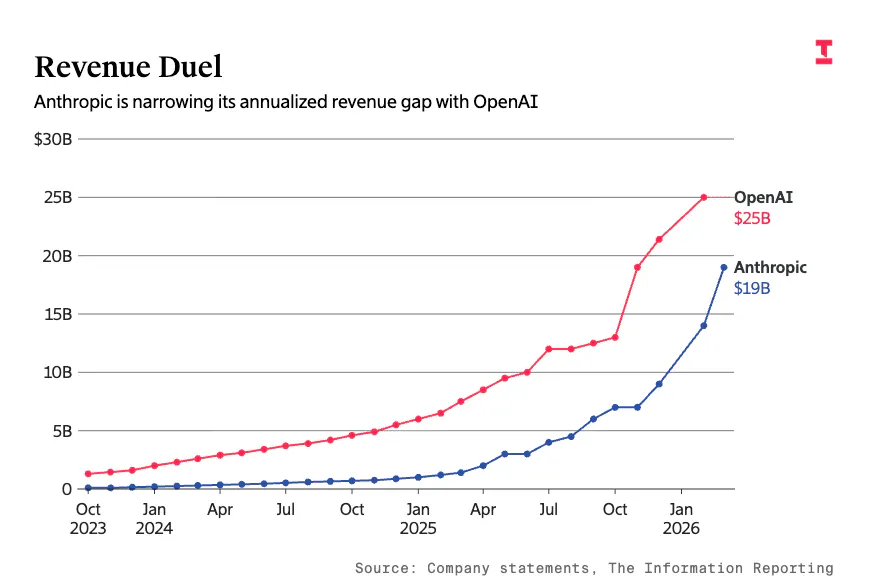
OpenAI and Anthropic’s remarkable revenue growth has invited scrutiny of how the AI startups are tallying the headline-making figures they have privately or publicly disclosed. Last month, OpenAI’s annualized revenue jumped to $25 billion, nearly four times higher than a year earlier. Anthropic has grown even faster: At the end of last month, Anthropic crossed $19 billion in annualized revenue—about 14 times higher than a year earlier. If the trend lines continue, it isn’t unfathomable to imagine Anthropic catching up to OpenAI over the next year or so! Both companies take a similar approach to calculating annualized revenue. OpenAI multiplies its total revenue for a recent four-week period by 13, which equals 52 weeks —or a full year, according to a person with direct knowledge of its finances.
Please join The Information at the New York Stock Exchange on Monday, April 27, to hear from top executives and investors on how the rapid buildout of AI is reshaping tech, finance, and capital markets. Learn more here.
Welcome back! Sri here.
OpenAI and Anthropic’s remarkable revenue growth has invited scrutiny of how the AI startups are tallying the headline-making figures they have privately or publicly disclosed.
Last month, OpenAI’s annualized revenue jumped to $25 billion, nearly four times higher than a year earlier. Anthropic has grown even faster: At the end of last month, Anthropic crossed $19 billion in annualized revenue—about 14 times higher than a year earlier. If the trend lines continue, it isn’t unfathomable to imagine Anthropic catching up to OpenAI over the next year or so!
Both companies take a similar approach to calculating annualized revenue. OpenAI multiplies its total revenue for a recentfour-week period by 13, which equals 52 weeks —or a full year, according to a person with direct knowledge of its finances.
Anthropic calculates its annualized revenue by taking the last four weeks of application programming interface revenue and multiplying it by 13, and then adding another figure: its monthly recurring chatbot subscription revenue multiplied by 12, according to a person with direct knowledge of Anthropic’s finances.The monthly figure used to calculate recurring subscriptions is based on the number of active subscriptions that day, said the person.
In any case, this should put to rest speculation on X that Anthropic’s annualized sales accounting may be wildly different or less valid than OpenAI’s. It’s not.
While annualized sales can be questionable because the metric is usually much bigger than actual revenue, using annualized revenue may be justified in the case of OpenAI and Anthropic. That’s because of the meteoric revenue spikes they have experienced.
Still, for mature companies sprinting toward public offerings, total revenue is what really matters. And there are meaningful differences in how these companies disclose revenue figures privately to current and prospective investors.
Principal Differences
OpenAI shares 20% of its revenue with Microsoft due to their multifaceted business arrangement, but OpenAI’s financial statements count sales before the company gives Microsoft its slice. (OpenAI expects revenue to jump to about $30 billion for all of this year, from $13.1 billion last year.)
Anthropic, which generated around $4.5 billion in revenue last year, doesn’t have an agreement to share a slice of all of its revenue with a cloud provider. But, like OpenAI, it has agreed to share some of the revenue from cloud partners’ sales of its models with those partners.
The two firms’ cloud revenue-sharing deals differ in major ways, however, as does the way they count such revenue in their financial statements.
OpenAI, for instance, receives 20% of Microsoft sales of OpenAI models to Azure cloud customers. The ChatGPT maker counts that figure as revenue in its financial statements. (It’s not yet clear how OpenAI will account for revenue it generates through Amazon Web Services as part of a new deal between the companies.)
Anthropic counts such revenue very differently from OpenAI. AWS, Microsoft and Google each resell Anthropic’s Claude models to their respective cloud customers, but Anthropic reports all those sales as revenue, before the cloud providers receive their share of those sales. Instead, Anthropic accounts for the cloud provider payouts in its sales and marketing expenses, as we’ve previously reported here.
The revenue accounting differences between OpenAI and Anthropic come down to which company is considered a “principal” that controls the service that is delivered to customers. OpenAI considers Microsoft to be the principal for the Azure OpenAI service, according to a person with knowledge of the relationship, because Microsoft directly controls the Azure service in question and also has exclusive rights to use OpenAI’s intellectual property.
Anthropic, meanwhile, considers itself to be the principal in its relationship with cloud partners. They don’t control the delivery of the models and products and instead are so-called distributors, according to a person with knowledge of the situation.
Bottom line: Both companies are following Generally Accepted Accounting Principles, but because the nature of their deals with cloud providers differ markedly, they are at odds when accounting for sales through these companies. Unfortunately, we aren’t able to calculate how much that hurts OpenAI’s top line.
Start your day withApplied AI, the newsletter from The Information that uncovers how leading businesses are leveraging AI to automate tasks across the board.Subscribe nowfor free to get it delivered straight to your inbox twice a week.
Join The Information's live Q&A on Talent Tracker: Venture Capital’s Rising Leaders on March 26th! Our expert team, including Laura Mandaro and Julia Hornstein, will provide a behind-the-scenes look at the next generation of top GPs and operators.
Join The Information at the New York Stock Exchange on Monday, April 27, to hear from top executives and investors on how the rapid buildout of AI is reshaping tech, finance, and capital markets
Save the date for The Information’s annual AI Agenda Live in San Francisco, where top AI researchers, founders, investors and executives come together for a day of conversations about the breakthroughs and applications shaping the future of AI.