A new statewide law came into effect in New York on Saturday requiring food stores and retail establishments to allow customers to pay in cash. However, the rule doesn’t apply to bills in denominations above $20, which you wouldn’t think would be a problem, except that there are more $100 bills than any other denomination in circulation.
The S&P 500 and Nasdaq 100 fell on Tuesday, paring steeper losses after a midday report that Iran is willing to listen to proposals to end the war, but stocks were unable to keep their momentum as traders digested news that the US is deploying 3,000 troops to the Middle East. After the market closed, reports emerged that the US has sent a plan to Iran to end the war, sending stocks up and oil down in the aftermarket session.
|
|
|
How much does oil matter for inflation anyway? |
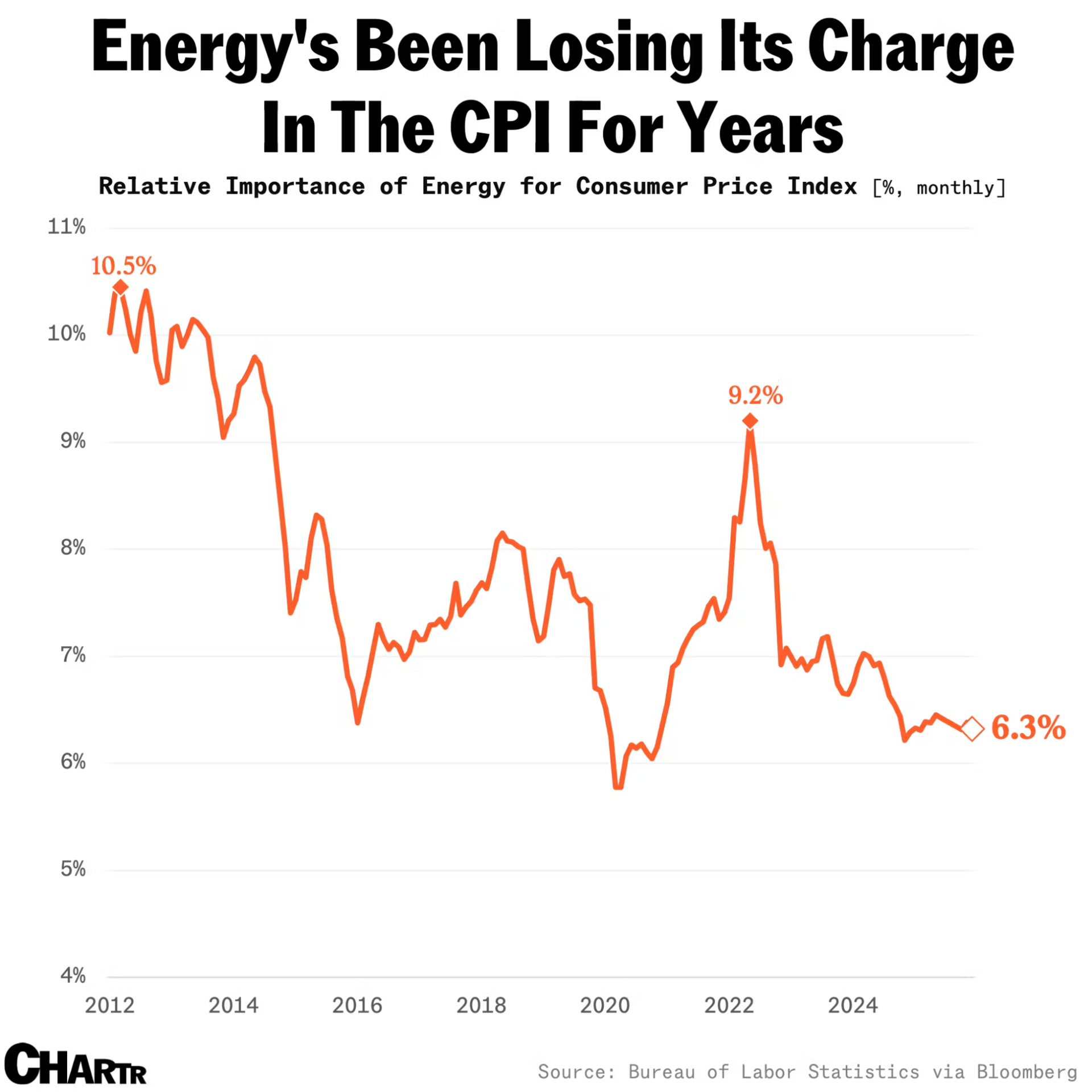
As markets await the first Consumer Price Index print measured since the start of the Iran war, slated for April 10, it’s worth stepping back and asking one important question: how much does oil matter for inflation anyway? Energy is only about 6% of the CPI, but that’s not the full picture. |
- That is significantly lower than it was back in 2012, when energy was more than 10% of the index — and, of course, when prices spike, people have to spend more on those goods, which is why the weight of energy in the CPI basket jumped after Covid in 2022.
-
Of course, while the share of energy contributing to the CPI directly might be lower than what many people expect, higher oil and energy prices affect nearly everything else indirectly.
-
Food prices, making up ~15% of the index, are sensitive to fertilizers, which are often produced using natural gas, as well as transportation costs. Airfares, worth 0.8% of the index, are already rising.
- Supply chains across nearly every physical industry in America are impacted by more expensive barrels of oil.
|
Indeed, RBC analysts project that if oil prices settle around $100 per barrel, US inflation would rise above 3.5% from Q2, about 0.7 percentage points higher than the base case. IMF analysis estimated last week that every 10% increase in energy prices, if sustained for a year, would result in a 40-basis point increase in global inflation.
|
|
|
For now, traders in prediction markets* are expecting a chunky rise in headline inflation, with the majority expecting CPI to rise 3.2% for March. Even if the war in Iran were to end, oil prices are likely to remain elevated. In addition to the increased costs of shipping oil through the Strait of Hormuz — whether that involves paying the Iranians or merely just factoring in the higher price of insuring the vessels that transport oil and the valuable cargo within — a significant amount of fossil fuel infrastructure has been damaged and a number of facilities have ceased processing. Getting those facilities back online will take time, so for now pricey oil is going to stick around for a bit.
|
*Event contracts are offered through Robinhood Derivatives, LLC — probabilities referenced or sourced from KalshiEx LLC or ForecastEx LLC. |
|
|
Trade the market, not just the tickers |
More and more traders are using index options. Why?
|
- Benchmark-level exposure: Nasdaq-100 Index® Options allow for more macro expressions than single-stock securities, giving traders the potential to participate in upside or mitigate downside portfolio risk.
-
Enhanced leverage: With index options, traders can control larger positions than they access with single stocks. Available in two contract sizes, NDX® and XND®, Nasdaq-100 Index Options can be suitable for all portfolio types.
-
Potential Tax Benefits: In many cases, there are meaningful tax benefits associated with index options compared to similar stock or ETF options. Consult a tax advisor before investing.
|
Nasdaq-100 Index Options are cash-settled at expiration, rather than in shares — and as European-styled options, they carry no risk of early assignment.
Discover the NDX advantage. |
|
|
America is officially spending more on building data centers than offices |
- America’s construction spending on data centers reached a record annualized rate of $45 billion in December, crossing paths with declining private office outlays at $44 billion, per US Census Bureau data.
-
Recently, research from CBRE found that data center capacity under construction actually fell from 6.35 megawatts in 2024 to 5.99 megawatts by the end of 2025 — but the bottleneck doesn’t appear to be demand, but more mundane supply issues, with deal implementation at the local level, including slow permitting and constrained supply chains, seemingly causing the slowdown.
- Indeed, considering how hyperscaler clients are trying to secure power capacity, it’s hard to imagine data center spending not expanding its lead.
|
|
|
With skyrocketing demand, construction costs are jumping, too — helping construction firms to become the best-performing non-Iran-related segment of the stock market this year, as Sherwood News Senior Markets Correspondent Matt Phillips pointed out. |
|
|
One of the most boring and ubiquitous pieces of modern consumer technology is suddenly in the crosshairs of the Trump administration. It turns out your dusty internet router that’s probably from China is a favorite target for cyberattacks.
Why they’re vulnerable |
|
|
- ⚾️ MLB: It’s Opening Day! The victors of the 2025 season, the Los Angeles Dodgers, have a 29% chance of repeating, according to prediction markets, with other strong contenders including the Seattle Mariners (9%) and New York Yankees (9%).
-
|
|
|
|