| | In this edition: Mobile apps drive retail spending in Kenya, Nigeria’s oil strategy, and the Trump a͏ ͏ ͏ ͏ ͏ ͏ |
| |  | Africa |  |
| |
|
 - Mobile apps drive investment
- Call to build capacity
- Nigeria’s oil strategy
- Iran war drives air demand
- Namibia rejects Starlink
- Heat-related deaths
- US accused of Black erasure
 Why Nigeria is burying its history under a mountain. |
|
Mobile apps drive investment |
  Esther Waititu, Safaricom Chief Financial Services Officer and CEO of M-Pesa Kenya with Semafor’s Managing Editor Africa Alexis Akwagyiram. Alvin Angaya, Xpose/Semafor. Esther Waititu, Safaricom Chief Financial Services Officer and CEO of M-Pesa Kenya with Semafor’s Managing Editor Africa Alexis Akwagyiram. Alvin Angaya, Xpose/Semafor.Kenyan mobile money users have doubled the number of active retail investors on the country’s main stock exchange, just six weeks after the bourse opened trading on the M-Pesa platform, executives said at Semafor’s Next 3 Billion event. Safaricom executive Esther Waititu, who is also CEO of M-Pesa Kenya, said 200,000 people were trading using an M-Pesa-linked app since its launch in early February, doubling the number of active retail traders and accounting for “60% of the trades happening on the securities exchange today.” Frank Mwiti, CEO of the Nairobi Stock Exchange, said mobile money access was the cornerstone of the bourse’s strategy to broaden access to the general public: The NSE is betting on widely used mobile money platforms to reach its target of 9 million traders by 2029. African policymakers are keen to deepen capital markets by bringing more citizens into the financial system. They hope such moves will help reduce the need for government reliance on foreign borrowing at high interest rates and provide domestic funds to support infrastructure development. — Alexis Akwagyiram |
|
Shocks reinforce local production needs |
 Abubakar Hassan Abubakar, Kenya’s permanent secretary, trade and investment, with Semafor Africa Editor Yinka Adegoke. Alvin Angaya, Xpose/Semafor. Abubakar Hassan Abubakar, Kenya’s permanent secretary, trade and investment, with Semafor Africa Editor Yinka Adegoke. Alvin Angaya, Xpose/Semafor.Global economic shocks of recent years have reinforced the need for African countries to build capacity in key sectors, said an official from a leading pan-African industrial park developer. Arise Integrated Industrial Platforms’ top executive in Kenya, George Olaka, told Semafor’s Next 3 Billion event that local production offers “resilience against shocks” while also “providing production capacity that the country needs.” He used the example of sugarcane, saying such crops could be used to produce fuel, which would reduce the dependence on imports. Kenya remains confident in its economic outlook despite the fuel crisis sparked by the Iran war, the country’s top investment official added. The disruption has driven increased use of infrastructure, with more ships docking at Mombasa and Lamu ports as cargo is rerouted through Kenya, said Abubakar Hassan Abubakar, permanent secretary of trade. He said the disruption was boosting activity that had previously been underutilized. — Alexis Akwagyiram and Yinka Adegoke |
|
Nigeria’s oil price windfall |
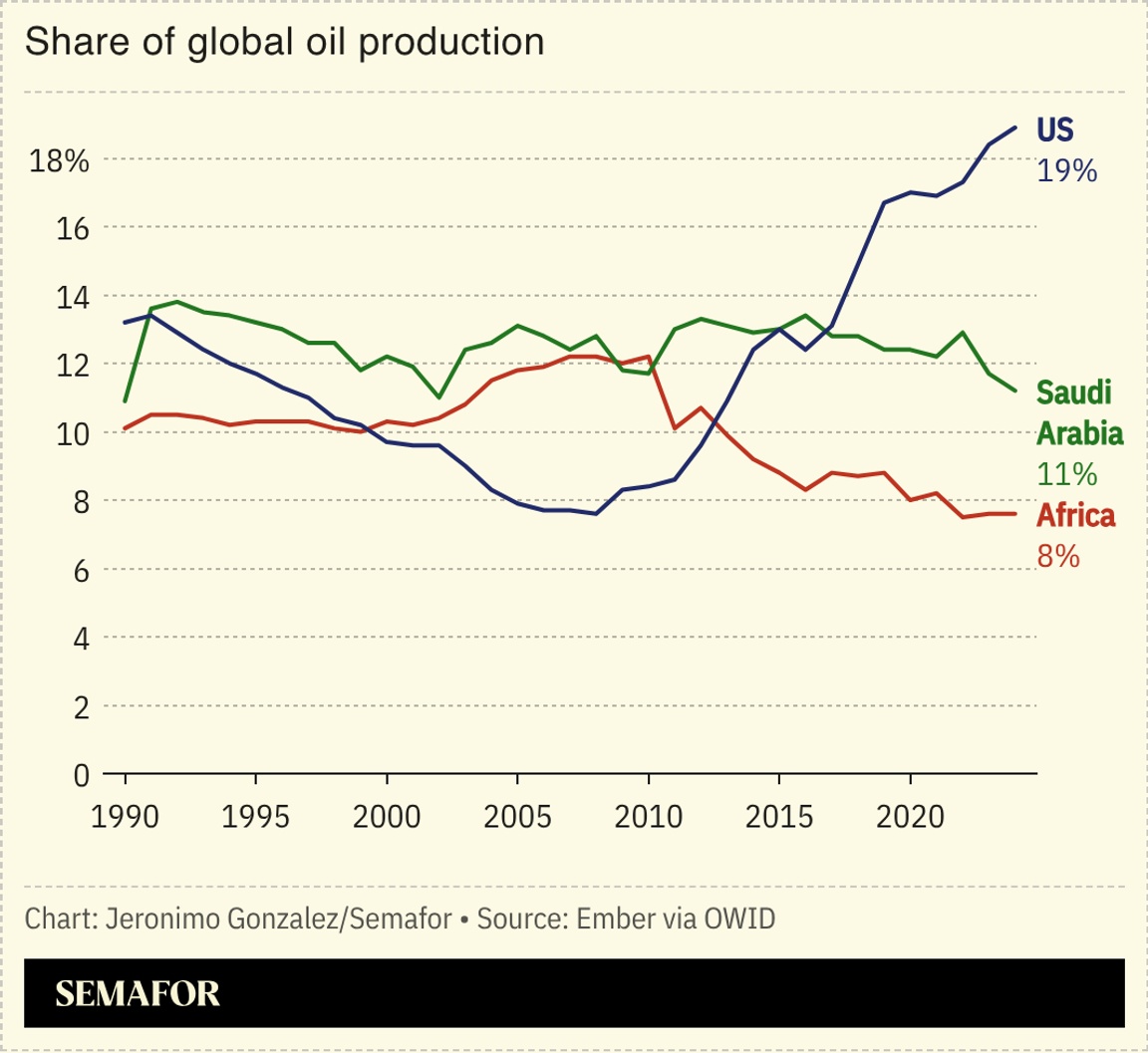 Nigeria’s decision to scrap fuel subsidies left the country better prepared to capture a windfall from spiking oil prices and protect consumers from higher costs, the top energy adviser to President Bola Tinubu told Semafor. For Nigeria, rising oil prices are a mixed blessing: As Africa’s top producer of crude, it stands to gain more from exports, but the country’s reliance on imported refined products means drivers and people who depend on diesel generators for electricity remain highly exposed to price shocks. Tinubu’s removal of fuel subsidies in 2023 made Nigeria a more attractive destination for energy investors, said Olu Verheijen, the president’s special adviser on energy, on the sidelines of the CERAWeek energy conference in Houston, Texas this week. She said the country has locked in more than $8 billion in new drilling projects since Tinubu took office, with another $20 billion under development. There are no plans to reintroduce fuel subsidies, Verheijen said, even though pump prices are now 50% higher than they were before the Iran war. Tinubu’s administration, she said, is counting on the market to solve that problem on its own. “The reforms we took were designed to drive our own energy security agenda and decouple from exactly this kind of volatility.” Nigeria has sped up the approval period for oil well exploration permits from weeks to hours, Bloomberg reported on Wednesday. — Tim McDonnell |
|
 This April, Howard Lutnick, US Secretary of Commerce, will join global leaders at Semafor World Economy — the largest gathering of top CEOs and officials in the United States — to sit down with Semafor editors for conversations on the forces shaping world markets, emerging technologies, and geopolitics. See the full lineup of speakers, including Global Advisory Board members, Fortune 500 CEOs, and officials from the US and across the G20. |
|
Kenya Airways sees passenger surge |
 Thomas Mukoya/File Photo/Reuters Thomas Mukoya/File Photo/ReutersKenya’s flag carrier is operating at near full capacity as the war in the Middle East drives up demand, the company’s CEO said. African aviation is facing a stress test as a result of the Iran war, as fuel costs rise and routes are closed in the Middle East. The tensions have led to losses for Ethiopian Airlines, the continent’s largest airline, Kenya Airways’ flights have gone from 70% occupancy to up to 99%, acting Chief Executive George Kamal said. The increased demand has come from Asia, Europe, and the US. Kenya Airways, which is majority-owned by the government, posted a pre-tax loss of $138 million last year. Its performance was impacted by the grounding of three Dreamliner jets but Boeing planes will be added to its fleet this year, the company said. |
|
 Namibia blocked Elon Musk’s Starlink from entering its telecoms market, enforcing local ownership rules that have become a point of contention for foreign firms operating in Africa. The pushback underscores a widening divide of values between Musk and some African governments that are tying ownership rules to post-liberation efforts to broaden economic opportunity. Several African countries have relaxed regulations around ownership to allow access to Starlink, which has set up operations in nearly 20 countries across the continent. Namibia’s hard-line approach makes South Africa’s look moderate, by comparison: Pretoria has created a formal pathway for equity equivalents, allowing foreign operators to propose alternative contributions in place of direct shareholding — a move that has triggered sharp criticism across political, labor, and policy circles. |
|
Heat-related deaths projected to rise |
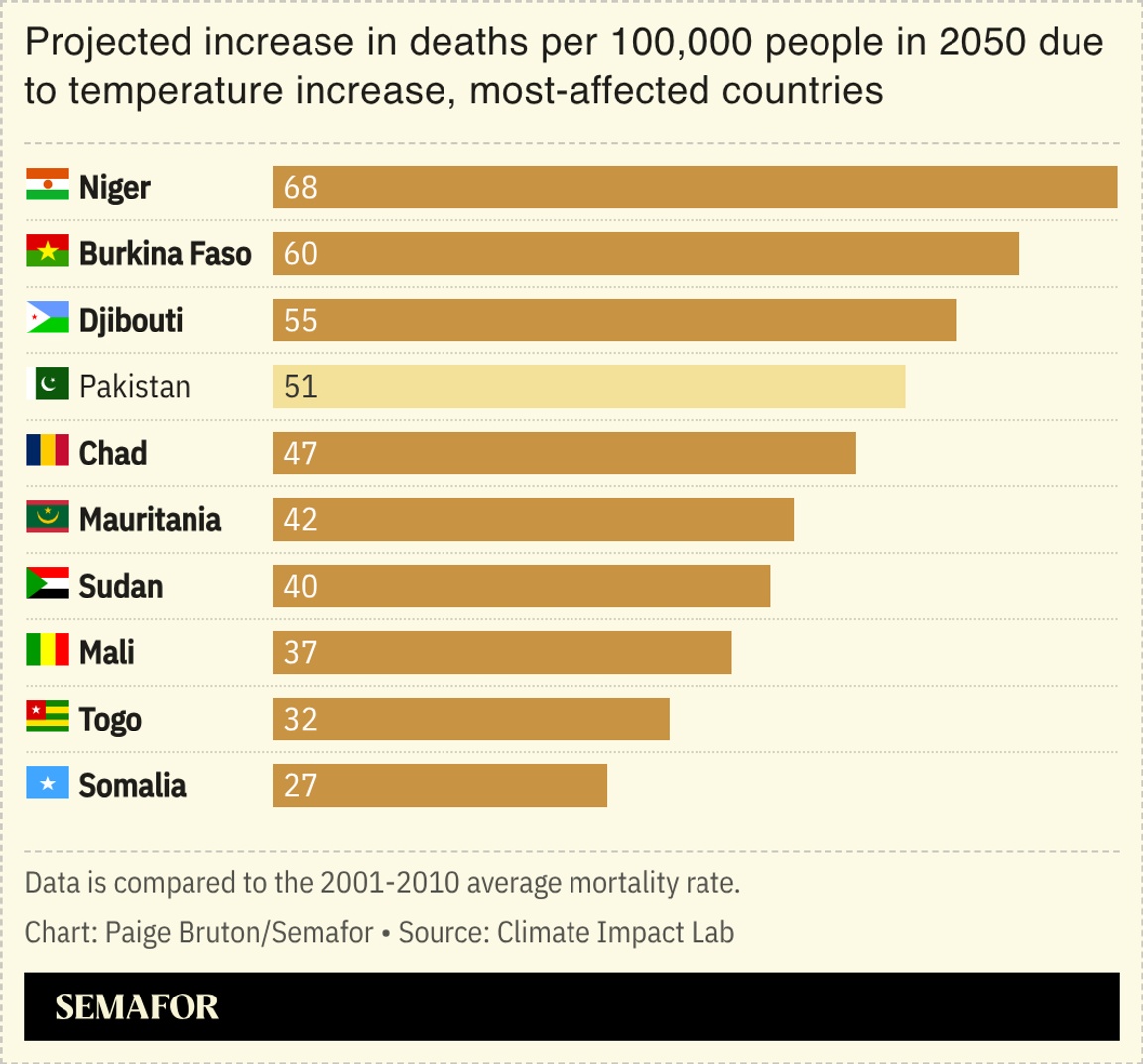 At least 26 African countries will experience increases in temperature-related deaths due to climate change in 2050 compared to the 2001-2010 average, according to a new report. Burkina Faso, Mauritania, and Niger are among those that will see such deaths exceeding those from stroke, one of the top causes of death across the globe, research from the nonprofit group Climate Impact Lab found. It projected that parts of the Horn of Africa will also experience some of the largest increases in temperature-related mortality, including Djibouti, Somalia, and the lowlands of Ethiopia. “Today’s poorest populations are projected to suffer the most from a warming climate, making adaptation investments in low-income areas critical,” it said. Djibouti, for example, is projected to experience an increase in temperature-related deaths that is two times that of Kuwait despite their similar climate. — Preeti Jha |
|
US accused of erasing Black history |
 Ghanaian President John Dramani Mahama. Bernd von Jutrczenka/picture alliance via Getty Images. Ghanaian President John Dramani Mahama. Bernd von Jutrczenka/picture alliance via Getty Images.Ghanaian President John Dramani Mahama accused the Trump administration of “normalizing the erasure” of Black history, warning that US policies could have ripple effects in other parts of the world. Speaking in New York City on Tuesday, Mahama was referring to moves such as the dismantling of slavery exhibits, the restoration of Confederate statues, and the removal of Black history courses from school curricula, Reuters reported. “These policies are becoming a template for other governments as well as some private institutions,” Mahama said. “At the very least, they are slowly normalizing the erasure.” The Ghanaian president is set to propose a resolution at the UN General Assembly on Wednesday to recognize transatlantic slavery as the “gravest crime in the history of humankind” and to demand reparations. |
|
 Business & Macro |
|
|


