| | In today’s edition: Zombie tankers sail the Strait of Hormuz, schools are starting to welcome back p͏ ͏ ͏ ͏ ͏ ͏ |
| |  Larak Island Larak Island |  Dubai Dubai |  Riyadh Riyadh |
 | Gulf |  |
| |
|
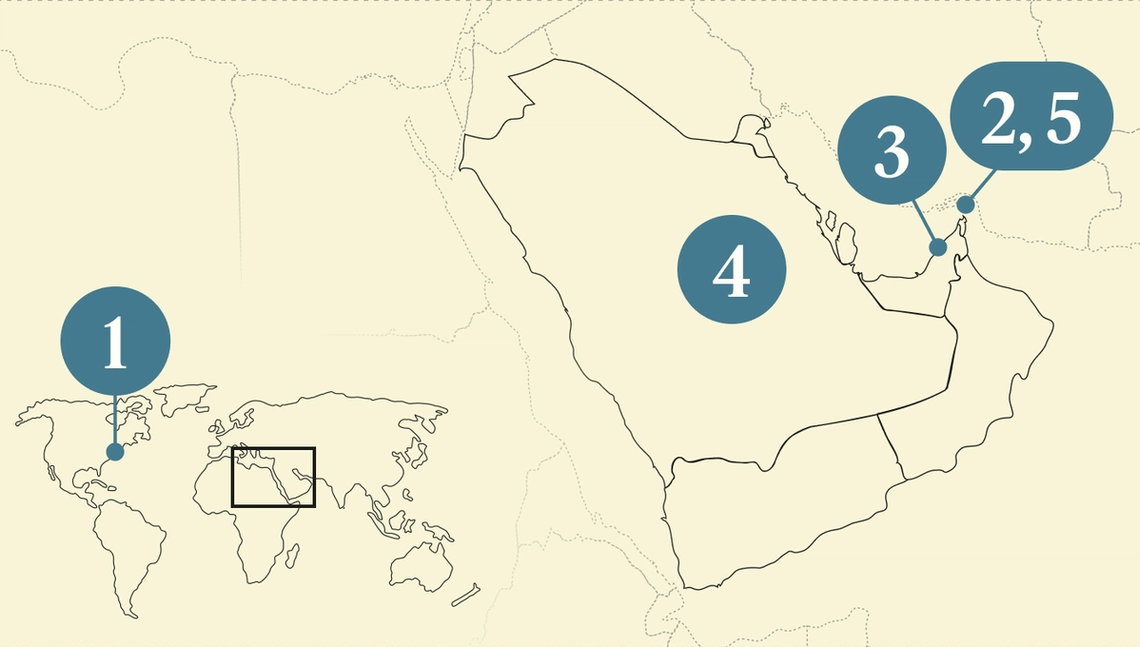 - Trump confirms Gulf support
- Zombie tankers in Hormuz
- Some Gulf schools reopen
- Saudis face up to war
- Energy diplomacy evolves
 Desert floods. |
|
 There are many signals that when it comes to the Gulf it is, broadly, business as usual. Saudi Arabia and Kuwait are pushing ahead with multibillion-dollar energy deals. The IPO pipeline is moving. Budget retailer Primark is opening a massive store in Dubai. Saudi’s Savvy Games is buying a $6 billion Chinese studio. Qatar’s sovereign fund is eyeing a stake in Italian sneaker maker Golden Goose. On the other side of the ledger, however, are signs of stress. Shut-ins and halted drilling are straining contractors in the energy patch. Some Dubai real estate developer bonds are slipping into distressed territory, according to Bloomberg, and highly paid traders are looking to move to other tax-friendly financial hubs. The ripple effects of the war are global: Drivers queuing for gas in China, car manufacturers scrambling for aluminum, and helium supplies crunched after Qatar stopped exports. While there is no doubt that business will continue during the war, the question is whether the deals we are seeing now were just the ones that were already too far along to be reversed, and how long it will take to reboot the economy and rebuild confidence. This is what we are hoping to learn more about over the next three days, as business leaders from Saudi Arabia and the US convene for FII Priority Miami. My colleague Matthew Martin will be there. If you’re in Miami, let us know by replying to this email. |
|
Trump praises Gulf support |
 Evelyn Hockstein/Reuters Evelyn Hockstein/ReutersOne of the biggest questions so far in the Iran war is whether Saudi Crown Prince Mohammed bin Salman supported — and actively lobbied — for US strikes. Saudi government-linked media has repeatedly denied claims that Riyadh is aiming to prolong the war, but The New York Times reported Tuesday that MBS urged US President Donald Trump to pursue regime change in Tehran. Trump hasn’t commented on specifics of talks with Gulf leaders, but yesterday said “he’s a warrior” when asked about the crown prince. “He’s fighting with us, by the way. Saudi Arabia has been excellent, and UAE, excellent. And I will tell you, Qatar, incredible.” Meanwhile, Washington has reportedly sent Iran a 15-point ceasefire proposal via Pakistani intermediaries, even as it ramps up military deployments, including airborne troops and thousands of marines. Tehran publicly rejected the overture and continued its attacks on Israel and the Gulf states, while Israel launched a series of strikes on Iran. |
|
Zombie tankers in the Strait of Hormuz |
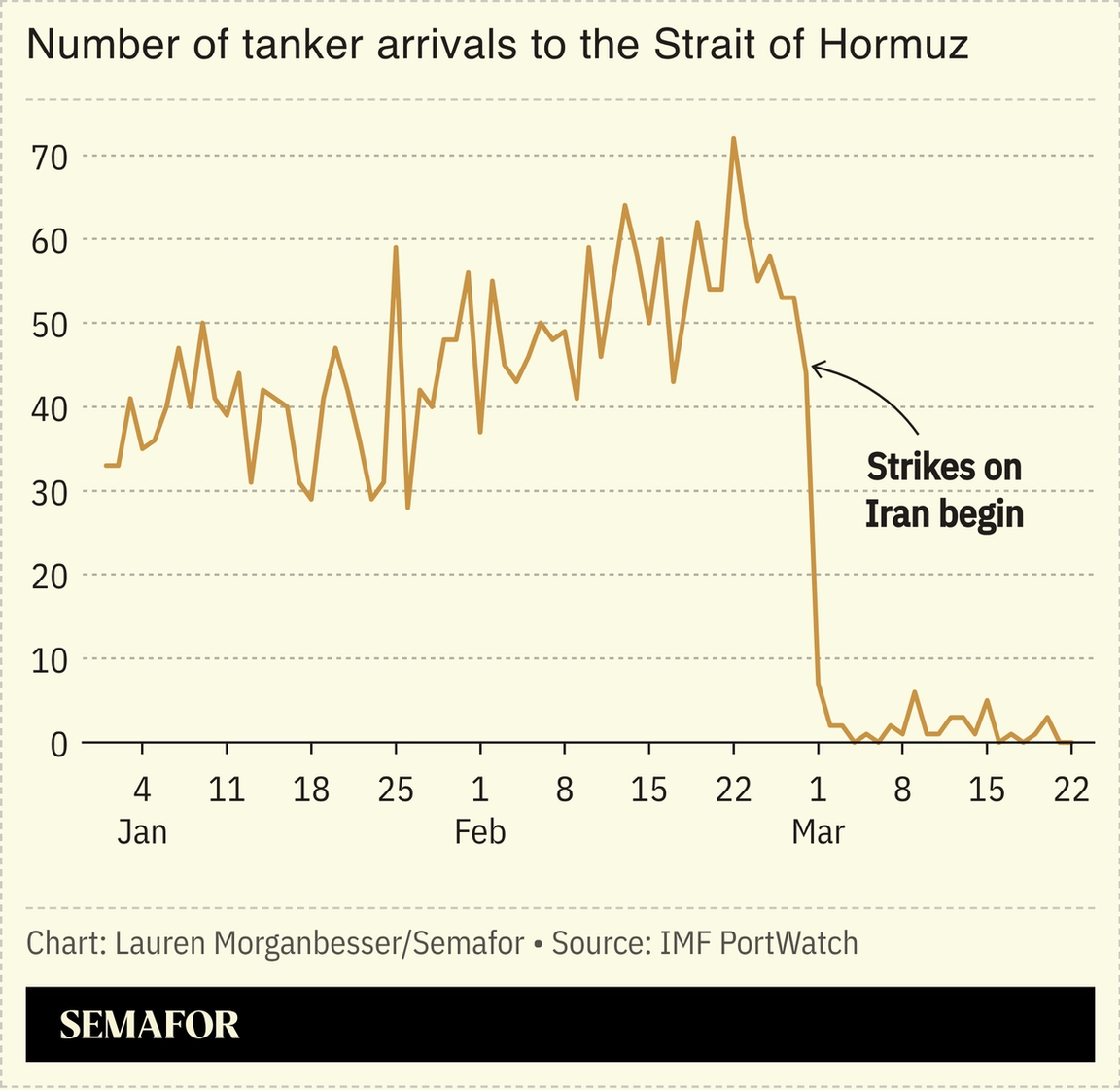 At least two tankers have passed through the Strait of Hormuz while impersonating ships scrapped long ago, as Iran continues to exert a tight hold on traffic through the waterway. The so-called zombie tankers used the identities of defunct Japanese and Liberian vessels, Lloyd’s List reported. Passage through the strait, which in normal times handles around 20% of global oil supplies, has almost ground to a halt since the start of the US-Israel war with Iran. Around 16 vessels traversed the area between Friday and Monday, with most of them heading out of the Gulf and sailing between Iran’s Qeshm and Larak islands — a route that has been dubbed the “Tehran toll booth” due to payments allegedly made by some shipowners to ensure safe passage. One vessel is reported to have paid Iran a fee of $2 million. Before the war, around 120 tankers would pass through the strait every day. Tehran has said that “non-hostile” ships will be allowed to transit through the strait, provided they are from countries that “neither participate in nor support acts of aggression against Iran.” — Matthew Martin |
|
 A school in Dubai, pictured in 2024. Rula Rouhana/Reuters. A school in Dubai, pictured in 2024. Rula Rouhana/Reuters.Parents in Dubai this week received an unexpected — but welcome — survey from schools to gauge how comfortable they would be sending their children back to classrooms. For one of the UAE’s biggest private educators, responses were mixed. Other countries are taking similar steps, even as Iranian missiles and drones continue to target their cities: Qatar resumed in-person learning in schools and universities this week. UAE authorities have mandated distance learning until April 3, but Dubai schools can request to allow pupils back next week. Getting kids back to a normal routine is an important element of wider efforts to project a “business as usual” mood, and to keep some expats who have shifted to remote work from leaving the country for the rest of the school year. With air defenses proving resilient and commercial flights returning, the lack of in-person education is starting to look like an outlier. Still, for families that evacuated on flights paid for by their governments or employers, the move has come as a bit of a surprise. — Kelsey Warner |
|
Riyadh population’s calm tested |
 Faisal Al Nasser/Reuters Faisal Al Nasser/ReutersSince Iran’s first attacks on its Gulf neighbors, the atmosphere in Riyadh has remained calm, with the exodus from nearby countries feeling like a distant phenomenon. For many Saudis, this war has paled in comparison to the one that followed Iraq’s invasion of Kuwait in 1990. “We’ve lived through the Gulf War, this is nothing,” has been a common refrain. That sense of normalcy largely held until Wednesday evening, when emergency alerts began chiming on phones across Riyadh. Similar warnings had been issued in other Gulf cities over recent weeks, but this was the first time residents in Riyadh were confronted with them. “We stayed inside. All we could do was watch the news,” said one local. During the US-led Operation Desert Storm in 1991, Riyadh was directly in the line of fire, but the American military presence offered some comfort. Today, allegiance and belief in the abilities of Crown Prince Mohammed Bin Salman is underpinning sentiment. However, the sense that Riyadh would remain largely insulated from the war has now been dented. — Manal Albarakati |
|
View: The world’s new energy security age |
 Essam Al-Sudan/Reuters Essam Al-Sudan/ReutersIran’s effective closure of the Strait of Hormuz shows that oil and gas remain powerful geopolitical levers, but these days power flows not only through pipelines and tankers but also through transmission cables, semiconductor supply chains, and the capital markets, write JPMorgan’s Sarah Kapnick and Derek Chollet in a column for Semafor. The global energy mix is diversifying at a time when AI and electrification are driving enormous increases in electricity consumption. The infrastructure, mineral supply chains, and financing networks needed to deliver that energy is creating new forms of geopolitical interdependence. For investors and policymakers, this means that energy security now demands tapping all sources of diversified energy, while also being alive to the new cross-border energy infrastructure alliances that are being forged. “In the decades ahead, the countries that succeed will be those that recognize this shift early and invest accordingly,” write Kapnick and Chollet. “The contest is no longer just about who controls the oil fields. It is about who controls the systems that power the 21st-century economy.” |
|
 This April, Howard Lutnick, US Secretary of Commerce, will join global leaders at Semafor World Economy — the largest gathering of top CEOs and officials in the United States — to sit down with Semafor editors for conversations on the forces shaping world markets, emerging technologies, and geopolitics. See the full lineup of speakers, including Global Advisory Board members, Fortune 500 CEOs, and officials from the US and across the G20. |
|
 - Arab Gulf States Institute: The Gulf Arab states have discovered that wealth without hard power, and alliances without political influence leave them exposed to other countries’ wars.
- Asharq Al-Awsat: Some non-Gulf Arabs are not merely remaining silent in the face of Iranian attacks but actively seeking to justify Tehran’s actions.
- Bloomberg: A small Swiss bank, MBaer Merchant Bank, was forced to shut down on the eve of the Iran war, amid US allegations that it was laundering money for Tehran.
- FT: Oil prices, stock markets, and bond yields may have risen and fallen in response to statements from US President Donald Trump, but that doesn’t mean traders think the president is a reliable narrator of the war.
- Rest of World: Iranian attacks on Gulf data centers threaten the region’s prospects of becoming the nerve center of the AI age.
|
|
The Al-Baha region in southwest Saudi Arabia experienced heavy rainfall in recent days.  Courtesy of Saudi Press Agency Courtesy of Saudi Press Agency |
|
|


