| | President Trump is up against another deadline: the grace period for the Strait of Hormuz is running͏ ͏ ͏ ͏ ͏ ͏ |
| |  | | | CERAWeek Special Edition |
| |
|
 - Talks and troop buildups
- New energy security age
- Jet fuel soars
- Scramble for helium
- Copper gap ahead
 Non-Gulf oil producers see a share price boost, and China’s booming AI trade is a shield from higher oil prices. |
|
 US President Donald Trump is up against a deadline: the grace period for the Strait of Hormuz is running out. Price spikes in oil and gas so far have been based more on vibes than actual disruptions to physical supplies; that’s why they’ve tended to bounce up and down in recent days every time Trump posts on social media. But that will change within the next week or so, when the last tankers to have left the Middle East before the conflict began reach their destinations. “We’re getting to the end of the point where we can tell a relatively benign story,” S&P Global’s chief economist Paul Gruenwald told me. Even if the strait is reopened soon, it could take months or even years for supply to fully rebound, as companies work to rebuild damaged or shuttered production, refining, and export facilities. In the meantime, the oil market will become increasingly fragmented, Gruenwald said; rather than having one price that is basically consistent worldwide, prices will diverge between countries with their own drilling operations and strategic reserves, and those without. South Asia, which lacks much of either, is particularly exposed. The same goes for oil products; the prices of things like jet fuel are running up even faster in Asia than they are elsewhere. Every day the war goes on, the market disruption will be harder and more time consuming to correct. Oil companies are used to ups and downs, Lord John Browne, who was the CEO of BP for more than a decade, told me. But a shock this big has already permanently altered how the energy industry thinks about risk. “Nobody will say we’ll go back to the same situation we were in when this calms down,” he said. “Things have changed.” |
|
Negotiations and troop buildups |
 Majid Asgaripour/WANA via Reuters Majid Asgaripour/WANA via ReutersOil prices dipped below $100 a barrel following reports that the US sent a 15-point proposal to end the war in the Middle East to Iran, via Pakistan. US President Donald Trump said Washington is negotiating with “the right people” in Iran, though Iran continues to reject the assertion that talks are ongoing. At the same time, Washington is sending 2,000 paratroopers to the Middle East, and Israeli and Iranian strikes are continuing, with no signs that attacks in the region are easing. A cessation of US and Israeli attacks will not necessarily mean Iran will stop retaliatory strikes on its Gulf neighbours, and the suspension of Qatar’s LNG exports will last at least as long as the war, analysis by the Oxford Institute for Energy Studies warned. In an optimistic scenario, the curtailment of Qatari LNG exports will delay the expected lower prices of an anticipated global LNG supply wave by at least a year to 2028. But if the supply disruptions persist for longer, “the notion of lower prices must be set aside for the foreseeable future.” |
|
View: New energy security age |
 Essam al-Sudani/Reuters Essam al-Sudani/ReutersIran’s effective closure of the Strait of Hormuz shows that oil and gas remain powerful geopolitical levers, but these days power flows not only through pipelines and tankers but also through transmission cables, semiconductor supply chains, and the capital markets, write JPMorgan’s Sarah Kapnick and Derek Chollet in a column for Semafor. The global energy mix is diversifying at a time when AI and electrification are driving enormous increases in electricity consumption. The infrastructure, mineral supply chains, and financing networks needed to deliver that energy is creating new forms of geopolitical interdependence. For investors and policymakers, this means that energy security now demands tapping all sources of diversified energy, while also being alive to the new cross-border energy infrastructure alliances that are being forged. “In the decades ahead, the countries that succeed will be those that recognize this shift early and invest accordingly,” write Kapnick and Chollet. “The contest is no longer just about who controls the oil fields. It is about who controls the systems that power the 21st-century economy.” |
|
 Surging jet fuel prices stemming from the effective closure of the Strait of Hormuz are hitting airlines and regions across the world, albeit unevenly. Europe and the US remain the most insulated. Higher disposable incomes there have mostly meant consumers have room to absorb fare increases, such as the €50 fuel surcharge Air France introduced to help offset rising costs. European carriers are also better shielded by their tendency to hedge large portions of their jet fuel needs well in advance. In Asia, however, the situation is more volatile: Some airlines are cutting flights as prices surge and supplies tighten, compounded by export bans such as those from China, which accounts for at least half the jet fuel consumed in certain countries. Yet others, at least temporarily, are capitalizing. Singapore Airlines, for example, is benefitting from the influx of travellers who might otherwise have flown with Middle Eastern carriers. |
|
 Share of global helium supply produced by Qatar. The price of helium, which is essential for semiconductors, medical devices, aerospace manufacturing, and other sectors, has jumped more than 40% since the war in Iran started. Air Liquide, one of the world’s top producers, is scrambling to ramp up production from other locations, including the US, Matthieu Giard, the company’s vice president for the Americas, told Semafor. In the meantime, supply chains for other industrial gases should be more protected, Giard said, since they tend to be manufactured close to the point of consumption and not shipped over long distances. “Our business model protects us from these swings,” he said. “But if it’s a longer crisis, we enter into uncharted territory.” |
|
| |  | Tim McDonnell |
| |
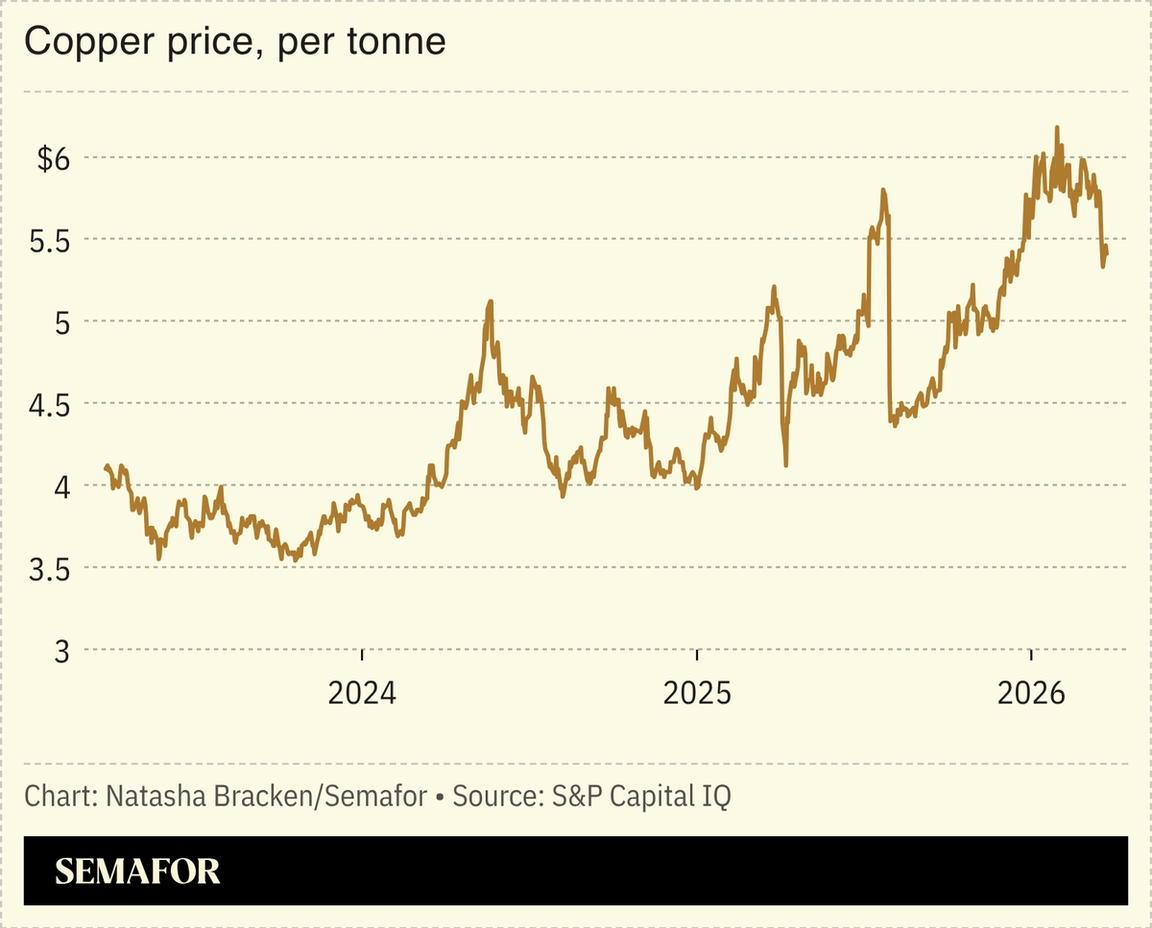 A major global copper shortage is looming, even as mining companies scramble to ramp up production, the top copper boss of Rio Tinto told Semafor. Rio Tinto won a breakthrough legal victory this month allowing the company to move ahead on its massive new Resolution Copper mine in Arizona. Still, it will take until the mid-2030s for that mine to reach full production, Katie Jackson, the company’s chief executive for copper, said on the sidelines of the CERAWeek energy conference in Houston this week. The company is also waiting for its board to approve a plan to expand an existing mine in Utah, and investing in new technologies to extract copper more efficiently from low-quality ore and mine waste. But the AI boom is driving demand up much faster than supply can come online, and Jackson said a gap of about 10 million tons per year — equal to a little less than half of current global consumption — is due to open by the 2030s. “The balance is very challenged,” she said. In the meantime, the industry is struggling with a deficit of copper refining capacity outside of China. The US should do more to promote investment in domestic copper refining, she said. But at the moment, “the current tariff arrangements don’t protect this part of the value chain.” |
|
 New Energy- Amazon and supermarket chain Lidl are working with the UK government to make it easier for consumers to buy and install solar panels that can help cut their electricity bills.
- Solar generators in India are being told to curb their output after the government delayed a plan for coal-fired power plants to lower generation when solar power is high as regulators are yet to agree on coal compensation rules.
Fossil Fuels- Major oil exporters outside of the Middle East, such as Canada and Norway, have been lifted by Iran’s closure of the Strait of Hormuz, and are looking to position themselves as reliable suppliers in a world desperate for energy.
 Finance- Energy supply disruptions have exposed India’s gas systems vulnerability to sudden shocks, leaving the country facing significant economic impacts. Every $10 increase in crude prices can widen India’s account deficit by around $9 billion, estimates show.
- Bezos Earth Fund is backing Gabon’s $200 million plan to protect at least 30% of its land, fresh-water, and marine ecosystems by 2030.
TechMinerals & Mining- Ivanhoe Mines has made the first copper export via the Lobito Corridor, shipping 99.7% pure copper anodes from the Kamoa-Kakula copper complex in the DRC to the Lobito port in Angola. The copper anodes will be shipped to Europe for further processing.
- Also in the DRC, China’s Zijin Mining Group is set to open one of the world’s largest lithium mines this year, which would account for 5% of mined lithium supply when operating at full capacity.
|
|
|


