|
 |




Don’t look now, but there’s yet another major potential energy shock on the horizon: Reuters reported yesterday that Ukrainian drone attacks had forced shutdowns at two major Russian oil export terminals. The war in Iran has been a godsend for Russia’s war economy, permitting more oil exports at higher prices—particularly after the White House eased sanctions on Russian oil companies to help meet global demand. Ukraine has stepped up its attacks on Russian energy infrastructure in response. Happy Thursday.
 |
Not Even Trump Likes Trump’s War
by William Kristol
President Trump was the featured speaker at the House Republicans’ annual fundraiser last night in Washington. As the crowd eagerly awaited their supreme leader’s remarks, Speaker Mike Johnson (R-La.) paused the proceedings for an important surprise announcement. House Republicans had come up with a new honor to bestow on Donald Trump: “And so, tonight, we have created a new award. He is the suitable and fitting recipient of the first-ever America First Award . . . this beautiful golden statue here.”
Trump seemed pleased by the award. Many commentators, noting our president’s enthusiasm for all manner of phony awards, have compared him to a child.
But this comparison is unfair to children. They’ve always seemed to me to have a pretty good nose for phoniness. They often scorn fake awards that they know have been invented to make them feel good. They have more self-awareness than Donald Trump. And what about golden statues? Johnson, a man of the Good Book, must be aware of their dubious reputation, from the Israelites’ golden calf in the book of Exodus to King Nebuchadnezzer’s golden idol in the book of Daniel.
But House Republicans are not interested in following the example of Shadrach, Meshach, and Abednego. They continue to bow down to their leader.
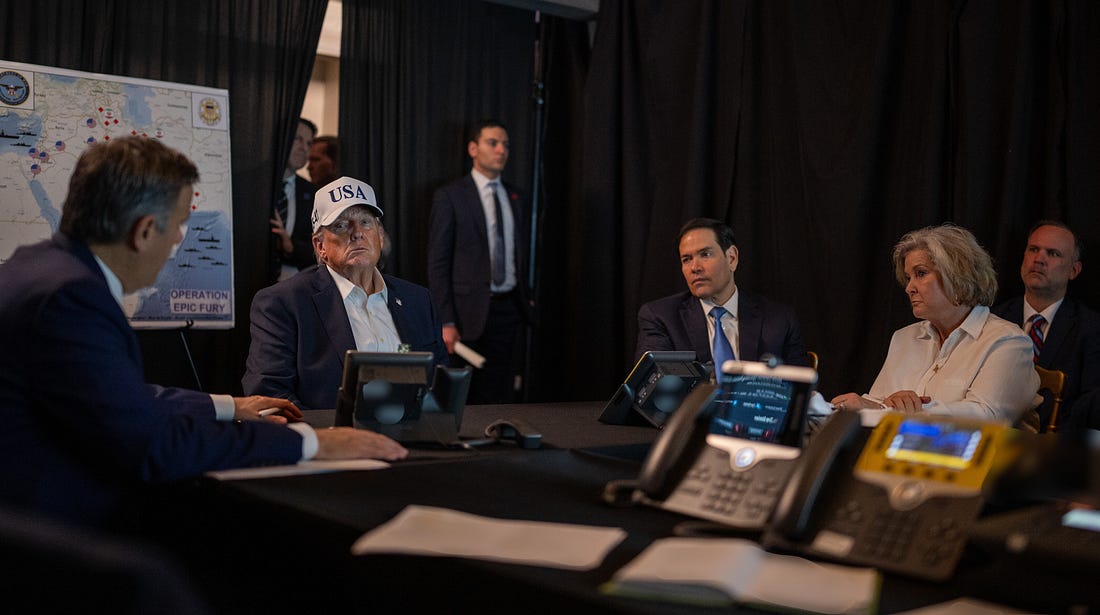
As do their colleagues in the Senate. All Republican senators but one voted once again on Tuesday against requiring congressional support for the war that Trump unilaterally launched, and that he may now be dramatically expanding with troops on the ground.
It’s true that yesterday, after sitting through briefings from Trump administration officials, some GOP members of Congress expressed concerns. Rep. Mike Rogers (R-Ala.), chairman of the House Armed Services Committee, said senior officials had failed to provide clarity about the scope and direction of the military campaign. “We want to know more about what’s going on,” Rogers said. “We’re just not getting enough answers.” His counterpart in the senate, Sen. Roger Wicker (R-Miss.) remarked, “I can see why [Rogers] might have said that.”
So Republicans on the Hill are frustrated. But they’re unwilling to act. Which means this is not just Trump’s war. It is the GOP’s war.
Now, Trump and some Republicans don’t want to call it a war. Trump said last night that he’s avoiding describing the conflict as a “war” because Congress hasn’t authorized it. “I won’t use the word ‘war’ because they say, if you use the word ‘war,’ that’s maybe not a good thing to do. They don’t like the word ‘war,’ because you’re supposed to get approval, so I’ll use the word ‘military operation,’ which is what it really is.”
But in his same speech last night Trump did use the word “war,” saying, “The war essentially ended a few days after we went in.” On Tuesday, Trump had pointed out that “people don’t like me using the word ‘war,’ so I won’t, but the Democrats call it a war.”
Democrats should keep on calling it a war. And they should keep on opposing the war.
For one thing, the war is an ill-conceived idea launched without sufficient preparation and planning. As David French summed it up:
This is not how our democracy should go to war. Trump is not the right man to lead our nation into battle. I see recklessness. I see thoughtlessness. He led America into an unconstitutional war. And now he’s compounding that sin by proving to be every bit as reckless a commander as he is a president.
There’s no reason for Democrats to sound more hesitant in their condemnations of Trump’s war than French.
And if Democrats need some political reassurance, the war really is strikingly unpopular.
A recent survey by the Pew Research Center found that only 38 percent of Americans think the initial decision to use military force was right. Fifty-nine percent think it was wrong. Only 37 percent of Americans approve of Trump’s handling of the conflict, while 61 percent of Americans disapprove. Only 18 percent strongly approve of Trump’s handling of the war, while 44 percent strongly disapprove.
Even Trump, it seem