From Ypres to Paris...
The Doughboy Foundation’s Exclusive
"Over There" Tour, Sept. 27-Oct. 5, 2026 is
an evocative journey through the heart of WWI
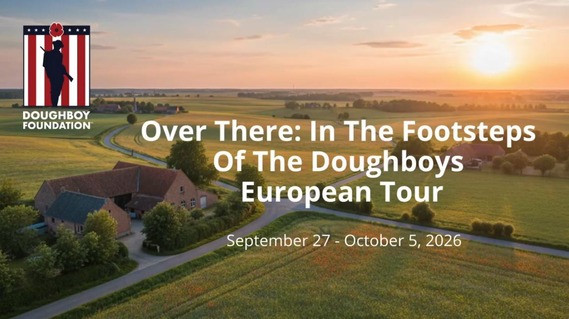
 Have you ever wanted to walk in the footsteps of the Doughboys? To tread the earth where they gave their last full measure, or pay respects at their gravesites? To understand the pivotal moments of the Great War from the vantage point of those who fought it? Here is your chance to embark on an astounding, week-long, curated and guided tour that will offer this once-in-a-lifetime insight into World War I and its impact. The Doughboy Foundation’s Board of Directors invites you to stand with us in the young Doughboys’ footsteps and discover firsthand the war’s important legacy as we travel along history’s hallowed path in remembrance of all who served and sacrificed in World War I. Read Doughboy Foundation Board Chair Denise Van Buren's personal invitation to you, and watch an exclusive video detailing this amazinge journey through the heart of World War I, visiting the hallowed battlefields where heroes were made—from the trenches of Ypres to the Meuse-Argonne Offensive sites.
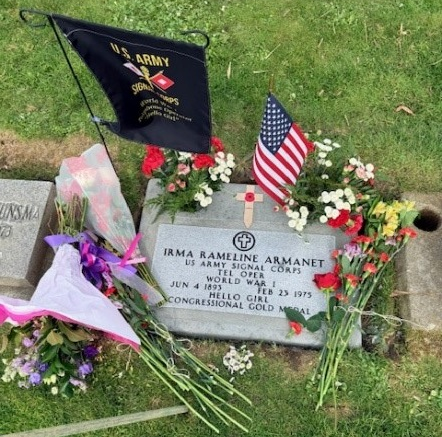 Irma Armanet's new VA grave marker at Holy Cross Cemetery, Colma, CA.
Finding the Hello Girls:
The U.S. Army SIgnal Corps Female Telephone Operators of WWI, known as the Hello Girls, were finally awarded a Congressional Gold Medal in 2024, thanks in large measure to the hard work and diligence of a small group of descendants of Hello Girls and several dedicated researchers. In 2025, the group evolved into the Hello Girls Military Honors and Remembrance Program, a new Special Project of the Doughboy Foundation, with the mission of honoring and preserving the legacy of these 280 women. Part of that mission: ensuring that each woman has an appropriate grave marker showing their military service.
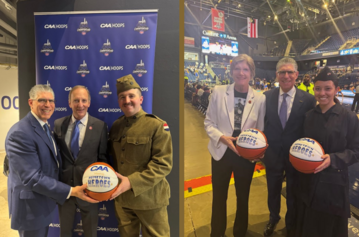
During the 2026 Coastal Athletic Association (CAA) Basketball Championships at CareFirst Arena in Washington, D.C., the Doughboy Foundation continued its proud tradition of honoring those who serve our nation and community. This year’s “Hometown Hero” recognitions highlighted exceptional military and community service during the tournament’s most high-profile matchups. Read more about these big events, and how three great veterans were in the spotlight for their service to the nation, and their contributions to the Doughboy Foundation's mission.
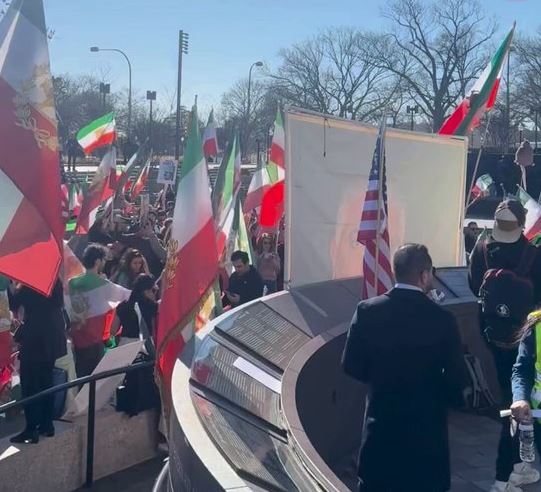
Some hours after the United State’s military strike against the leadership of the Iran regime on Saturday, February 28, a large crowd gathered at the National World War I Memorial in Washington, DC, just across the street from the White House. The gathering waved the traditional Iranian flag, celebrated the U.S. military action, and called for the complete overthrow of the Iranian government. Learn how the selection of the National WWI Memorial as the site of the demonstration may have been happenstance, but the history of modern Iran, like that of so many nations, is inextricably connected to, and still affected by, events of the Great War a century later, making the location of the demonstration very, even if unintentionally, ironic.
A Loaf of Bread A Week
Michael Santoro:
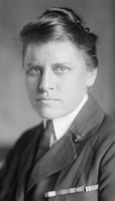
On Monday, Sunday March 22, 2026, Daily Taps at the National World War I Memorial in Washington, DC was sounded in honor of Colonel Julia Catherine Stimson, Chief Nurse of the American Expeditionary Forces in World War I.
When the United States entered World War I, Stimson enlisted as a nurse on May 19, 1917. The Army was desperate for nurses so Stimson worked to enlist nurses into the Army Nurse Corps for service in France. Stimson was stationed at Base #21 Hospital in Roam, France. After briefly leaving the Army to serve as chief nurse of the American Red Cross in France, supervising the 10,000 American Red Cross nurses stationed in France, Stimson returned to the Army as the director of the Nursing Service for the AEF. In this role, Stimson led around 10,000 Army nurses in France. Her work earned her the Distinguished Service Medal and the Red Cross Florence Nightingale Medal. General John J. Pershing cited that her awards were for “exceptionally meritorious and conspicuous service.” |
|
 |
The Daily Taps program of the Doughboy Foundation provides a unique opportunity to dedicate a livestreamed sounding of Taps in honor of a special person of your choice while supporting the important work of the Doughboy Foundation. Choose a day, or even establish this honor in perpetuity. Click here for more information on how to honor a loved veteran with the sounding of Taps.
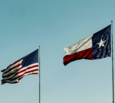
Texas significantly influenced the American war effort during World War I through its manpower, training grounds, and supply networks. The state hosted major camps that prepared thousands of soldiers for overseas combat. Communities near these camps grew at a rapid pace. Farms increased production to support troops, while rail lines carried equipment across the region. As a matter of fact, military demand pushed small towns toward long-term expansion. Business districts formed near camp gates, and new neighborhoods welcomed workers and families. For this reason, many residents today experience the lasting impact of that era. Learn more about why living in a WWI legacy town means seeing history in daily routines, public spaces, and community traditions, and how Texas military history continues to shape identity, growth, and civic pride across generations.
|
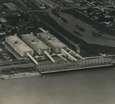
For over a century, the former Bywater Navy base in New Orleans has been a prominent riverfront landmark, and after 92 years of military use and 14 years of uncertainty, its future is finally coming into focus as a mixed-use housing and retail hub anchored by a tech-innovation center. A place of many names since its completion in 1919, the former Naval Support Activity East Bank is made up of three 600-by-140-foot, six-story depots plus grounds so large it has two addresses (officially at 4400 Dauphine Street and paralleling 600-700 Poland Avenue) and two waterfronts (facing the Mississippi River and flanking the Industrial Canal). Learn how the complicated history of this sprawling facility began rather unexpectedly, at the outbreak of what would become World War I.
|
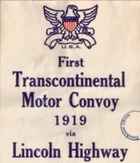
In the summer of 1919, in the immediate aftermath of World War I, a young Lieutenant Colonel—only four years out of West Point—named Dwight D. Eisenhower participated in the first Army transcontinental motor convoy. The expedition consisted of 81 motorized Army vehicles that crossed the United States from Washington, DC, to San Francisco. The convoy was to test the mobility of the military during wartime conditions. As an observer for the Tank Corps, Lt. Col. Eisenhower learned first-hand during the war in France of the difficulties faced in traveling great distances on roads that were impassable and resulted in frequent breakdowns of the military vehicles. Find out how these early experiences influenced his later decisions concerning the building of the interstate highway system during his presidential administration.
|

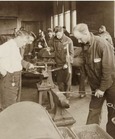
The advent of tank warfare during World War I introduced a totally new battlefield threat to the infantryman. The first operational tank was fielded by the British during the Battle of the Somme in September 1916, and the French developed their own tanks in the spring of 1917. Although slow- moving and plagued by mechanical difficulties, the tanks were relatively safe from rifle and machine-gun fire and struck fear into the average German soldier. The U.S. military also contended with the reality that infantrymen would need an effective arm to defeat tanks. Their idea? Bring more gun. Read more about the U.S armed forces efforts to develop an effective infantry anti-tank weapon during the post-World War I period.
|
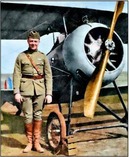
On Nov. 6, 1918, 95th Aero Squadron pilot William Vail engaged nine German Fokker D.VII fighters alone and saved the life of a fellow aviator. Vail’s adversaries peppered his Spad XIII No. 7 with upwards of 150 rounds of machine gun bullets, one or more striking his left leg below the knee, shattering it. He crashed into a farm field and survived only because the soft mud cushioned his impact and enveloped him in an earthen scab that kept him from bleeding to death. His commanders recommended him for both the Distinguished Service Cross and the Medal of Honor. He received the DSC and later the Silver Star and the Purple Heart. The Medal of Honor recommendation vanished into Army bureaucracy and was never seen by Gen. John J. Pershing for adjudication. Learn how, 108 years later, William Vail’s only son is working to finally secure the | |