|
 |
Greetings, and welcome to this week’s edition of Receipts. I’ve struggled in recent weeks to articulate why all the fanboying/girling over Fed Chair Jerome Powell has been so bizarre. It’s partly because people don’t usually pay much attention to the Fed—and if they do, it usually means something terrible is happening. The Fed operates best when normies don’t realize it exists and don’t have to think about it.
But I think it’s more than that. Powell has been involuntarily cast as a scene partner in a political drama. And it’s clearly been awkward for him, and for the Fed, to have liberal pundits, among others, cheering for him to take on Trump. He doesn’t want to be a part of the Resistance.
Meanwhile, Trump has also shafted Powell’s likely successor, Kevin Warsh. After all, Warsh got the nomination by promising to cut rates, which is increasingly difficult to do when Trump is finding new ways to drive up prices.
Are there other nerdy civil servants you think should become folk heroes? Leave them in the comments. And if you’re not already a member of Bulwark+, I hope you’ll consider joining. You can do that right here, at 20 percent off the regular annual price:
–Catherine
Jerome Powell Didn’t Ask for This Sh*t
He doesn’t want to lead the Resistance, and his likely successor is trapped.
|
| ||||||||||||


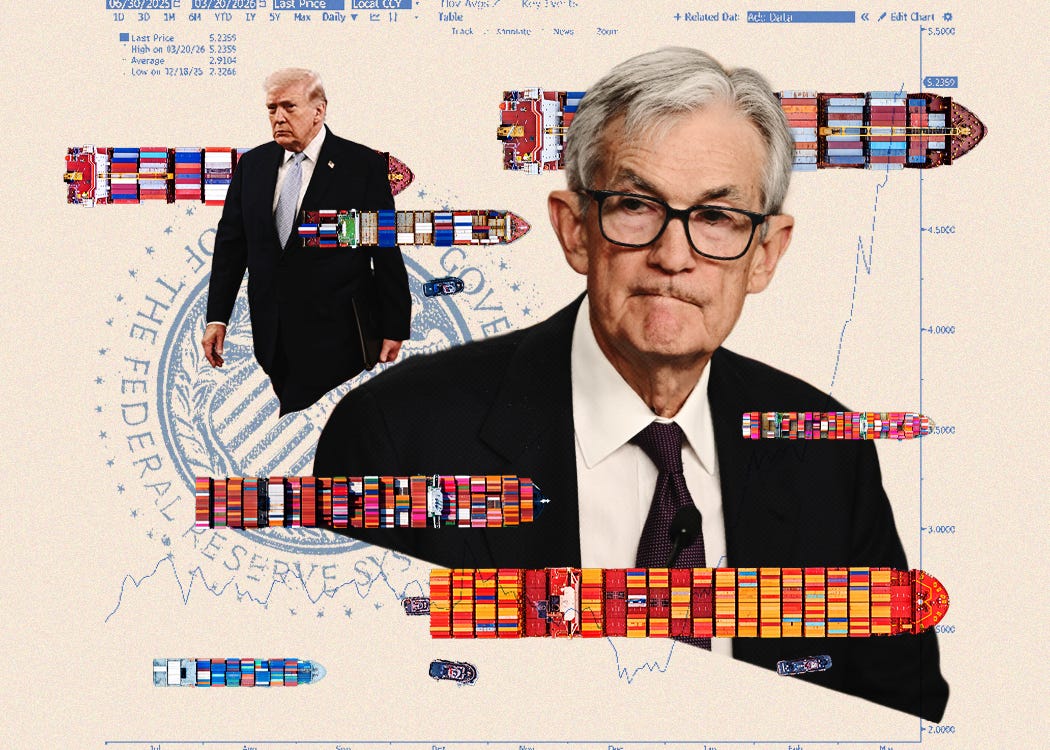 |
MOST PEOPLE THINK ABOUT the Federal Reserve as a dull, technocratic agency. If they think about it at all. Unlike other parts of government, the Fed isn’t trying to make headlines. They’re not trying to have viral moments.
Which is why it’s so weird that Fed Chair Jerome Powell has become something of a folk hero.
The John F. Kennedy Library Foundation announced last week that it would be honoring Powell with its Profile in Courage Award for “protecting the independence of the Federal Reserve . . . despite years of personal attacks and threats from the highest levels of government.”¹
That’s a euphemism for: Trump launched a bogus criminal investigation into Powell to try to bully him into doing Trump’s bidding; and at great personal and professional risk, Powell stood his ground. This unlikely gallantry included some (yes) viral moments, such as a tense exchange with Trump on a hard-hatted tour of the Fed’s renovation project. And Powell’s dry-mouthed, direct-to-camera video, released late on a Sunday night, in which he revealed that the DOJ had threatened to criminally indict him.
The Fed has not released a statement on the award, but confirmed to me that Powell will accept it, and will speak at the May ceremony where he’ll be honored.
For those of us who cover the Fed—as I have for almost two decades now—this has all been super weird. For a few reasons.
First, on the rare occasions that Fed news has gone viral before, it’s never been for anything good. At least I can’t think of anything comparable to this. If normies are sitting around discussing the Fed, and Fed officials are getting memed,² something has usually gone very wrong for the economy, or monetary policy, or both.
Second, Powell does not want to be a leader of the Resistance. Central bankers are nerds who fiddle with interest rates. They sit around debating the value of r*.³ They’re not looking for political battles; in fact, they deliberately duck them, cognizant of the fact that the central bank needs to be politically independent in order to function.
By “politically independent,” I mean not just that Fed officials have to make decisions without regard to politicians’ preferences. They also must be perceived as operating entirely apart from politics. The public needs to believe the Fed is willing to do politically unpopular things, like hiking interest rates if necessary. That credibility—the mere belief that the Fed would willingly play bad cop—meant it rarely had to, and helped keep inflation low for decades.⁴
Powell doesn’t want to be viewed as a friend to Trump; and he also doesn’t want to be perceived as an enemy either. He wants to be seen, rightly, as a nothing to Trump.
This situation is also super weird when you think about the kinds of people and temperaments the central bank tends to attract. The Fed is an institution that operates largely via consensus.⁵ Fed officials are generally not the kinds of personalities looking for public confrontation, or for opportunities to flaunt how brave they are. They’re not looking to win awards for “courage.”
Then again, maybe most people who truly deserve such awards aren’t those who seek them out. Winning an award for “courage” is like the moral equivalent of having a disease named after you. It’s nice to be recognized, I suppose, but maybe not worth going through what you had to go through to get it.
Just as Trump likes making apolitical things political, he also has a knack for forcing people to reveal either their courage or (too often) their cowardice. Powell’s choices have clearly resonated with the American public. If normie Americans are suddenly stans of a 73-year-old investment-banker-turned-technocrat, it’s because the country has been so starved of basic public virtue.
IF POWELL DESERVES OUR ADMIRATION, his presumed successor may soon warrant our pity: Trump has already put Kevin Warsh in a horrible position, and Warsh hasn’t even been confirmed yet.
Trump selected Warsh to succeed Powell as chair of the Fed when Powell’s term ends in May. A lifelong inflation hawk, Warsh nonetheless secured the nomination after declaring his intention to cut interest rates—something you don’t usually do when inflation is high. Trump had made clear this was a prerequisite for anyone wanting the job, after all.