|
Second Evaluation Report (Performance Year 2023)
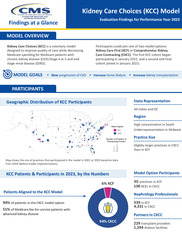
Kidney Care Choices (KCC) is a voluntary model designed to improve quality of care while decreasing Medicare spending for Medicare patients with chronic kidney disease (CKD) Stage 4 or 5 and end-stage renal disease (ESRD).
Participants could join one of two model options: Kidney Care First (KCF) or Comprehensive Kidney Care Contracting (CKCC). The first KCC cohort began participating in January 2022, and a second and final cohort joined in January 2023. The CKCC model option was extended by 1 year and will end December 31, 2027. The KCF model option ended December 31, 2025.
Key Findings:
In its second performance year, the KCC Model led to improvements in quality but an increase in net Medicare spending. Changes in quality and utilization of care in line with model goals include:
-
Increase in use of home dialysis
-
Increase in Optimal ESRD Starts
-
Increase in living donor transplant rates
-
Improvements in information sharing with patients and patient activation
|
The Two Page Overview:
The Report (includes an Executive Summary):
Additional Supporting Materials:
|
|
 |
Evaluation Report (2024 - 2025)
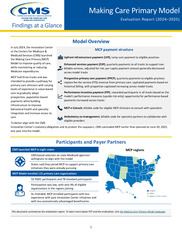
In July 2024, the Innovation Center at the Centers for Medicare & Medicaid Services (CMS) launched the Making Care Primary (MCP) Model to improve quality of care, while maintaining or reducing Medicare expenditures.
MCP had three tracks and was intended to provide a pathway for primary care clinicians with varying levels of experience in value-based care to gradually adopt prospective, population-based payments while building infrastructure to improve behavioral health and specialty integration and increase access to care.
Key Findings:
-
Participation was low, with only 4% of eligible organizations in the regions joining. Low participation would have limited the MCP evaluation’s ability to detect effects.
- CMS provided participants with $37.6 million in MCP-specific payments, as well as non-financial supports.
- Model participants faced substantial barriers to cost reduction and care improvement in the initial year of MCP.
- MCP was not projected to achieve cost neutrality for Medicare until 2027 or 2028 at the earliest and the magnitude of the savings, if any, was expected to be small.
Due to low uptake, a lack of projected savings, and a desire to put resources towards more impactful models, CMS concluded MCP earlier than planned on June 30, 2025, to better align with the CMS Innovation Center’s statutory obligation and to protect the taxpayers.
|
The Two Page Overview:
The Report:
Additional Supporting Materials:
|
|
 |
Report to Congress
The Bipartisan Budget Act of 2018 required a report to Congress (RTC) on utilization and spending of telehealth services related to the expansion of telehealth services for fee-for-service Medicare beneficiaries attributed to applicable ACOs. The ACO telehealth expansion was implemented on January 1, 2020. Within a couple months, COVID-19 Public Health Emergency (PHE) flexibilities allowed any fee-for-service Medicare beneficiary to receive telehealth services at any location, which mitigated the intended effects of the legislation.
Key Findings:
- ACO-attributed beneficiaries’ telehealth utilization and spending sharply increased in 2020 and then decreased but remained higher than prior to the COVID-19 PHE.
- ACO-attributed beneficiaries had higher rates of telehealth use relative to the full fee-for-service Medicare population throughout the COVID-19 PHE.
- Telehealth utilization for ACO-attributed beneficiaries was greater with ACO health care providers than non-ACO health care providers, but ACO-attributed beneficiaries more often sought behavioral health services from non-ACO health care providers.
|
The Report:
Additional Supporting Materials:
|
|
 |
|

