|
 |
Every week, Popular Information shines a light on stories powerful people would rather keep in the shadows. We conduct investigations, uncover new facts, and impact the national political debate. Consider four examples from the last few weeks:
On February 23, Popular Information revealed how, days after Crypto.com donated $5 million to Trump’s Super PAC, the Trump administration intervened on Crypto.com’s behalf in a high-stakes federal lawsuit.
On March 4, Popular Information reported that the Department of Labor was hiring legal interns from Liberty University law school — even if they had poor grades — but only if they were enthusiastic Trump supporters.
On March 16, we uncovered that Jared Kushner broke his pledge not to seek additional funds for his private equity firm during Trump’s presidency.
On March 23, we exposed how HealthEquity, the nation’s largest administrator of health savings accounts, was profiting from the health care crisis while providing few benefits to working Americans.
Popular Information has over 540,000 readers, but only a small percentage support our work as paid subscribers. We could put up a paywall to encourage more people to pay, but we believe access to crucial information should not be limited by income.
Original reporting is time-consuming and expensive. If you value this work and can afford $6 per month or $50 per year, please consider helping Popular Information fight for the truth by becoming a paid subscriber.
New lawsuit alleges DraftKings and FanDuel are digital heroin
“By coordinating their use of immersive marketing, AI, cloud computing, and algorithms customized for every customer, they hijack customers’ brains”
| |||||||||||||||


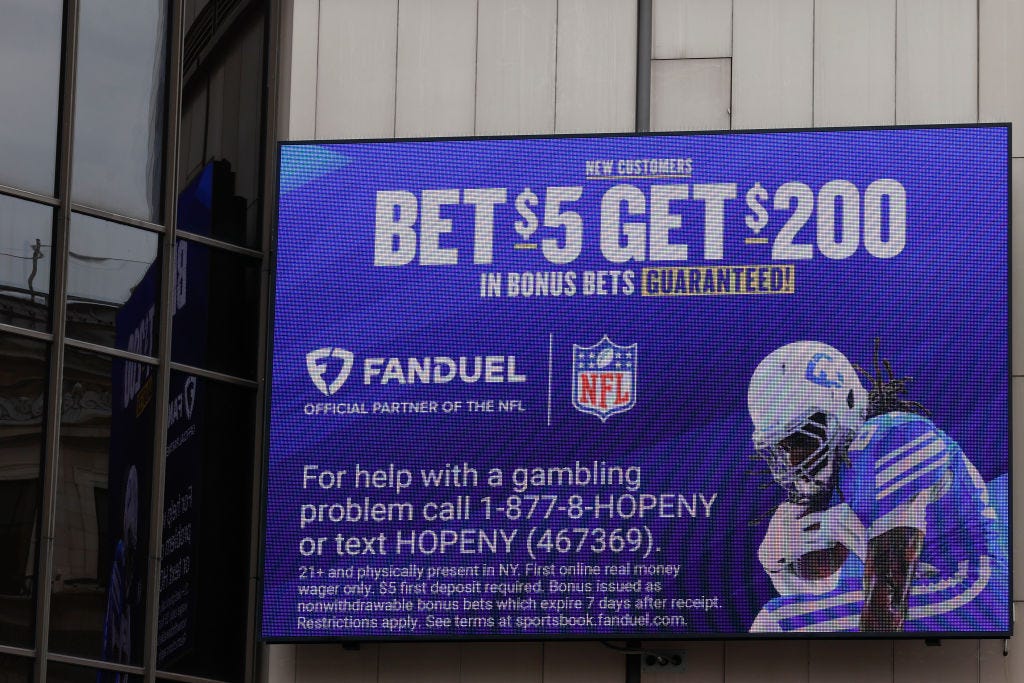 |
A new product liability lawsuit alleges that the online sportsbooks DraftKings and FanDuel use a variety of sophisticated tactics to addict users, comparing their offerings to tobacco, cocaine, and heroin. The case, filed by the Public Health Advocacy Institute (PHAI) at Northeastern University School of Law on behalf of two former gamblers, is being led by Richard Daynard — the same lawyer who secured a $206 billion settlement from the tobacco industry.
Filed in Pennsylvania state court, the lawsuit argues that DraftKings and FanDuel are “defective” products that are fundamentally different from traditional sportsbooks. Specifically, the plaintiffs allege that the two companies “capture every aspect of a customer’s interaction in real-time through automated analytical tools, and then process the data through predictive algorithms to generate bets that are optimized to stimulate compulsive gambling.”
When sports gambling was restricted to brick-and-mortar locations, “a person had to physically go to a casino or a sports bookmaker’s establishment with their money in hand to place their bet.” That meant gamblers were offered a limited number of bets — generally on the winner of the game or the total points scored — that had to be placed before the game started. The outcome, crucially, was decided hours later when the game concluded.
DraftKings and FanDuel, on the other hand, use advanced analytics to offer near-instantaneous real-time bets throughout every game. In a typical NFL game, for example, the companies take real-time bets on “whether the next play in the game will be a passing or running play, or whether the outcome of the next play will be yards gained, yards lost, an incompletion, a touchdown, or a turnover.”
Across all sports, DraftKings offers an average of 517 different bets per game. In-game prop bets accounted for “54% of the total amount of money wagered on the DraftKings Sportsbook App” in 2025. According to the lawsuit, these in-game betting opportunities are “intentionally designed and implemented to be as addictive as possible, to ensure that customers spend as much time as possible in the ‘dark flow’ of gambling, and to prevent customers from understanding the risk of addiction that attends these products.”
The lawsuit also names the NFL and its data partner, Genius Sports, for providing the statistics to sportsbooks that enable in-game bets.
“These defendants, including the NFL, are engaging in a coordinated effort to convert ordinary sports fans into nonstop gamblers,” PHAI Executive Director Mark Gottlieb said. “By coordinating their use of immersive marketing, AI, cloud computing, and algorithms customized for every customer, they hijack customers’ brains.”
How users get hooked
One of the plaintiffs, Christopher Sage, had been gambling on sports since 2003, when he was a senior in high school. At that time, to place a bet, he had to travel to a physical sportsbook. Sage gambled periodically on football and tennis in this way for 15 years, and it “was a sustainable recreational activity in his life that did not create any friction or problems.”
This changed in 2018, when a Supreme Court decision allowed Pennsylvania to legalize online sports gambling. Sage signed up for DraftKings and FanDuel and “became consumed by the rapid pace of the microbets and became uninterested in making a bet that did not resolve instantaneously.” He would find a tennis match and “bet on every single point.” He also placed in-game wagers on “NFL football, soccer, and baseball.” If no U.S. games were available, he would place bets on individual points of international table tennis matches.
Although he had never previously had a gambling addiction, Sage “soon found himself betting nearly 24 hours per day, 7 days a week.” If he set his phone down for a moment, the DraftKings and FanDuel apps would quickly alert him to “various betting opportunities that were personalized to him” or lure him back to the action with “various promotions, profit boosts, and customized bets.”
As a result, Sage “soon became unable to pay his bills,” and his truck was repossessed twice. Sage “started to lie to everyone in his life, including his wife, to hide the depth of his gambling addiction and scope of his financial losses.” He borrowed $40,000 from family members and another $25,000 from loan sharks. In total, Sage “made more than $1,645,000 worth of wagers on the FanDuel Sportsbook App” — almost entirely in in-game bets — and lost more than $133,000. On DraftKings, Sage bet another $360,000 and lost about $42,000.
The other plaintiff, Terry Thompson, suffered even greater losses. Thompson paired in-game betting on football games with “parlays.” In a parlay, gamblers combine various individual bets (known as “legs”) to secure a higher theoretical payoff — but must win every individual leg to win. The lawsuit alleges parlays, which are heavily promoted by DraftKings and FanDuel, are “a particularly dangerous and addictive form of gambling…because of the ‘near-miss’ effect.” Gamblers frequently believe they just missed out on a huge payday, correctly predicting, for example, three of the four legs.
A 2009 University of Cambridge study found that “near-misses” increase the desire for more gambling through the “recruitment of brain reward circuitry.” The lawsuit alleges that DraftKings and FanDuel “supercharge addiction by combining the dopamine payoffs associated with fast-resolving in-game bets with the psycholog