|
 |




There’s a natural ebb and flow to Donald Trump’s cycle of threats and walk-backs against Iran. On Friday, he blinked for a second time on his supposed ultimatum for Iran to reopen the Strait of Hormuz, announcing that his deadline—originally a 48-hour window that Trump had already extended by five days—would be extended again until April 6. But this morning, he was back to rattling his saber, with some new war-crime threats thrown in for good measure: If Iran did not reopen the strait, Trump said, “we will conclude our lovely ‘stay’ in Iran by blowing up and completely obliterating all of their Electric Generating Plants, Oil Wells and Kharg Island (and possibly all desalinization plants!), which we have purposely not yet ‘touched.’”
Blessed Holy Week to all observing it. Happy Monday.
 |
The King’s Congress
by William Kristol
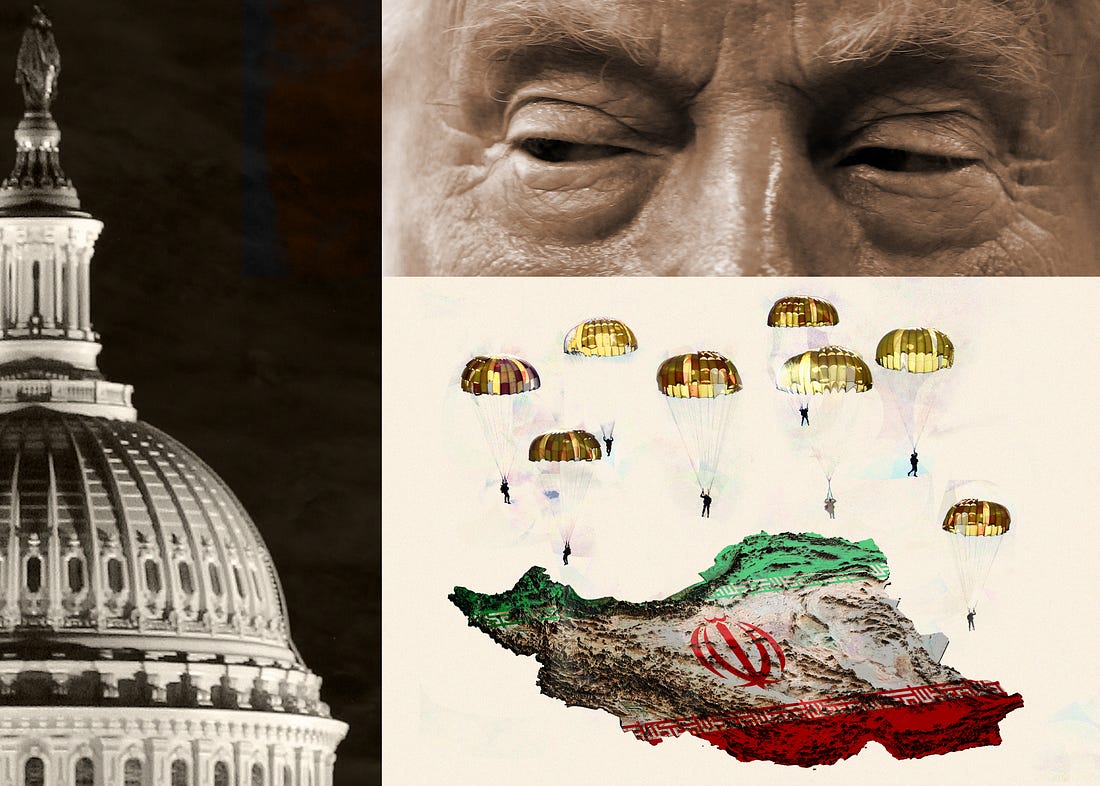
We’re entering the second month of President Trump’s unauthorized war in Iran. Thousands more U.S. troops are being rushed to the Middle East.
Where, you may ask, is Congress?
Remember Congress? It’s the branch discussed in the first article of the Constitution. There it’s charged with the responsibility “to declare war,” “to raise and support armies,” and “to make rules for the government and regulation of the land and naval forces.”
Congress is in recess. Until mid-April.
Why not? So far, the Republican majority that controls Congress has blocked it from exercising its authority over matters of war and peace. We’re a month into the war and we haven’t even had public hearings, with testimony and questioning of administration officials. Democrats’ attempts to invoke congressional power and their pleas for congressional oversight have been waved aside.
Combat operations on Iranian soil may well be imminent. On Saturday, Dan Lamothe reported in the Washington Post that “The Pentagon is preparing for weeks of ground operations in Iran, U.S. officials said, as thousands of American soldiers and Marines arrive in the Middle East for what could become a dangerous new phase of the war should President Donald Trump choose to escalate.”
How can members of Congress—yes, even Republican members of Congress—read that and not think: What the hell about us? This shouldn’t be the president’s decision alone. We need a say here. We need to get back to town, hold hearings, have debates in depth on the floor, and vote on various measures on the war in general and on ground troops in particular.
Some members of Congress are thinking this, and saying so. But not enough are saying it loudly or insistently or urgently enough. The public surely deserves more than occasional cryptic and contradictory comments from the president and his advisers. Both Congress and the American people are now entitled to hear the arguments for ground troops set out formally and publicly by administration officials.
Perhaps Congress will find the arguments for U.S. troops on Iranian soil convincing. I’ve tried hard to find the best arguments for ground troops and to speak with knowledgeable experts about them, and they seem utterly unconvincing to me.
More importantly, those arguments have so far been unconvincing to the American people. A survey conducted from March 19–23 by the Associated Press and the National Opinion Research Center at the University of Chicago found 62 percent of the American public opposed to deploying U.S. troops on the ground to fight Iran. Only 12 percent were in favor, and 26 percent were uncertain.
But perhaps the public could be convinced to change its mind. And in any case, members of Congress have an obligation to act as they think best, not simply to follow their constituents’ views. But they do have an obligation to act. And that obligation remains no matter how eager the executive branch is to act on its own. To the contrary: When the executive is eager to ignore Congress is precisely when Congress most needs to step up.
Abraham Lincoln served one term in the House of Representatives, from 1847 to 1849, during which he opposed President Polk’s decision to go to war with Mexico. In an exchange of letters debating the issue with his friend and law partner, William Herndon, Lincoln characterized Herndon’s pro-executive argument defending Polk as this: When the president judges it necessary, he can invade another country. And “whether such necessity exists in any given case, the President is to be the sole judge.”
Lincoln warned that if you allow the president this, “you allow him to make war at pleasure.” He continued,
The provision of the Constitution giving the war-making power to Congress, was dictated, as I understand it, by the following reasons—Kings had always been involving and impoverishing their people in wars, pretending generally, if not always, that the good of the people was the object—This, our convention understood to be the most oppressive of all Kingly oppressions; and they resolved to so frame the Constitution that no one man should hold the power of bringing this oppression upon us—But your view destroys the whole matter, and places our President where Kings have always stood.
Donald Trump is now involved in what Lincoln considered the “the most oppressive of all Kingly oppressions,” placing himself “where Kings have always stood.” Lincoln was very much a No Kings man, and Democratic leaders in Congress claim to be sympathetic to today’s message of No Kings, for which millions of Americans rallied Saturday. But No Kings isn’t a wish or a sentiment. It’s an imperative and a responsibility.
Democratic members of Congress—even if joined by a few constitutional Republicans—may not be able to stop Trump. They may not even be able to get Congress to reconvene urgently. But they may be able to raise enough of an outcry to deter Trump from deploying ground troops, which would itself be a service to the nation. In any case, our elected officials have an obligation not to sit by while a wannabe King plunges us deeper into an unwise and unconstitutional war.