Pakistan, Turkey and Egypt step up
 

Gulf Currents

Gulf Currents


By Andrew Mills, Deputy Bureau Chief, Gulf 

U.S. President Donald Trump signalled a possible U.S. drawdown from Iran, telling Reuters on Wednesday that Washington would be “out pretty quickly” but ready to return for limited strikes if needed, even as he claims Iran is now incapable of developing nuclear weapons.  

The remarks come as thousands of U.S. troops from the 82nd Airborne Division started arriving in the Middle East, underscoring the tension between talk of an off-ramp and Washington’s expanding military options as the war enters its fifth week. 

In Gulf Currents this week, signals of a U.S. off-ramp contrast with troop deployments, oil market volatility and rising regional threats, underscoring how the war is reshaping diplomacy, markets and daily life across the Middle East. 


Top headlines from the region

  • How an Indian LPG tanker escaped Hormuz via an unusual route
  • When do attacks on civilian installations amount to war crimes?
  • France suspects link to pro-Iranian group in foiled BofA Paris plot
 

News briefing

  • Oil prices slipped on Wednesday as investors weighed mixed signals from Washington over how soon the Iran war might end against continued uncertainty over supply disruptions. Brent and U.S. crude fell after Trump suggested the United States could exit Iran “pretty quickly,” but analysts warned that energy flows through the Strait of Hormuz would be slow to recover even in the event of a ceasefire, with OPEC output already sharply lower and supply risks still skewed to the upside. 
  • Iran’s Revolutionary Guards said they would target U.S. companies operating in the Middle East in retaliation for attacks on Iran, according to state media. The IRGC named 18 firms — including Microsoft, Google, Apple, Tesla and Boeing — warning their regional assets could be hit starting Wednesday evening. 
  • Dubai-based airline Emirates said Iranian nationals are currently barred from entering or transiting the United Arab Emirates, according to a notice on its website. The move is likely to have a wide impact given that tens of thousands of Iranians live and work in the UAE, though Flydubai said Iranians holding UAE “Golden Visas” are exempt and can still enter and transit the country.


As Iran war drags on, new mediators step forward

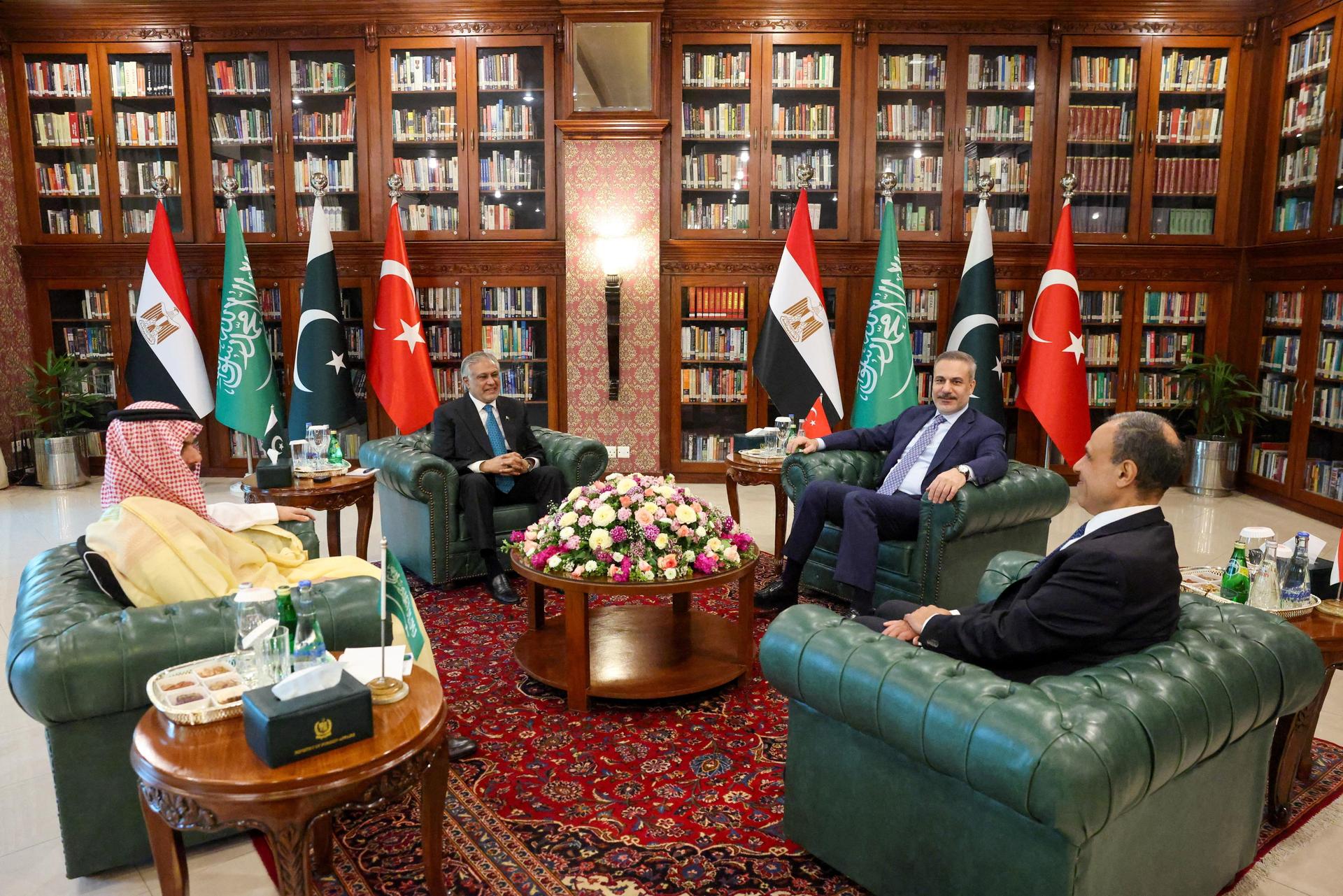
Foreign Ministers Badr Abdelatty of Egypt, Prince Faisal bin Farhan Al Saud of Saudi Arabia, Ishaq Dar of Pakistan and Hakan Fidan of Turkey meet to discuss regional de-escalation, amid the U.S.-Israel conflict with Iran, in Islamabad, Pakistan, March 29, 2026. Muammer Tan/Turkish Foreign MinistryHandout via REUTERS

As fighting between the United States, Israel and Iran grinds into its second month, a diplomatic track is coming into sharper focus — one that was being assembled well before the first missiles were fired. 

Pakistan, Turkey and Egypt have emerged as the most visibly active intermediaries, forming an unusual grouping outside the Gulf states that have traditionally anchored Iran diplomacy. Their growing prominence reflects pre-war manoeuvring and a shared advantage: working channels to Tehran alongside closer ties to U.S. President Donald Trump’s administration. 

That dynamic was on display last week when Pakistan hosted foreign ministers from Turkey, Egypt and Saudi Arabia in Islamabad to discuss regional de-escalation and proposals to reopen the Strait of Hormuz. Ideas floated to Washington included a Suez Canal-style fee structure or a consortium to manage shipping flows — confidence-building steps that could feed into efforts to secure a broader ceasefire. Two days later, Pakistan’s foreign minister travelled to Beijing to seek Chinese backing. 

Turkey had been pushing for a multilateral diplomatic format even before the war, seeking to host talks aimed at reviving an Iran deal. Those efforts were derailed when Tehran opted at the last minute to shift discussions back to Oman. 

Egypt’s role has been quieter but steady. Foreign Minister Badr Abdelatty has built up regular diplomatic contact with Iran’s foreign minister Abbas Araqchi in the years leading up to the war, reflecting Cairo’s increased engagement on the Iran file. Egypt and Iran have had rocky relations for decades, moving only early this year to restore diplomatic ties after decades of fitful engagement. 

Pakistan, meanwhile, has moved decisively into the spotlight. Senior officials have stepped up contacts with Trump administration figures, with army chief Asim Munir in regular touch – Trump has called him his “favourite field marshall.” Islamabad has offered to host U.S.–Iran talks, leveraging its border with Iran, its large Shi’ite population and defence ties with both Saudi Arabia and Turkey, to position itself as a key channel. 

All three countries are also under mounting economic strain from the war, which has disrupted trade, tourism and energy supplies. In Egypt, authorities ordered shops and cafés — hallmarks of famously nocturnal Cairo — to close by 9 p.m. to conserve electricity. 

Taken together, these shifts suggest a mediation landscape being reshaped by the war, with non-Gulf actors stepping forward as traditional channels strain. Oman, which hosted U.S.–Iran talks until shortly before the conflict, has slipped behind after U.S. officials publicly criticised Muscat’s foreign minister. Qatar, long a backchannel to Tehran, has said it cannot play that role while under attack, even as its emir has embarked on diplomacy with Gulf Arab neighbours. 

The result is a diplomatic map that looks markedly different from past Iran crises — and one that may shape any eventual off-ramp from the conflict.


Chart of the week


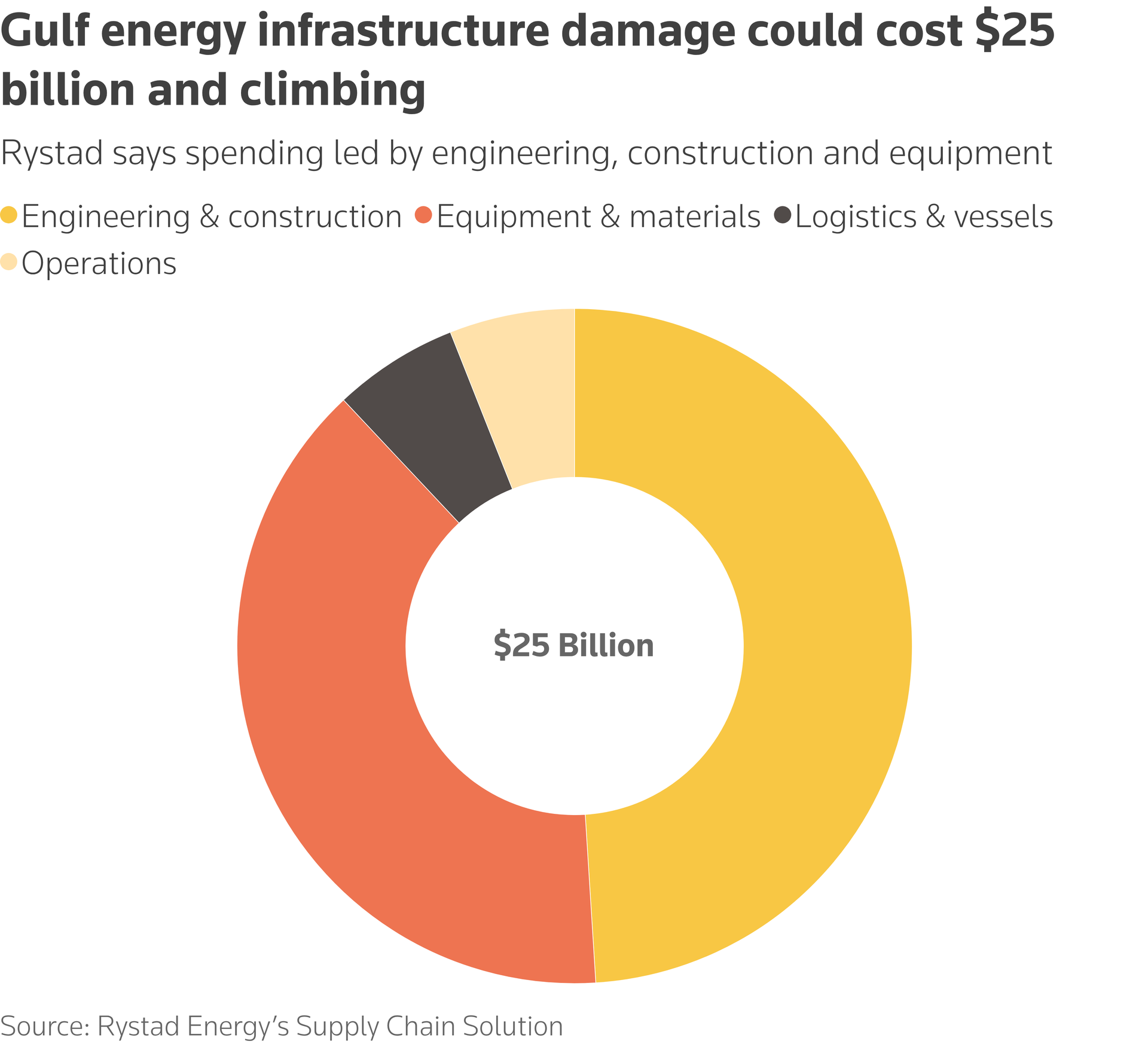
The conflict is weighing on activity now, but is expected to support future demand, as refineries will need repairs once export routes are restored. Energy infrastructure repair costs in the Middle East have reached at least $25 billion, according to Rystad Energy. Read more.  


The last wave: Iran war hits makeup industry 

Visitors browse stalls at the beauty industry Cosmoprof trade show, in Bologna, Italy, March 26, 2026. Picture taken with a mobile phone. REUTERS/Elisa Anzo


Even the beauty industry, built on gloss and glamour, is not immune to the grind of war. The Iran conflict is squeezing cosmetics supply chains from plastic jars to lipstick tubes. 

At Italy’s sprawling Cosmoprof trade fair in Bologna last week, executives warned that higher oil prices, shipping disruptions and Iran’s blockade of the Strait of Hormuz were driving up costs and delaying deliveries. 

Containers are stuck, routes are longer and some shipments are being rerouted by rail or even air, pushing expenses higher. Italian cosmetics group Kiko estimates an extra 1.5 million euros in logistics costs this year alone. 

Packaging suppliers are scrambling for plastic resin, while manufacturers say lead times have stretched from weeks to months. 

With inflation already biting, executives warned the conflict risks becoming a “perfect storm” for both producers and consumers. 


This newsletter was edited by Alexandra Hudson and produced by Rawan Yaghi.