What matters in AI this week |
|
|
OpenAI has just raised $122 billion in what is likely the largest-ever fundraising round in Silicon Valley history. That kind of cash should show you that the richest, most sophisticated investors in the world have ample faith in the ChatGPT maker, now worth $852 billion. What’s actually happening: OpenAI is scrambling to make up for lost time.
In the past six months, the company has twice redrawn its product roadmap because of threats posed by rivals, first by Google and now Anthropic. Some industry watchers now predict that Anthropic’s pace of revenue growth will eclipse that of OpenAI within a couple of months.
That prospect has sent OpenAI running to redirect resources to its own coding product, Codex, as well as to teams building tools for businesses - so far two of the most obvious opportunities for OpenAI to generate revenue and justify its valuation. That inevitably means killing off some of OpenAI’s most high-profile projects. Case in point: Sora.
The news to shut down the AI video app came as a shock to many people involved in Sora – including Disney, which inked a $1 billion deal tied to Sora in December. In fact, Disney and OpenAI employees were working side-by-side on a Sora-related project until 7:30 pm or so the night before Sora was canceled, my colleague Dawn Chmielewski and I reported last week. From one angle, these are the moves of a startup moving on to more promising new bets. But the Disney episode also shows how messy OpenAI’s latest pivot could be. Read on to learn more about OpenAI’s new strategy.
Do you think OpenAI’s strategy to focus on enterprise and coding will pay dividends? Share your thoughts by emailing me or following me on LinkedIn. Forward this newsletter to your friend who would benefit from weekly news and insights on AI. They can also subscribe here.
|
|
|
Read our latest reporting in tech and AI: |
|
|
‘Double Down and Avoid Distractions’ |
CEO of OpenAI Sam Altman speaks during the 2026 Infrastructure Summit of government officials, corporate executives, and labor leaders, in Washington, D.C., U.S., March 11, 2026. REUTERS/Kylie Cooper/File Photo |
For a long time, ChatGPT was the undisputed leader of the AI pack. And as OpenAI’s star rose, so did its coffers and opportunities.
Then, in late 2025, OpenAI declared a “code red” after Google released its latest Gemini model to great fanfare. Then, Anthropic managed to catch OpenAI off-guard with Claude Code, a popular coding product that sent OpenAI scrambling to pour resources into its own coding tool, Codex.
The back-to-back crises have forced OpenAI to reckon with what had become a sprawling empire of loosely correlated projects that often competed for talent, computational power and other resources.
“Companies go through phases of exploration and phases of refocus; both are critical,” said Fidji Simo, one of OpenAI’s senior executives. “But when new bets start to work, like we're seeing now with Codex, it's very important to double down on them and avoid distractions. Really glad we're seizing this moment.”
The embrace of focus is a far cry from the OpenAI of just six months ago.
At that point, OpenAI was working on everything: AI-generated video, consumer devices, shopping and ads for ChatGPT. It struck a deal with Mattel to hook Barbie up with ChatGPT. Executives negotiated more than $1 trillion worth of AI infrastructure deals and the finance team started exploring the possibility of going public to the tune of a trillion dollars.
“OpenAI is attempting to excel simultaneously at every level of the stack and across every customer segment,” Leonis Capital, a fund founded by a former OpenAI researcher, wrote in a report last year. “But the breadth also raises a core risk: loss of focus.” |
|
|
Altman argued that what looked like a disparate slew of projects was actually all part of one effort to build artificial general intelligence, or AGI - the holy grail. It was important to embrace a variety of bets, he said, because moments like this don’t come along very often. OpenAI is now reversing course.
After announcing its epic fundraising round on March 31, the company flicked at this newfound approach. It confirmed that it was now building a superapp that would bundle ChatGPT with the company’s other tools including Codex. “Users do not want disconnected tools,” the company wrote. “They want a single system that can understand intent, take action, and operate across applications, data, and workflows.”
The company statement also reiterated that this was a rare moment in history and an important opportunity for OpenAI itself. “Moments like this do not come often.” |
|
|
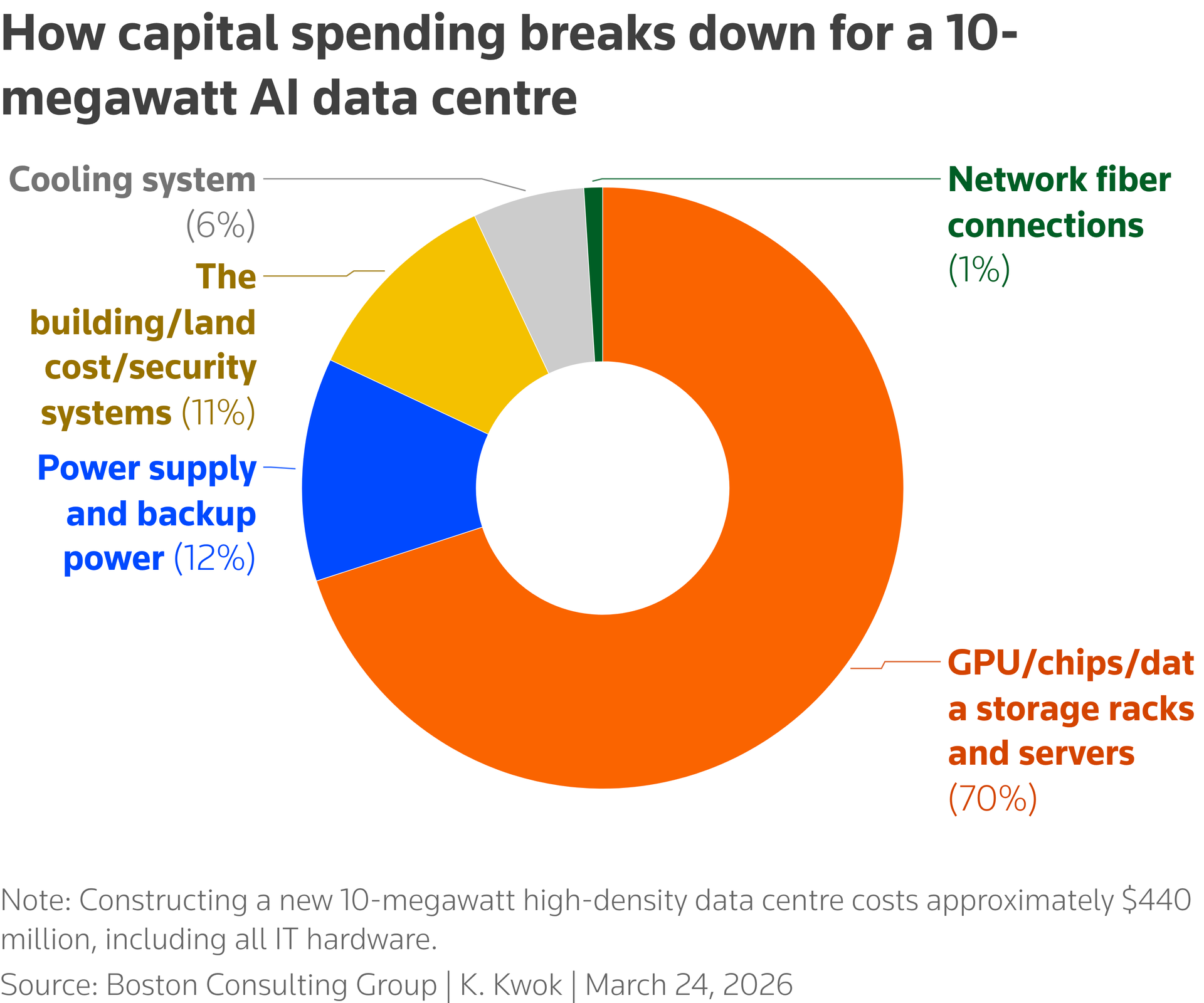
The prevailing fear among investors is that technology firms will spend hundreds of billions – or even trillions of dollars – on building AI infrastructure only to see demand flop. But there’s another, more immediate issue: physics.
Four companies – Amazon, Microsoft, Alphabet and Meta – are projected to spend about $630 billion in 2026, Morgan Stanley estimates. That equates to roughly 2.2% of U.S. GDP. The bulk of that money will be spent on servers and graphics processing units i.e. chips designed by Nvidia. Land accounts for 6% of the cost, depending on the location.
But the rest? It’s buildings, networking equipment, security – and most importantly, power. And these aren’t trivial details, my colleague at Breakingviews, Karen Kwok, says.
Let’s examine power. Securing a connection to the public grid in major hubs like London can now take up to a decade. You can turn to more remote areas like Abilene, Texas – which I visited last fall – but in those areas, skilled labor is often scarce. A third option is for data centers to generate their own power. Suitable gas turbines are more or less sold out until 2029. |
|
|
This newsletter was edited by Rosalba O'Brien |
|
|
| |
|
|
|
Reuters Artificial Intelligencer is sent once a week. Think your friend or colleague should know about us? Forward this newsletter to them. They can also sign up here.
Want to stop receiving this email? Unsubscribe here. To manage which newsletters you're signed up for, click here.
This email includes limited tracking for Reuters to understand whether you’ve engaged with its contents. For more information on how we process your personal information and your rights, please see our Privacy Statement.
| | | |
|
|
|