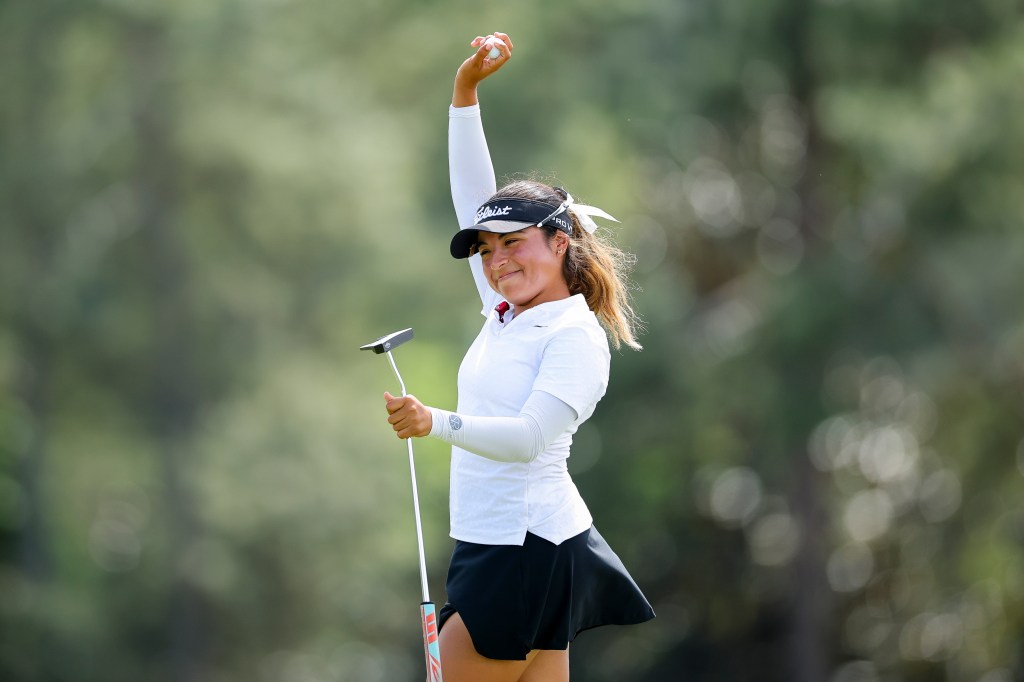
This past weekend, thousands of spectators arrived in Augusta, Georgia for a once-in-a-lifetime experience. They descended on Augusta National Golf Club, the uber-elite course that is home to the Masters. They locked their phones away for the day to comply with the course’s strict rules, ate $1.50 pimento cheese sandwiches, and lined up for hours to purchase Masters merch from the club’s stores. And they watched women’s golf.
Seven years ago, Augusta National launched the Augusta National Women’s Amateur, or ANWA. It’s a three-day tournament of the world’s top amateur female golfers that culminates in a final round on the course. The splash that Augusta devotes to the event, which takes place just before the Masters, is remarkable when you consider its history. For decades, the club was known for its exclusion of female members. (It would change its policy “at the point of a bayonet,” the club’s former chairman once said.) It was only in 2012 that Condoleezza Rice and Darla Moore
were admitted as its first.
Throughout Augusta’s long catch-up with modernity, the Masters’ sponsors have played a role in pushing the club forward. Ginni Rometty’s appointment as CEO of
IBM in 2012 helped
reignite a debate about women and Augusta; IBM was a major Masters sponsor and her predecessors as CEO had all been invited to be members.
Today, Mercedes-Benz is among the sponsors ensuring that ANWA gets a spotlight comparable to the Masters’. I was in Augusta this weekend with Mercedes-Benz CMO Melody Lee, who every year invites a group of female executives to join her for ANWA weekend. Mercedes-Benz has been sponsoring the Masters for almost 20 years; the 144-year-old automaker came on as an inaugural sponsor of ANWA seven years ago. “You can’t afford to follow just trends and buzz and experiment lightly when you’ve got a brand to take care of for 144 years,” Lee says. And yet Mercedes-Benz was excited to sponsor a brand-new property in 2019—to some brands, maybe a risk. “It’s really important to have long-term partnerships in which we build equity in the sport. You need leadership in the sport. And you need brands to underwrite it as well.” AT&T,
Bank of America, IBM, and Rolex are ANWA’s other presenting partners.
Seven years in, the impact of that investment was clear. Sure, some fans probably attended for the chance to see Augusta in person. But most were devotedly watching the field of amateurs compete. The night before the final round, we got to hear from Carla Bernat Escuder, a 22-year-old Spanish golfer who
won last year’s tournament. She said she heard from 2025 Masters champion Rory McIlroy, comparing the putts
they both sank to win that year. This year, 19-year-old Maria Jose Marin
won the tournament.
Augusta still doesn’t have a tournament for female pros, so the amateur is the main event for women’s golf. Augusta’s reasoning was that running an amateur tournament helps grow the game and support the next generation of female golfers, and the club has a long history of supporting amateurs. ANWA is a unique amateur tournament for young female golfers—rising male golfers really don’t have anything like it.
While I haven’t been to the Masters itself, it’s hard to imagine a crowd more excited than what I saw this weekend. And it wasn’t just for Augusta. It was for an amazing field of female golfers who are hopefully just at the beginning of other opportunities like this throughout their careers as their sport grows.
Emma Hinchliffeemma.hinchliffe@fortune.comThe Most Powerful Women Daily newsletter is Fortune’
s daily briefing for and about the women leading the business world. Subscribe here.