| | In this edition, announcing Semafor World Economy speakers, and bankers are worried about what comes͏ ͏ ͏ ͏ ͏ ͏ |
| |  | Business |  |
| |
|
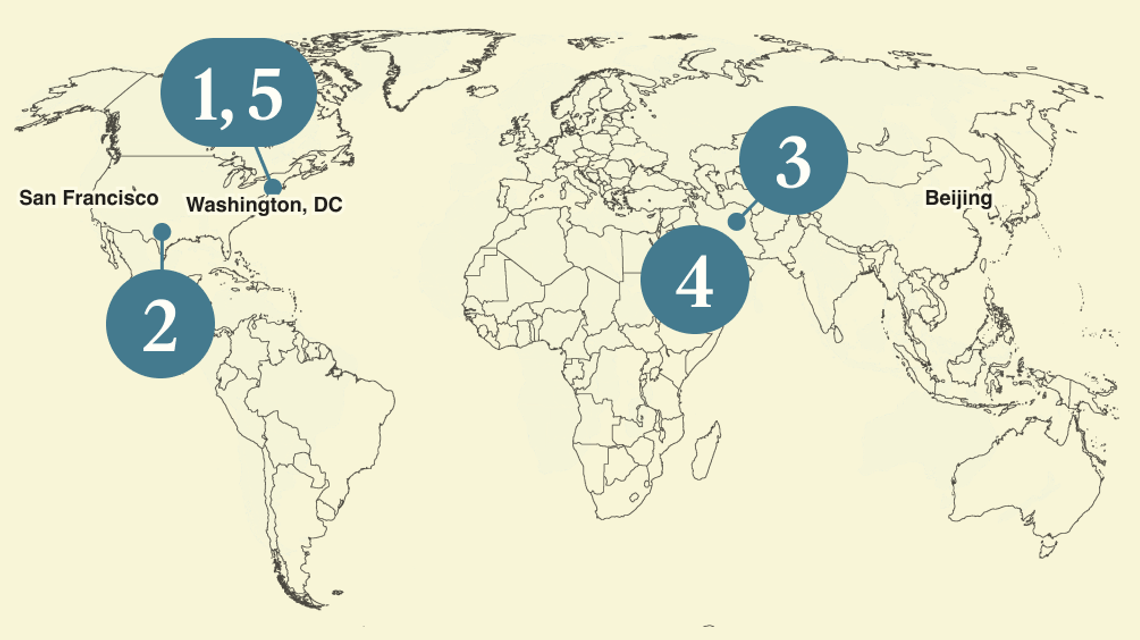 - Semafor World Economy
- SpaceX IPO fix
- Oil’s historic slide
- Gulf + private credit collide
- Airline M&A runway cleared?
|
|
 “Things that were previously held to be sort of unassailable truths are now coming into question,” a16z partner David Ulevitch told me last month. He was making the point that previously uninvestable sectors — like hardware, long ignored by venture capital firms — were becoming attractive because of underlying technological shifts. But the last few weeks have shown that the gloomier inverse is also true. A generation of kids who learned to code are being supplanted before they’ve even hit their 20s. Enterprise software was the most durable business model of all time, until AI arrived. Loans to those companies were underwritten on the basis of revenue with the assumption that profits would materialize; they didn’t and cans were kicked. In 2007, the thinking was that a mortgage in Montana didn’t have anything to do with a mortgage in Maine; oops. Here’s another one to watch: The fastest-growing type of bank lending over the past decade has been loans to private-credit firms, secured by the value of those firms’ own loans. That $1.3 trillion pot is, as Advent’s managing partner neatly told me a while back, “leverage on leverage.” The portfolios are diversified, and banks lend 40 or 50 cents on the dollar, which leaves some room for things to go badly before they lose money. But that’s what lenders said about mortgage bonds in the run-up to 2008. They built creaky securities to withstand losses of 10% or so, then watched prices fall by twice that or more. For the moment, concerns about liquidity in private credit — retail investors want their locked-up money out — have obscured the more important question: are some of the underlying loans bad? (I’ll be putting that question squarely to Blue Owl co-CEOs Marc Lipschultz and Doug Ostrover on stage at Semafor World Economy next week in Washington.) We’ll ask them and hundreds of other CEOs next week about assumptions we’re making today that could prove disastrously wrong. Risk underwriting has the same problem as AI models: garbage in, garbage out. Correction: Due to an editing error, Liz’s column on Tuesday misattributed comments from OpenAI to Anthropic. |
|
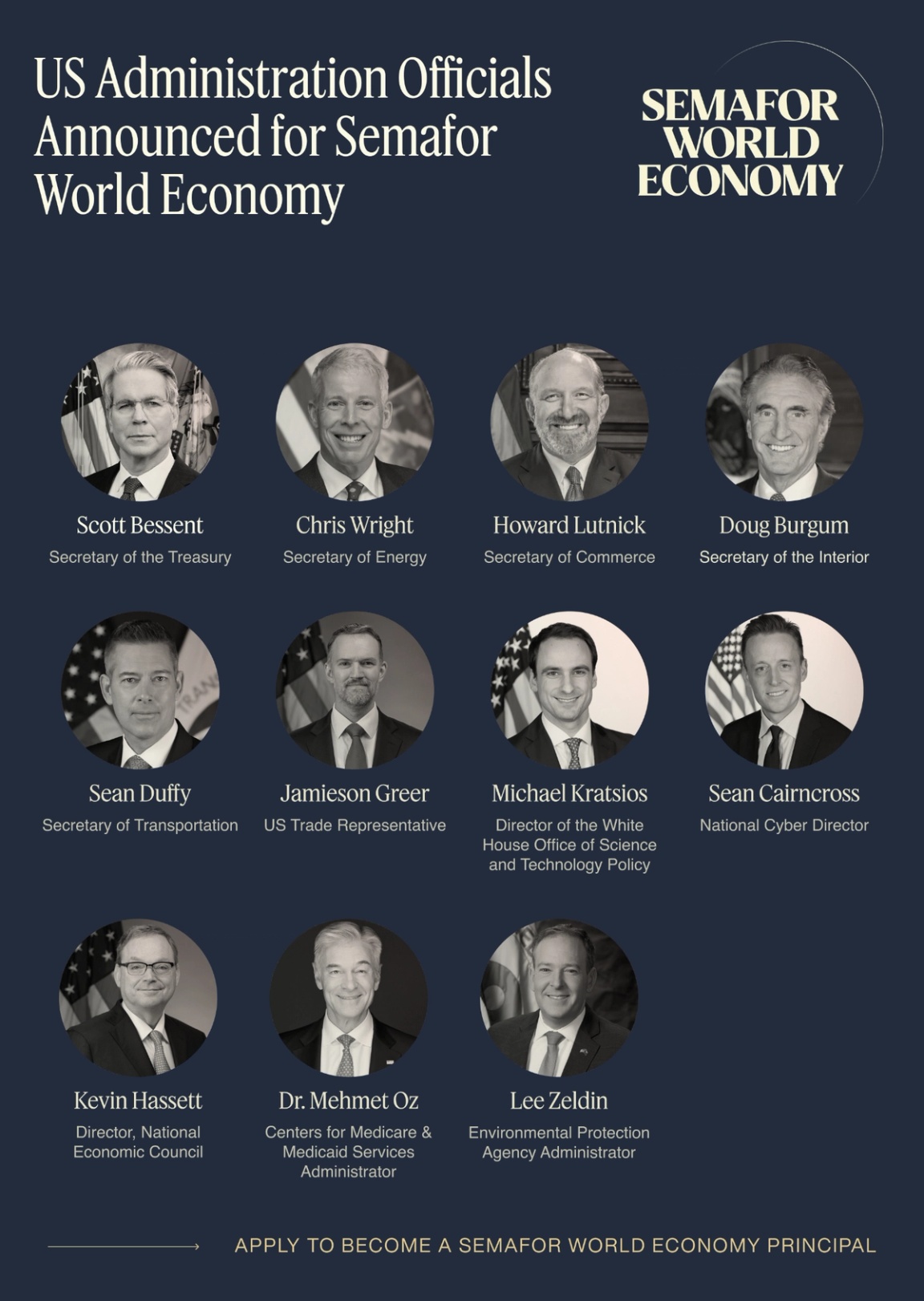 I’m heading to Washington for next week’s Semafor World Economy, the biggest gathering of economic leadership in the US. We’re bringing together more than 500 global CEOs, government officials, and leaders from 80 countries at a moment when the global economy, already under pressure from stretched budgets and slowing growth, is upended by war. Over five days, my colleagues and I will be asking tough questions of the people making key decisions in real time. Here are some big interviews and what I’ll be asking and listening for: - Treasury Secretary Scott Bessent: How is he viewing renewed inflation threats?
- Blue Owl Co-CEOs Marc Lipschultz and Doug Ostrover: Can private credit pull itself back from the brink?
- Citadel CEO Ken Griffin: Where does America’s brand in the world stand today?
- Goldman Sachs President John Waldron: Will Wall Street stay committed to the Gulf?
- Commerce Secretary Howard Lutnick: Is “state capitalism” breaking actual capitalism?
- Thoma Bravo’s Orlando Bravo: Is software investable anymore?
- Dell CEO Michael Dell: Are America’s billionaires meeting the moment?
- Eli Lilly CEO Dave Ricks: Are GLP-1s a winner-take-all market?
- Verizon CEO Dan Schulman: How much longer does the smartphone era have?
- OpenAI Chief Global Affairs Officer Chris Lehane: Can Sam Altman fix his trust problem?
— Liz This is your last chance to join as an inaugural member of our cohort of Semafor World Economy Principals — apply here to join us in-person next week. |
|
SpaceX bankers prep for post-IPO selling tsunami |
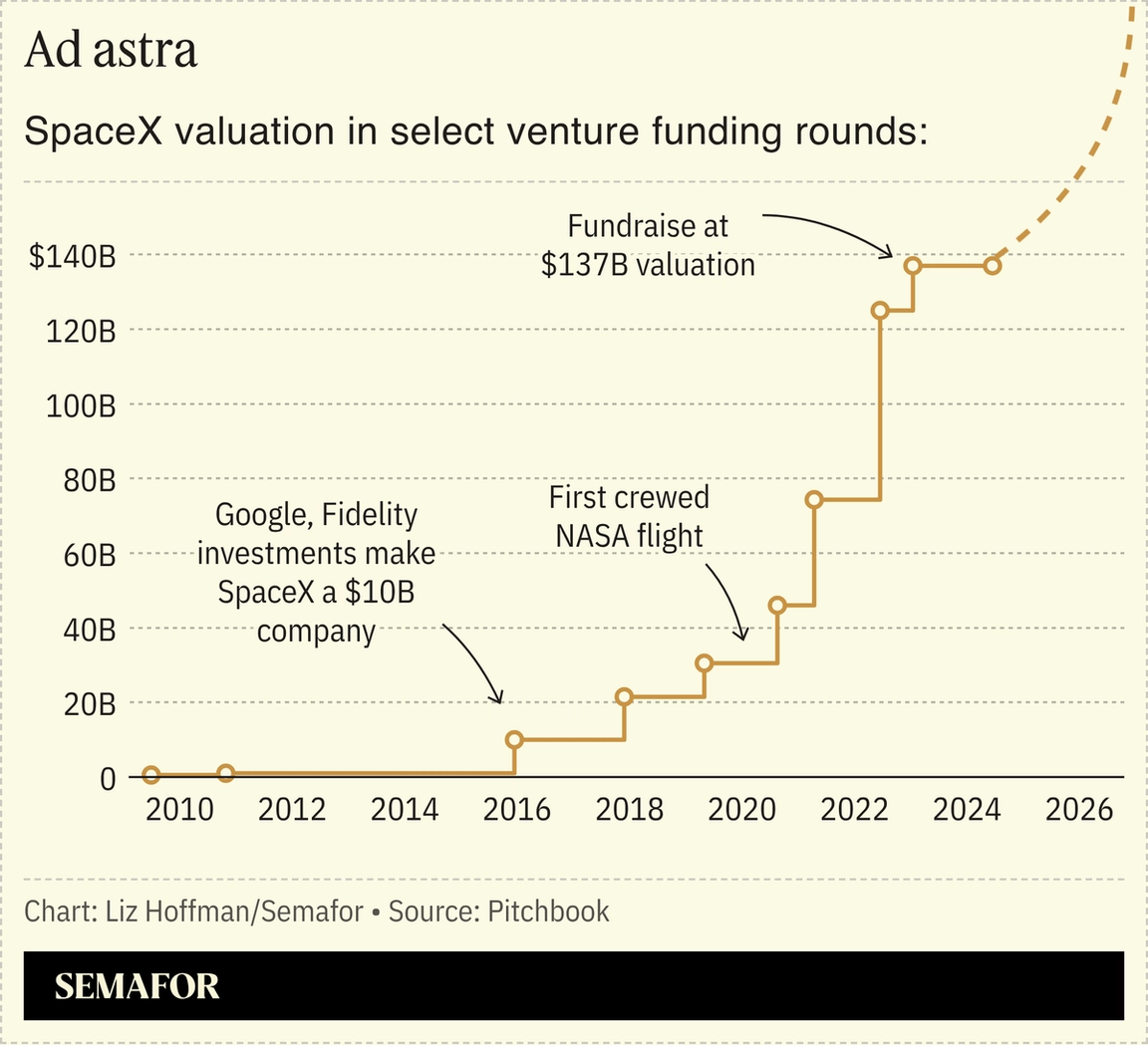 SpaceX’s IPO is primed to be the biggest in history. Its bankers are worried about what comes next. At a $2 trillion valuation, the listing could raise as much as $75 billion for Elon Musk’s rocket company. The problem is what happens months later, when early investors start selling, turn hundreds of billions of dollars of paper gains into cash, and create a wall of selling that drives the stock down. One idea that’s making the rounds among Wall Street banks: Let insiders sell some of that stock before the standard 180-day lock-up expires — but gradually, tied to price and potential trading volume thresholds. The idea, which SpaceX may choose not to pursue, would be to ease more than $1 trillion worth of stock into the market over several months, rather than all at once, according to people familiar with the matter. In recent weeks, bankers have been canvassing potential investors for feedback, trying to strike a balance that ensures a smooth path for an IPO that Wall Street is counting on to go well, these people said. SpaceX didn’t respond to requests for comment. |
|
Oil sees a historic slide |
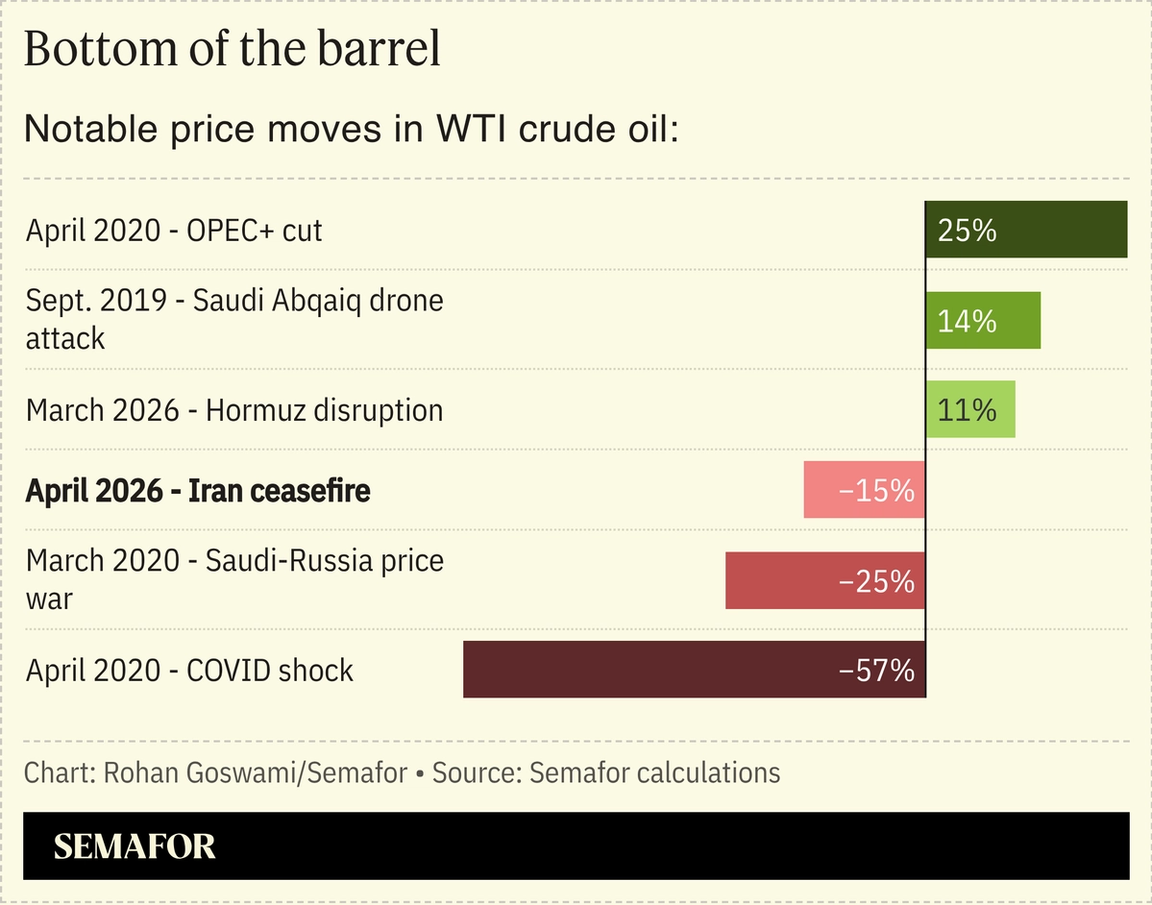 The two-week ceasefire in Iran caused the sharpest single-day drop in oil prices since 2020. Whether it holds, given the uncertainty around how many ships are able to transverse the strait, is a different question. |
|
Gulf states gorged on private credit |
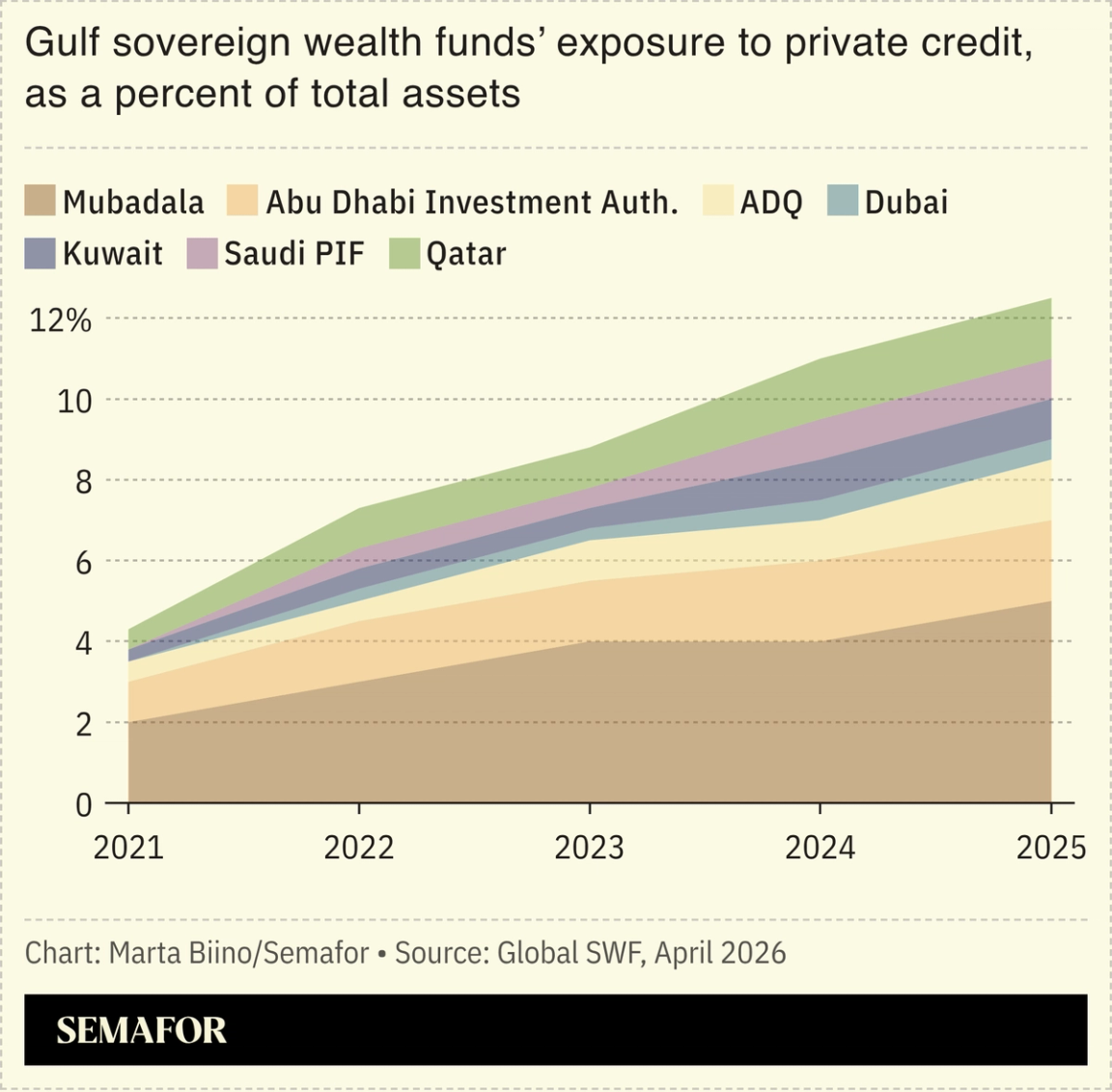 The collision of two financial trouble spots in a single stat: Middle East sovereign wealth funds more than quadrupled their private credit exposure between 2021 and 2025, to $80 billion. That data, from Global SWF, puts them at the forefront of an asset class that is looking rickety, at a moment when huge questions hang over their economies. Abu Dhabi’s Mubadala is the most extended, with 5% of its portfolio invested through partnerships with Apollo, Ares, Carlyle, Goldman Sachs, and KKR. Its sister fund, Abu Dhabi Investment Authority, holds the largest amount of any of the regional funds, with $24 billion invested. Kuwait, Qatar, and Saudi Arabia have also increased their allocations to the sector, although more cautiously. The regional build-up coincided with private credit’s boom years (and was Mubadala’s top performer for three years running). — Kelsey Warner |
|
Runway open for airline deals |
 Mike Blake/File Photo/Reuters Mike Blake/File Photo/ReutersSharpen your pencil, Scott Kirby. America’s top transportation regulator thinks it’s time for some airline M&A. “Is there room for some mergers in the aviation industry?” Transportation Secretary Sean Duffy told CNBC Monday. “Yeah, I think there is.” Semafor reported earlier this month that JetBlue was actively gaming out potential mergers, expecting a larger rival to come knocking. United has been floated as a natural buyer for JetBlue, which comes with choice gates at New York’s JFK and other airports; Kirby, its CEO, wasn’t coy with Stratechery’s Ben Thompson in a January interview. Any deal would also need antitrust approvals from the Justice Department, which also seems open to corporate consolidation. (We couldn’t draw its acting antitrust chief, Omeed Assefi, on his appetite for airline mergers in a recent interview but we’ll get two more bites at the apple when he — alongside Duffy and JetBlue CEO Joanna Geraghty — join us at Semafor World Economy next week) Meanwhile, the Iran war has sent the cost of jet fuel soaring, forcing many airlines to cut flights and raise ticket prices. — Rohan Goswami |
|
➚ BUY: The Office. Landlords are throwing in the towel on vacant office towers, opening the door to redevelopment options — midtown data centers? — that would have been too expensive before. ➘ SELL: Parks and Rec. Foreign tourists will pay more to visit US national parks this summer. |
|
 Companies & Deals- A “modest proposal”: WSJ’s James Mackintosh sketched out an imaginary, but not unimaginable, prospectus for a hypothetical IPO of an Iranian toll booth in the Strait of Hormuz.
- Asymmetric warfare: Bill Ackman is reviving his plan for a fund to repeat versions of his pandemic doomsday trades, the FT reports, hoping to pounce on investors’ complacency.
Markets- Unhedged: A widely tracked index of hedge funds fell 2.8% in March, the largest month decline in almost four years, with stock pickers faring the worst.
- Credit cliff: Private equity’s decade-long bet on software is in for a reckoning, with more than $330 billion of debt maturing in 2028, just at a time when the AI boom threatens to tank the industry.
|
|
| |  | | | You’re receiving this email because you signed up for briefings from Semafo |
|


