| | In this edition, whether a technocapitalist future makes for more innovation or less, and the accoun͏ ͏ ͏ ͏ ͏ ͏ |
| |  | Technology |  |
| |
|
 - AI Accounting
- Software’s best hope
- Amazon vs. Nvidia
- SpaceX’s IPO
- VCs go to campus
 Whether a technocapitalist future makes for more innovation or less, and why your next X-ray could be assessed by AI. |
|
 Can our current form of capitalism support another half-century of American-led tech innovation? That’s one of the big questions I’ll be asking Michael Kratsios, the director of the White House Office of Science and Technology Policy, LinkedIn co-founder Reid Hoffman and the 500 other policymakers and CEOs attending Semafor World Economy in Washington next week. The US tech industry, which blossomed in Northern California after World War II and led to massive economic growth for decades, was the product of a different brand of capitalism than we see today. Back then, there were huge government investments in science and technology, many of them a result of the Cold War, and a rapidly expanding middle-class consumer. Venture capitalists made risky bets on tech companies founded by “traitorous” employees who thought they could do better than the big companies paying their salaries. It would have been impossible outside of California, where companies often lock up employees with noncompete agreements. The private sector innovation that resulted was unparalleled, but the government had a big hand in pushing it along, whether it was building the backbone of the internet, funding promising commercial areas like web browsers, creating special visas for employees, or tuning economic policy to benefit tech giants. Even the patent system was overhauled by the vision of Silicon Valley giants. The current AI wave is happening in a wholly different climate. Government is playing a smaller role. The private sector is making the risky bets on infrastructure that eclipses even the Apollo mission in size and scope. It’s a less hospitable environment for foreign workers, which means higher costs — and much less tech talent — for the world’s most cutting-edge companies. Meanwhile, economic transformation underway means the top 10% of earners are now responsible for nearly half of consumer spending, according to Moody’s Analytics, a reversal of the post-war middle class expansion. Will those seismic shifts translate into less innovation, or simply a different form of it? We’ll pose this question to Kratsios, who has advocated for a shakeup in how the US funds university research, as well as tech leaders like Michael Dell and Jack Clark. But if you have other questions — please send them my way — and I’ll report back here with answers when the hundreds of CEOs and world leaders are on their way back to the office. |
|
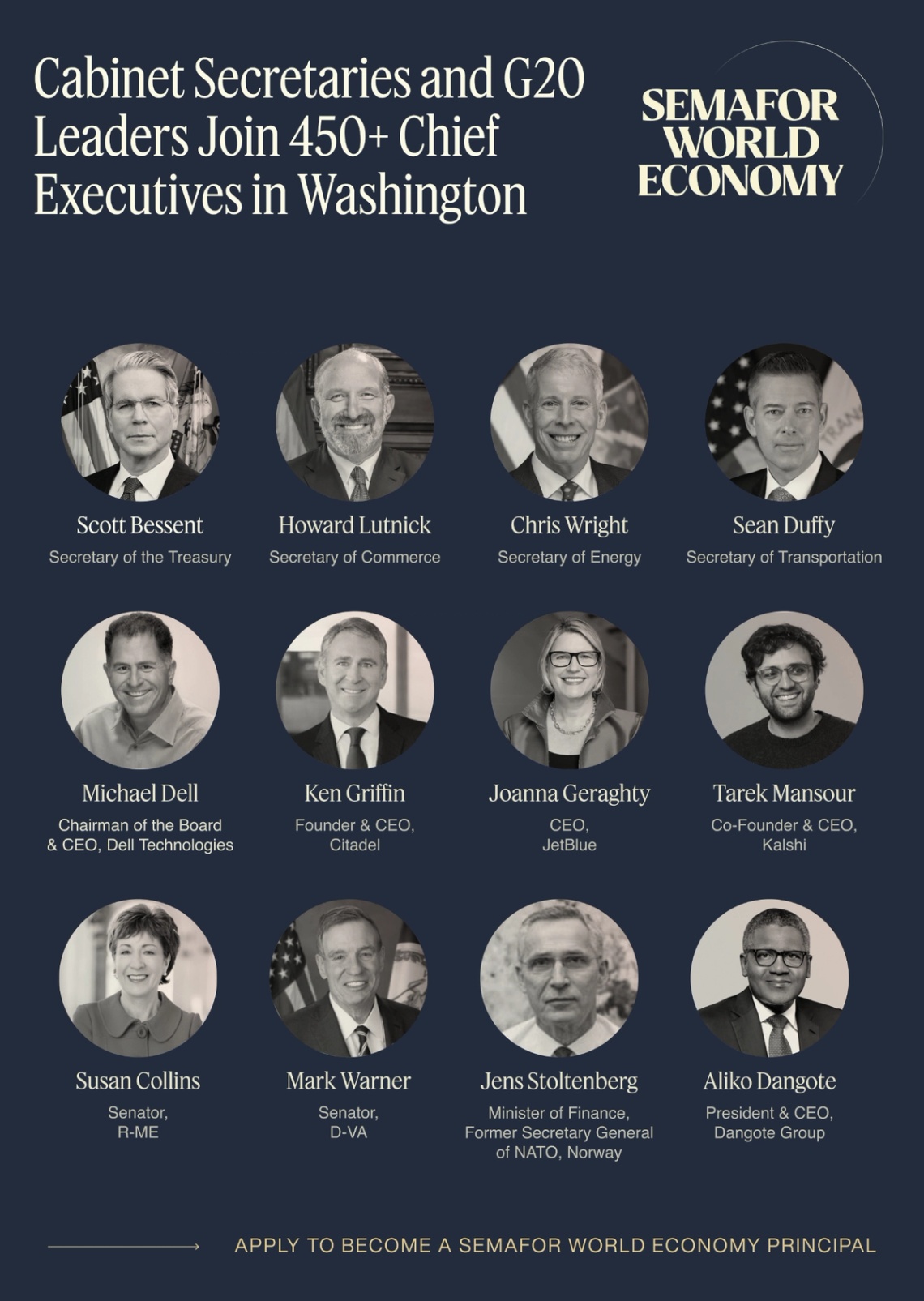 We’re so proud to be hosting a new kind of gathering in Washington, DC next week with Semafor World Economy, the single most important convening of economic leadership in the United States. Semafor World Economy comes at a moment when Washington increasingly sets the direction of the global economy, and we’ll bring together the leaders making key decisions, including US Cabinet Secretaries Scott Bessent, Chris Wright, Howard Lutnick, Doug Burgum, and Sean Duffy. Over five days, Semafor’s flagship live journalism platform will become a real-time stage for the conversations shaping markets, policy, and power, with a continuous run of high-level interviews and discussions featuring the world’s most influential policymakers and executives. We’ll be hosting leaders from more than 80 countries and over 500 global CEOs, and this is your last chance to join as an inaugural member of our cohort of Semafor World Economy Principals — apply here to join us in-person next week. |
|
AI powerhouses threaten data processing firms |
 Justin Sullivan/Getty Images Justin Sullivan/Getty ImagesThere may be hope yet for legacy software companies in an agentic world: Making customer data more easily ingestible by AI. “If you have Snowflake and DataBricks and your data is in good order, you will go faster,” Anthropic Chief Commercial Officer Paul Smith told Semafor when asked whether AI models are improving so rapidly it renders the Saas giants of the last decade useless. But if they don’t, he said, Anthropic can help them anyway. Shares in Snowflake and other software companies have been pummeled as investors question the viability of these companies in the AI era. Further up the stack, one investor in ThoughtSpot, which uses agents to help enterprises analyze large swaths of complex data and has raised $800 million from major investors, told Semafor they’re concerned the company will be outmaneuvered as Anthropic’s and OpenAI’s models improve. Models like Claude currently struggle with complicated inquiries pulling from various sources of data, but they will be able to handle that analysis within two years, the investor said. There’s still time for ThoughtSpot to jump ahead, they said, but if its business remains the same, “that’s where it’s in trouble.” The company has more than 1,000 customers, and 34 that are spending more than $1 million each year with ThoughtSpot, CEO Ketan Karkhanis told Semafor. “Better models aren’t replacing our work,” he said, adding that as models get better, they require the more sophisticated orchestration that ThoughtSpot provides. On whether this can be done by frontier AI companies themselves, he said, “I would welcome all competition.” — Rachyl Jones |
|
The GAAP between OpenAI and Anthropic |
| |  | Reed Albergotti |
| |
 Bhawika Chhabra/Reuters Bhawika Chhabra/ReutersThere’s been a debate in certain nerdier circles of the tech industry about comparing the revenues of Anthropic and OpenAI and I have at least part of the answer. But first, a word of warning. I’ve been covering the industry long enough that the pattern is clear: The numbers you see leaking in the press hardly ever match up when companies actually go public and have to adhere to regulatory and public investor scrutiny. As The Information wrote in March, the companies report revenue differently when they sell their tokens through cloud partners like AWS, Google and Microsoft. For instance, when a customer purchases $1 worth of tokens through a cloud partner, OpenAI counts its 20-cent cut as revenue, according to people familiar with the matter. By contrast, Anthropic counts the whole $1 as revenue, these people say. The percentages that OpenAI and Anthropic get from partnerships vary, making it difficult to figure out how to normalize the revenue numbers across both companies. But the different accounting tactics translate into a discrepancy of up to $8 billion in annualized revenue, according to a person familiar with the numbers. That’s based on how much OpenAI would add to its run rate if it counted gross revenue instead of net revenue. Anthropic is still gaining on OpenAI’s revenue, but the blurry projections suggest it hasn’t quite eclipsed the ChatGPT maker. — Reed Albergotti |
|
SpaceX bankers prep for post-IPO selling tsunami |
| |  | Liz Hoffman |
| |
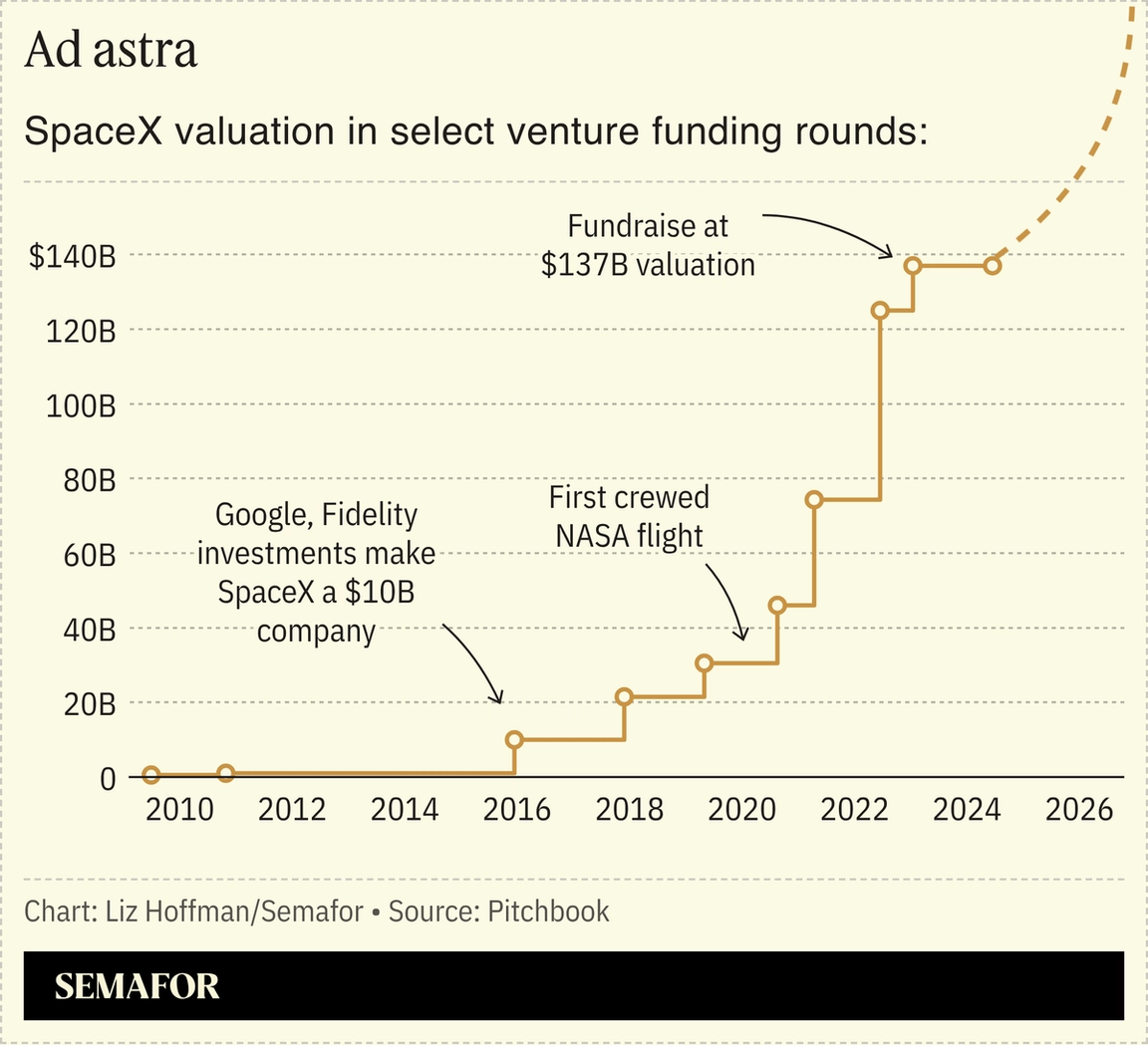 SpaceX’s IPO is primed to be the biggest in history. Its bankers are worried about what comes next. At a $2 trillion valuation, the listing could raise as much as $75 billion for Elon Musk’s rocket company. The problem is what happens months later, when early investors start selling, turn hundreds of billions of dollars of paper gains into cash, and create a wall of selling that drives the stock down. One idea that’s making the rounds among Wall Street banks: Let insiders sell some of that stock before the standard 180-day lock-up expires — but gradually, tied to price and potential trading volume thresholds. The idea, which SpaceX may choose not to pursue, would be to ease more than $1 trillion worth of stock into the market over several months, rather than all at once, according to people familiar with the matter. In recent weeks, bankers have been canvassing potential investors for feedback, trying to strike a balance that ensures a smooth path for an IPO that Wall Street is counting on to go well, these people said. SpaceX didn’t respond to requests for comment. |
|
VCs step in to fund university upstarts |
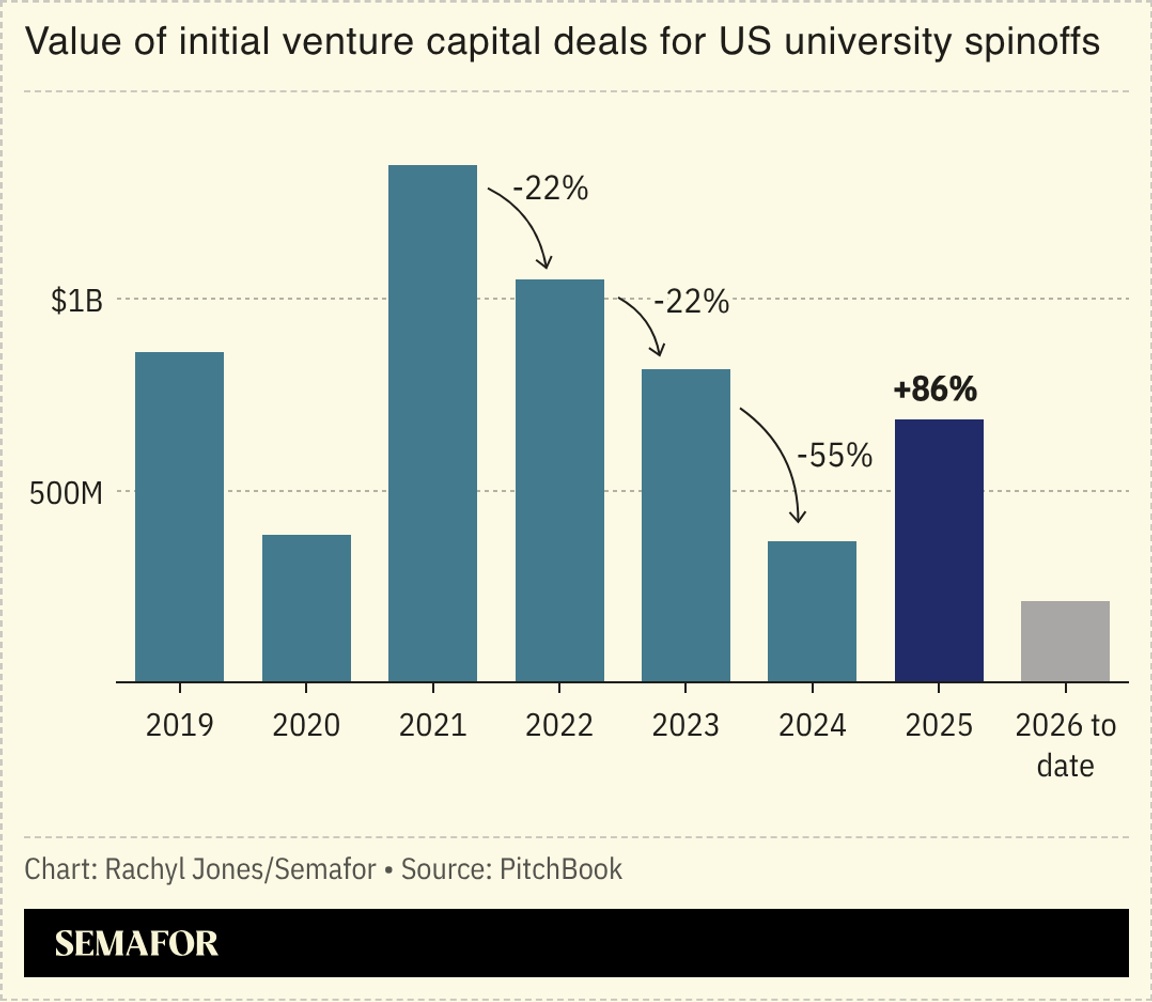 Back to school. Venture capitalists nearly doubled their spending on new US university spinoffs in 2025 to $690 million after three years of declines, PitchBook data show. They also increased their spending in later rounds of US companies spun out from academia, contributing $6.3 billion to those startups. One such example is Commonwealth Fusion Systems — the fusion energy firm out of the Massachusetts Institute of Technology that raised $863 million last year. They’re already on track to exceed 2025’s figures — in part, because federal funding has dried up, according to Katie Rae, CEO of venture firm Engine Ventures. The Trump administration’s funding crackdown has frozen or cut $12 billion in US universities. “In the long term, shutting down research is bad policy,” she told Semafor. After all, some of the most consequential tech advances in decades have happened in academia — including the touch screen and the internet. “In the short term, the best ideas are still finding a way through.” — Rachyl Jones |
|
Amazon takes a jab at Nvidia |
 Anna Moneymaker, Michael M. Santiago/Getty Images Anna Moneymaker, Michael M. Santiago/Getty ImagesThe tech stack is converging. “Our chips business is on fire, changes the economics for AWS, and will be much larger than most think,” Amazon CEO Andy Jassy said in his annual shareholder letter this week. “Virtually all AI thus far has been done on NVIDIA chips, but a new shift has started.” It was an unusual jab at a close partner that Amazon still heavily relies on for GPUs. But it’s another signal that Nvidia — historically a supplier to Big Tech — is in direct competition with the frontier AI labs it already supplies. As Nvidia rolls out its secure version of OpenClaw for enterprises and a series of specialized AI models for businesses, Nvidia is climbing up the stack, while software companies are expanding downward. They aren’t always competing directly — Amazon’s AI training chips and Google TPUs aren’t exactly replacements for Nvidia’s GPUs — but it is a sign that AI has prompted each company to take as much control of each layer of the stack as it can. — Rachyl Jones |
|
 Bluesky has a reputation as a politically charged platform — but COO Rose Wang says the company is reimagining social media through a more decentralized model. On this week’s episode of Mixed Signals, Max and Ben sit down with Wang to examine Bluesky’s rapid growth, its evolving identity, and the challenge of turning a utopian vision into a real business. Listen to the latest Mixed Signals now. |
|
 Eric Gaillard/File Photo/Reuters Eric Gaillard/File Photo/ReutersThe biggest US public hospital system could soon replace some radiologists with AI. Radiology is ground zero for arguments over AI’s employment impacts: The “Godfather of AI” Geoffrey Hinton said in 2016 that radiologists would soon be replaced. In fact, the number of radiologists in the US grew, as AI-human collaboration made them more effective and thus in demand. But perhaps, as with chess, it takes sophisticated strategy to find the sweet spot where human input improves rather than hinders AI output. The CEO of NYC Health + Hospitals told a conference: “ |
|
|


