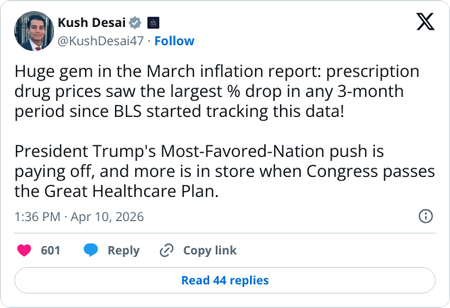
| |  | The Lead Brief | As the economy experiences a blast of short-term inflation, driven by energy price shocks following the United States’ entry into conflict with Iran, the cost of medicine has actually moved in the opposite direction. The price of prescription drugs decreased 1.5 percent in March compared to February, according to newly released Bureau of Labor Statistics data. The cost of medical care overall dropped by 0.2 percent last month. That’s amid the largest month-over-month increase — 0.9 percent — in overall consumer prices since 2022. Increases were fueled by the rise in energy prices — specifically the cost of gasoline, which jumped by more than 21 percent. My WaPo colleague Andrew Ackerman reports this is the largest uptick in the history of the Labor Department’s index. Overall, prescription drug costs are down by 0.2 percent since this time last year, according to the data. → The White House is using the news about prescription drug prices to take a victory lap over President Donald Trump’s agreements with drug giants to bring down the cost of their medicines and in line with what peer nations pay. But some experts say it’s more complicated. The figure doesn’t mean drugmakers suddenly slashed list prices. Instead, it reflects a shift in what pharmacies were paid for the prescriptions they filled — a number that blends what insurers reimburse and what patients chip in at the counter. The BLS collects pricing data from a sample of pharmacies, including retail and online outlets. The market has seen an influx of direct-to-consumer purchasing for drugs, such as GLP-1 weight loss treatments, through digital pharmacies at a relative discount to list prices. Some of this reflects policy pressure, including Medicare negotiation and Trump administration efforts to secure pricing agreements, though companies are also increasingly engaged in competition for market share. → William Padula, a senior scholar at the USC Schaeffer Institute, says that the number is often the result of several factors rather than a single policy. “Policy signals such as drug price negotiation and international reference pricing proposals [that tie U.S. prices to lower ones abroad] may also be contributing at the margins, although it is probably too early to attribute a measurable [consumer price index] effect to those alone,” he tells me. Padula added that a significant driver of the decline could be the continued rollout of biosimilars and generic medications, which tend to exert downward pressure on prices as competition increases. As more competitors enter a market, brand-name manufacturers often lower prices, while patients and payers shift toward lower-cost alternatives. → The federal government says it can take about six months after a generic or biosimilar drug is introduced before those pricing details get incorporated into the index. This lag means that the index could continue to go down as several blockbuster drugs lose exclusivity this year. Padula also pointed out the “growing pressure” from insurers and pharmacy benefit managers to control costs, which can sometimes steer patients to cheaper medication options. This means that early-year formulary changes may be driving costs down. | 

_tstmp_1756933376-1920-1080.png)