| | Hungary’s Viktor Orbán concedes defeat in a stunning election loss, Donald Trump says the US will bl͏ ͏ ͏ ͏ ͏ ͏ |
| |  | Flagship |  |
| |
|
The World Today | 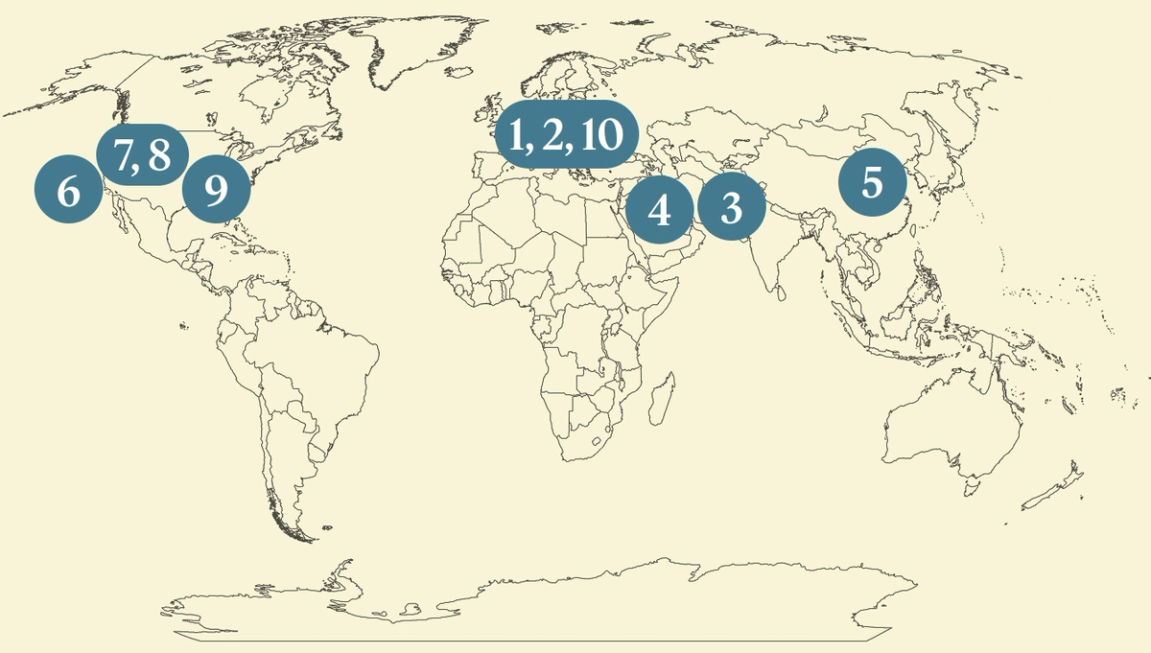 - Orbán ousted from power
- Setback for MAGA overseas
- US set to ‘blockade’ Hormuz
- Failed talks weigh on markets
- Trump threatens Beijing
- Artemis II mission a triumph
- Altman reacts to attack
- Quantum computing’s arrival
- Walmart’s digital price tags
- Skewed microplastics research
 Remembering “the sound of Bollywood.” |
|
Orbán defeated after 16 years in power |
 Péter Magyar. Marton Monus/Reuters Péter Magyar. Marton Monus/ReutersAn opposition party defeated Hungarian Prime Minister Viktor Orbán in national elections on Sunday, marking a stunning end to his 16-year tenure. Orbán conceded to challenger Péter Magyar, a conservative who ran on an anti-corruption platform, as projections showed the opposition was on track to win a two-thirds majority. Orbán’s defeat is welcome news to many in Brussels, where the Hungarian — a close ally of Donald Trump and Vladimir Putin — has been a thorn in the EU’s side. “Hungary has chosen Europe,” European Commission President Ursula von der Leyen wrote. But even with Orbán’s ouster, many of Hungary’s institutions remain entrenched with his loyalists, and Slovak leader Robert Fico vowed to continue his anti-EU push even without his close partner. |
|
Orbán loss a setback for Trump global clout |
 Jonathan Ernst/Reuters Jonathan Ernst/ReutersViktor Orbán’s defeat marks a major setback for US President Donald Trump’s overseas clout, as Washington loses a close ideological ally. The election was seen as a test of Trump’s global image — the president had promised economic support for Orbán, and US Vice President JD Vance campaigned for him last week. The strongman leader became “central to Trumpism, more important than almost any American in the movement,” a historian argued. But even some of Trump’s far-right European partners, including in France, the UK, and Germany, have broken with him over the Iran war, which has increased energy prices and is broadly unpopular in Europe. For the continent’s right, Orbán’s loss may be “a warning against getting too close” to Trump, one expert wrote. |
|
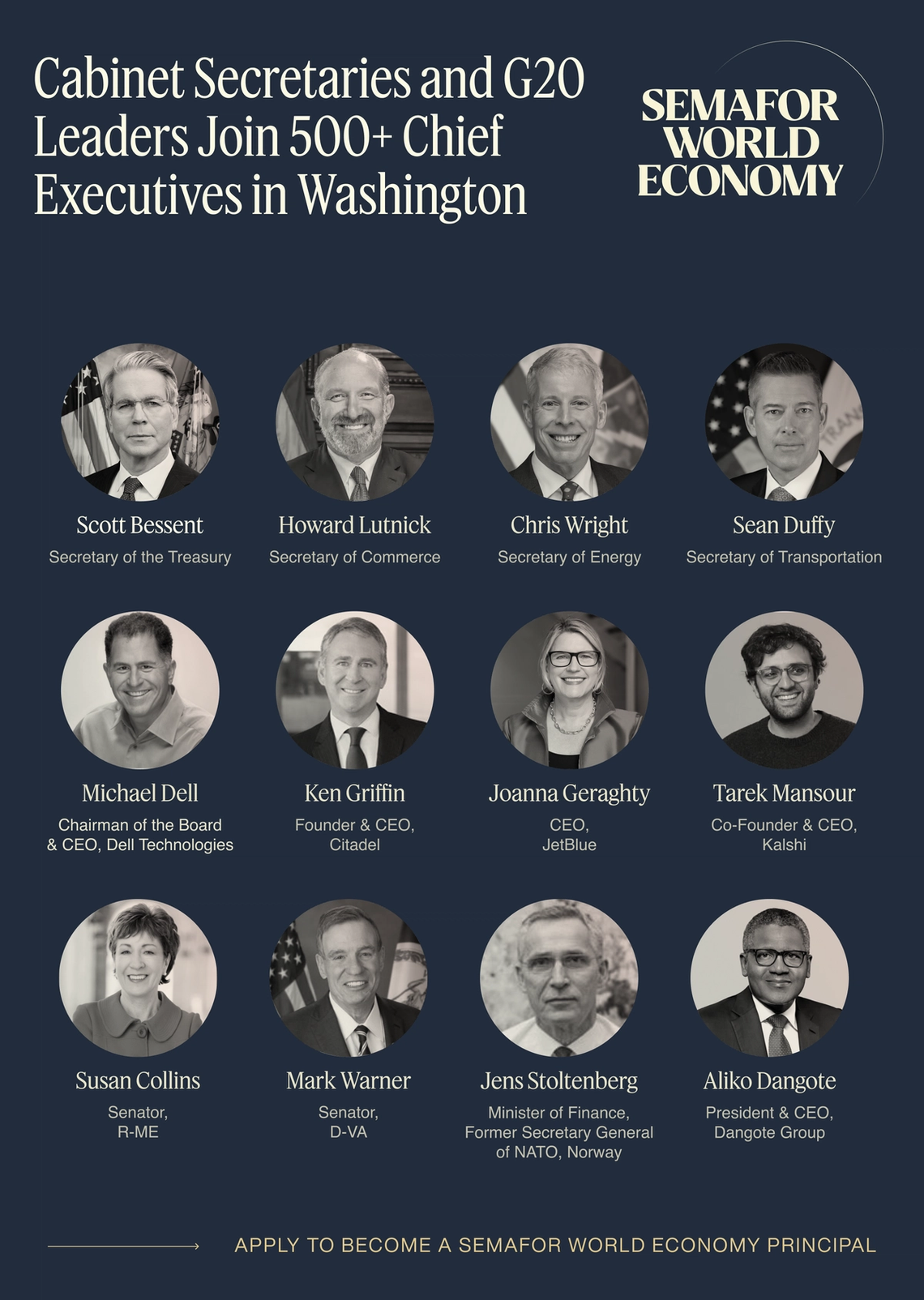 We’re so proud to be convening a new kind of gathering in Washington, DC this week with Semafor World Economy, the single most important convening of economic leadership in the United States. Semafor World Economy comes at a moment when Washington increasingly sets the direction of the global economy. We’ll bring together leaders making the key decisions, including US Cabinet Secretaries Scott Bessent, Chris Wright, Howard Lutnick, Doug Burgum, and Sean Duffy. And over five days, Semafor’s flagship live journalism platform will become a real-time stage for the conversations shaping markets, policy, and power, with a continuous run of high-level interviews and discussions featuring the world’s most influential policymakers and executives. We’ll be hosting leaders from more than 80 countries and over 500 global CEOs, and this is your last chance to join as an inaugural member of our cohort of Semafor World Economy Principals — apply here to join us in-person this week. |
|
Trump says US to ‘blockade’ Hormuz |
 Reuters ReutersUS President Donald Trump said Sunday that Washington would “blockade” the Strait of Hormuz after US and Iranian negotiators failed to reach a deal during marathon talks in Pakistan over the weekend. Trump’s announcement, suggesting the US would police ships that have paid Iran a toll to transit the waterway, threatens to escalate naval activity and further complicate countries’ efforts to get energy from the region. Control of the strait and the fate of Iran’s nuclear program were two main sticking points in the Pakistan talks. While officials left the door open for further diplomacy, the breakdown could mean the return of a devastating war. The US faces a choice, the BBC wrote: “Escalate or negotiate?” |
|
US-Iran impasse to stem relief rally |
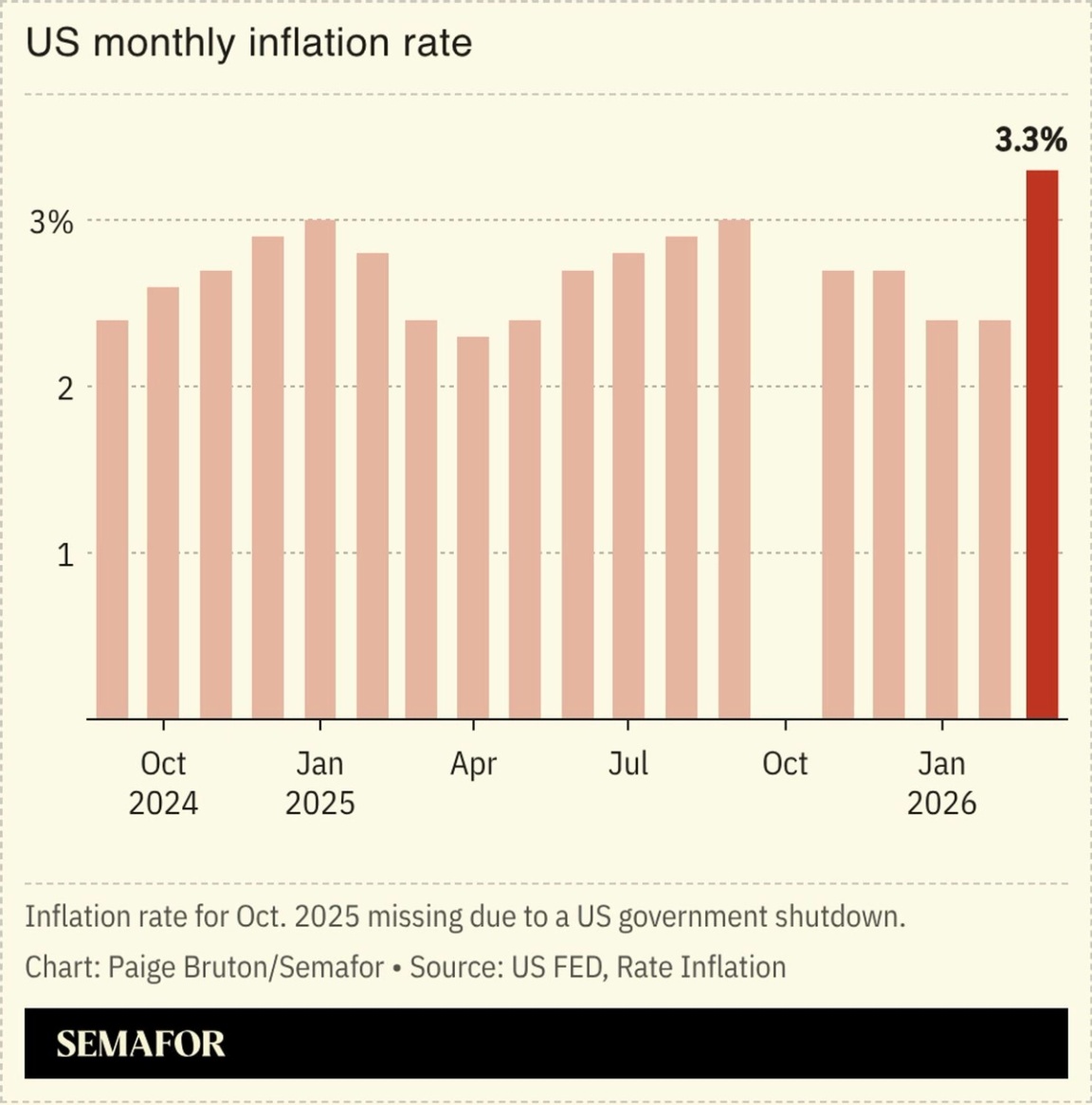 The collapse of talks between the US and Iran is poised to push energy prices back up and weigh on stocks globally. Markets have been rocked by volatility throughout the war, and US President Donald Trump’s plan to blockade the Strait of Hormuz is likely to stem last week’s relief rally, which was triggered by the two-week ceasefire. But analysts cautioned the market reaction could be limited if traders view the breakdown in talks as only a temporary setback. This week also marks the start of a new earnings season, as investors parse for new clues about the conflict’s economic impact: A report on Friday showed US inflation surged in March as the war drove up gas prices. |
|
Trump threatens China over Iran |
 Annabelle Gordon/Reuters Annabelle Gordon/ReutersUS President Donald Trump on Sunday threatened China with “staggering” 50% tariffs if it provides military assistance to Iran, raising the specter of further friction between the world’s two largest economies. Beijing has cast itself as a peacemaker and reportedly helped broker the temporary US-Iran ceasefire, but has also been playing a more active role in the conflict in recent weeks, The New York Times reported: US intelligence suggests China may have shipped missiles to Iran, a report Beijing strongly denied. While energy supply disruptions raise costs for China’s manufacturers, some in Beijing think the war is damaging American strength, drawing Washington’s attention away from Asia. The issue threatens to complicate Trump’s planned visit to China next month. |
|
‘Hard part’ still to come after Artemis II |
 US Navy/Mass Communication Specialist David Rowe/Handout via Reuters US Navy/Mass Communication Specialist David Rowe/Handout via ReutersNASA’s Artemis II mission successfully took astronauts farther from Earth than any human had ever gone, setting the stage for future — and more challenging — lunar voyages. The mission was widely viewed as a triumph for human space exploration following the capsule’s splashdown on Friday, but “the really hard part lies ahead,” the BBC wrote: NASA wants to achieve another Moon landing by 2028, but the equipment buildout for such a mission is behind schedule. Artemis II, though, is “getting the public excited” about the Moon again, a planetary geologist said. The mission spoke to “the thrill of exploration and discovery, feeding the curiosity that makes us human,” Scientific American wrote. “Earth without the moon would not be Earth as we know it.” |
|
Altman links attack to ‘great anxiety’ over AI |
 Jonathan Ernst/Reuters Jonathan Ernst/ReutersOpenAI CEO Sam Altman linked an attack on his home to a moment of “great anxiety” around AI. Authorities on Friday arrested a 20-year-old man who allegedly threw a molotov cocktail at Altman’s San Francisco residence and threatened to burn down OpenAI’s headquarters. The suspect had recently written about fears that advances in AI would “lead to human extinction,” the San Francisco Chronicle reported. Debates over the technology’s usage have grown more urgent amid rising AI adoption rates and a massive infrastructure buildout. “The fear and anxiety about AI is justified,” Altman wrote in a blog post. “We are in the process of witnessing the largest change to society in a long time, and perhaps ever.” |
|
 Bluesky has a reputation as a politically charged platform — but COO Rose Wang says the company is reimagining social media through a more decentralized model. On this week’s episode of Mixed Signals, Max and Ben sit down with Wang to examine Bluesky’s rapid growth, its evolving identity, and the challenge of turning a utopian vision into a real business. Listen to the latest Mixed Signals now. |
|
Tracking quantum computing’s arrival |
 Stephen Nellis/Reuters Stephen Nellis/ReutersCryptography needs to be ready for quantum computing by 2029, Google warned. Modern encryption uses math equations that would take conventional computers trillions of years to crack. In theory, quantum computers could do that math rapidly. “Q-day,” when the tech renders existing encryption useless, was — like fusion power — always 10 years away, but quantum computers have rapidly become less error-prone and more efficient. The quantum-computing scientist Scott Aaronson told Semafor that he agreed “it would be wise” to transition to post-quantum cryptography by 2029 because effective quantum computing could arrive by then. The estimated quantum computing power required to fully break standard encryption has drastically dropped since 2012, Ars Technica reported. |
|
|


