
|
 |





Donald Trump doesn’t have enough fights going on at the moment, it seems, so last night he picked one with the pope. “Pope Leo is WEAK on Crime, and terrible for Foreign Policy,” the president wrote on Truth Social. He went on and on: how he likes the pope’s MAGA brother Louis better, how he doesn’t “want a Pope who criticizes the President of the United States because I’m doing exactly what I was elected, IN A LANDSLIDE, to do,” how unforgivable it is that the pope had an audience with “Obama Sympathizers like David Axelrod.”
“Leo should get his act together as Pope, use Common Sense, stop catering to the Radical Left, and focus on being a Great Pope, not a Politician,” Trump concluded. “It’s hurting him very badly and, more importantly, it’s hurting the Catholic Church!”
Given Leo XIV’s richly earned reputation as the Bulwark pope, we suppose this was only a matter of time.
Programming note: Tonight is the first Founders Town Hall of 2026. Thanks to all our Founders and Navigators for helping to fuel our growth! Want in on this exclusive livestream? Upgrade now and join us tonight. Sarah and JVL will kick things off at 8:30 p.m. EDT.
Happy Monday.
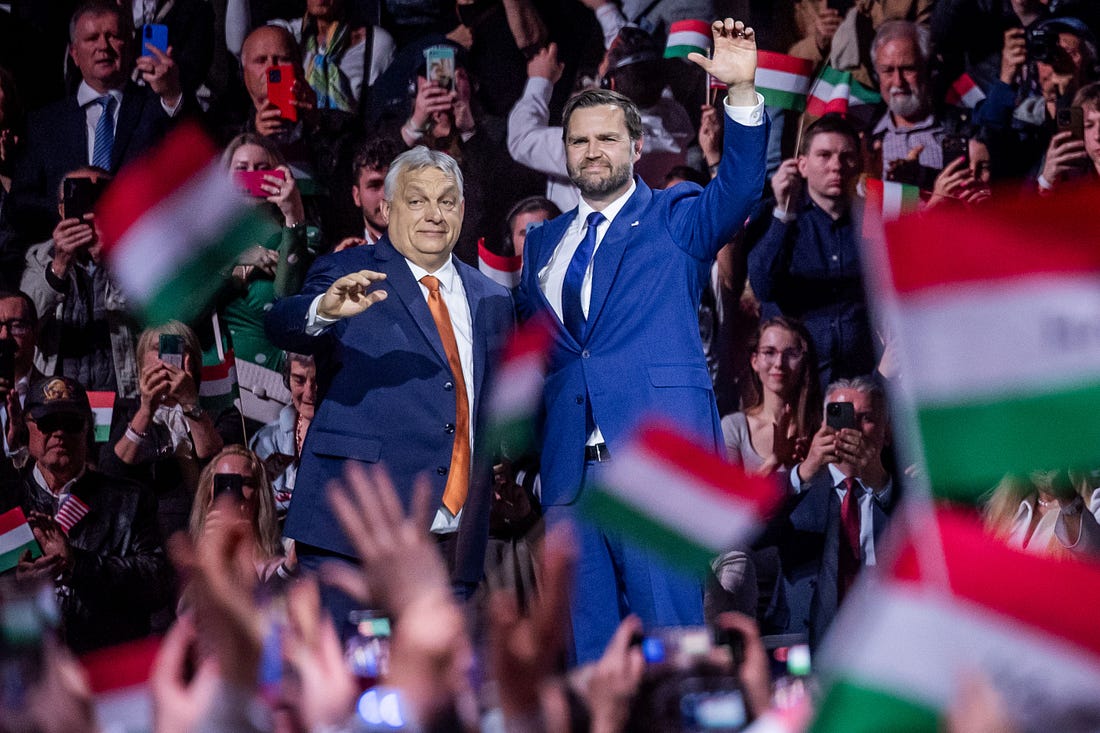 |
Victor Not Orbán
by H. David Baer
Budapest, Hungary
“Spring wind brings rising water . . . every bird must choose a partner”—so begins the popular Hungarian folk song that Péter Magyar’s opposition party adopted as the theme for its campaign. The image of rising water goes well with the party, which shares its name, Tisza, with a river in eastern Hungary. Yesterday, the Tisza flooded.
The flood began with record turnout, upwards of 77 percent, an early sign that looked favorable for the opposition. Soon after returns started coming in, Tisza took a commanding but not decisive lead. Then, unexpectedly, around 9:15 p.m. local time, Prime Minister Viktor Orbán phoned opposition leader Péter Magyar to congratulate him. Minutes later, Orbán delivered a concession speech that, if not exactly gracious, was nonetheless honorable and fully in line with democratic expectations. Fears that Orbán would not acknowledge defeat proved unfounded.
At 10:30 p.m., Magyar appeared, waving a Hungarian flag as he marched through the middle of the enormous crowd assembled for his victory party in Batthyány Square.
Like everything in Magyar’s history-making campaign, the choice of election-night venue was overlaid with symbolism. Batthyány Square takes its name from Lajos Batthyány, the first prime minister of Hungary and a hero of the 1848 Revolution, who was executed for his commitment to Hungarian freedom. The square sits on the banks of the Danube, directly across from the country’s neo-gothic Parliament, whose columns and spires glimmered as Magyar ascended the podium to deliver his victory speech—and to announce that Tisza had won a supermajority in Parliament. Now, with nearly all the votes counted, Tisza is expected to have 138 seats, five more than needed to reach the two-thirds threshold for enacting sweeping constitutional reforms.
Yesterday’s election was, in part, a referendum on Orbán’s leadership and his makeover of the Hungarian government. But it was also a battle for the soul of Hungary. To describe the election as a clash of two campaigns would be to miss a major part of the story: Yes, Orbán was running a campaign, but Magyar was leading a social movement. In every city he visited the last two weeks, crowds came out by the tens of thousands. The photos are astounding. Rallies this big aren’t really rallies; they feel more like marches or demonstrations, something more significant than a rally. Hungarians did not take to the streets in numbers like this even in 1989.
Orbán apologists are already trying to use this election as proof that his regime was always democratic—how else, after all, could Orbán have been defeated? But this shallow and self-serving argument ignores the improbability of Magyar’s rise, the scale of his achievement, and the change in Hungarian society set in motion by the movement he led. This country is different than it was when Orbán was returned to power sixteen years ago. Its people have drunk deeply from the bitter cup of divisive politics, of petty vindictiveness, of corruption and incompetence, of resentment and hatred. They have had more than a taste of kleptocratic authoritarianism, demagoguery, and unrestrained political power. They have gorged themselves on Christian nationalism—and they have spit it out. True to the Hungarian traditions of 1848 and 1956, they have chosen Europe; they have chosen democracy.
This must all be especially demoralizing for Orbán’s American apologists and the hangers-on at the Danube Institute and Matthias Corvinus College in Budapest. But if they look closely enough at Hungary rather than its strongman leader, they might discover a few lessons in Orbán’