| | New wind farms built by Chinese companies will be a lifeline for Egypt, one of the countries most vu͏ ͏ ͏ ͏ ͏ ͏ |
| |  Cairo Cairo | Washington, DC | Tehran |
 | Energy |  |
| |
|
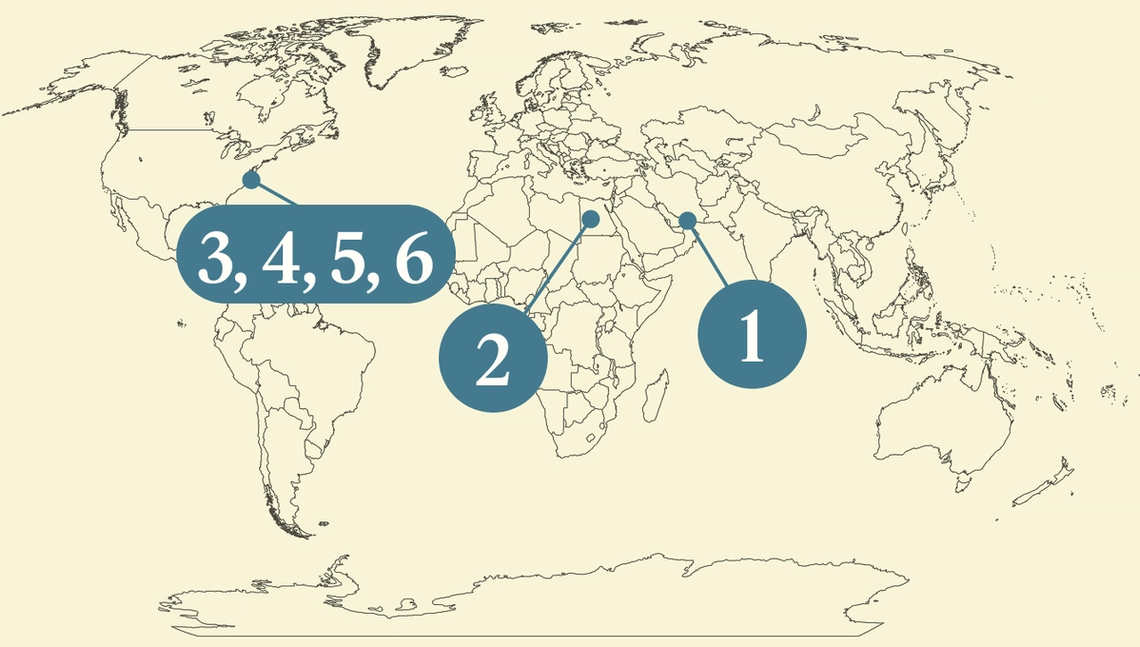 - Blockade begins
- China to the rescue
- Total’s diversification strategy
- More LNG
- ‘Industrial patriotism’
- World Bank’s climate plan
 Microsoft pauses buying new carbon removal credits, and China halts exports of sulfuric acid. |
|
 Leading CEOs and officials spent the opening day of Semafor World Economy grappling with how to hardwire more resilience into the global energy system at a moment of unprecedented risk. There are a lot of chokepoints in the energy market these days, from trade routes under threat of drone attack to maxed-out electric grids and China’s stranglehold on critical minerals. One lesson from Iran, several leaders said, is we can’t afford to sleep on these issues any longer. The first solution is build, baby, build. “We are stupid in our industry, you know,” TotalEnergies CEO Patrick Pouyanné told me on stage. “We spent billions, we made plenty of risk maps identifying the possible Strait of Hormuz closure. None of us have built enough pipeline capacity to avoid it.” The reason the Iran war has been so disruptive, Pouyanné said, is that there is zero spare capacity in the fossil fuel supply chain. But that may be changing. Infrastructure investors are increasingly willing to put near-term profits as a secondary consideration to redundancy and security, Baker Hughes CEO Lorenzo Simonelli told me. Another necessity is more adaptive insurance that can price in novel risks without completely freezing up, as has happened in the strait. Neither of those things matter, however, without the rule of law. Energy security is a game that takes decades to play out, and the best players want a clear view far into the future before making a move. New infrastructure can’t solve the problem if it’s not matched by durable good governance; replace the Strait of Hormuz with a new pipeline network, and someone could still blow it up if the region is unstable. Reflecting on Venezuela, US Energy Secretary Chris Wright said “there’s declining risk and massive reserves on the ground, so that’s a pretty fruitful environment for investment.” Pouyanné — whose company lost a lot of money in both Venezuela and Iran in the past — isn’t convinced: “We need to have an ecosystem in a country where we feel comfortable, because the billions we will invest need to deliver returns over the course of 20 years.” A final lesson is to accelerate the clean energy transition. I was in Egypt this month to report on how Chinese wind firms are rewiring the country’s grid to be more resilient to successive fossil fuel price shocks. Unlike Washington, Cairo can’t afford to be hawkish in its relationship with Beijing, and although Egypt poses numerous barriers to private investment, I found the energy community there to be refreshingly pragmatic and nonideological in its embrace of renewables. Just don’t let the desert bite you back; when I visited a new wind farm near the Suez Canal, a significant portion of the safety briefing focused on venomous reptile avoidance. You can read that feature story below. Semafor World Economy is just getting started. Today we’re onstage with IEA Executive Director Fatih Birol, Pedro Pizarro of the California power company Edison International, and Baiju Bhatt, the co-founder of stock trading app Robinhood who is now focused on building data centers in space. Tomorrow I’ll grill former US climate envoy and Iran negotiator John Kerry, along with Pedro Azagra, CEO of the Spanish clean energy giant Iberdrola. Check out the full summit program here, and follow along live on our website or YouTube channel. Stay tuned. |
|
 Reuters/File Photo Reuters/File PhotoThe US military began a blockade of Iran’s ports on Monday, preventing the passage of ships carrying Iranian oil to cut off Tehran’s revenue and further restricting global oil supplies after weekend talks foundered. The last oil tankers to go through the Strait of Hormuz before the war are due to reach refineries in the coming days, intensifying a supply crunch in Asia and driving up competition for cargoes, which could cause shortages in Europe and the US. Iran, which has — until the blockade — continued to export its oil, nearly doubled its daily income from oil sales since the start of the war and had promised safe passage through the strait to tankers paying a toll. Oil prices dipped below $100 a barrel amid reports of continued efforts to resolve the conflict with another round of in-person negotiations reportedly being discussed. US President Donald Trump said Iranian negotiators contacted Washington and wanted “very badly” to strike a deal, while Pakistan said Iran would continue talks “within the framework of international law”. US Energy Secretary Chris Wright told Semafor World Economy oil prices are likely to continue rising until meaningful ship traffic can resume through the strait. |
|
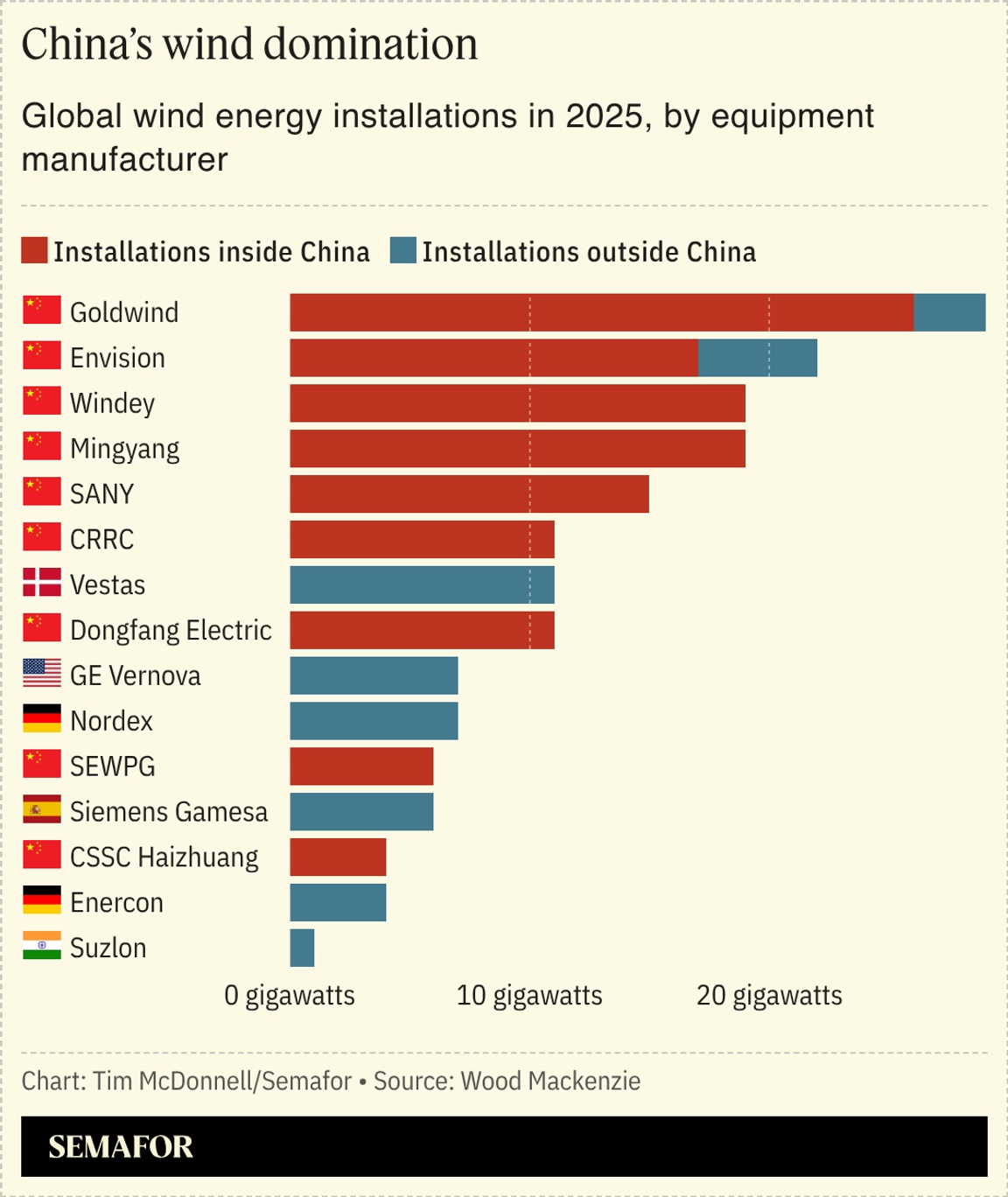 New wind farms built by Chinese companies will be a lifeline for Egypt, one of the countries most vulnerable to soaring natural gas prices from the war in Iran. Egypt’s energy import bill doubled from January to March as it was forced to compete for scarce LNG shipments; now the famously nocturnal megacity of Cairo has instituted strict power rationing measures and has ordered businesses to shut down after 9 pm. The country has an ambitious goal to get 45% of its power from renewables within two years, and as I reported from a visit there this month, it can’t get there without China. New wind projects cropping up near the Suez Canal are a crucial test of whether the world’s dominant “electrostate” can prove a more reliable partner than the US, the leading “petrostate,” for countries like Egypt that want to break their dependency on volatile global fossil fuel markets. And it’s a sign that the shift to renewables could happen faster than many think, driven by the confluence of war in Iran and massive Chinese industrial capacity. “When it comes to renewable energy, I don’t want to use the word ‘dominance’ or something,” one executive in Cairo said, “but the world is really relying on China.” |
|
Total’s diversification strategy |
  Patrick Pouyanné (L) and Semafor’s Tim McDonnell. Tasos Katopodis/Getty for Semafor Patrick Pouyanné (L) and Semafor’s Tim McDonnell. Tasos Katopodis/Getty for SemaforThe world will “face some serious supply issues” if the Iran war and the Strait of Hormuz blockade last for more than three months, TotalEnergies CEO Patrick Pouyanné warned. Speaking at Semafor World Economy, Pouyanné said that Iran charging a toll for ships to transit through the waterway was not the problem. “The free circulation through the Strait of Hormuz, even if you have to pay to anybody, is fundamental,” he said. If the strait is reopened, “things can come back to normality” within three months, given that the region’s energy production facilities remain largely undamaged. But, he warned, if the war escalates, “you change the magnitude of the problem.” In the meantime, Pouyanné stressed that the way to avoid future bottlenecks was through energy supply diversification. That includes new geographic locations for production: Total avoided declaring force majeure on any of its LNG deliveries even after the Ras Laffan terminal in Qatar was damaged, because it has nearly a dozen other global terminals to draw on. And it includes clean energy: “It’s obvious to me that the consequence of this crisis is that the countries will look to domestic solutions, and obviously renewables are a domestic solution.” |
|
 Baker Hughes CEO Lorenzo Simonelli. Tasos Katopodis/Getty Images for Semafor Baker Hughes CEO Lorenzo Simonelli. Tasos Katopodis/Getty Images for SemaforThe Iran war and the effective closure of the Strait of Hormuz could strengthen the case for more LNG investment, Lorenzo Simonelli, CEO of energy tech company Baker Hughes, told Semafor World Economy. “If you think about the future, natural gas isn’t just a transition fuel. It’s a destination fuel. It can be affordable, sustainable, and secure,” Simonelli said. “What you’re going to see happen is continued development of LNG as being the way in which to transport that natural gas.” Simonelli said the key to weathering global turmoil and preventing chokepoints in global energy flows was increased redundancy and diversification, opening opportunities for more investment in pipeline networks, some of which have been already built but have been left unused. |
|
 What happens when one of America’s sharpest energy traders takes on higher education — and the rise of sports betting? On this week’s Compound Interest, presented by Amazon Business, Liz and Rohan talk with John Arnold, the billionaire investor-turned-philanthropist who’s applying a data-driven, ROI mindset to reforming higher education, rethinking America’s sports betting boom, and making sense of the Trump-era turbulence shaking the energy markets. Listen to the latest episode of Compound Interest now. |
|
 Barbara Humpton, CEO of USA Rare Earth, and Semafor’s Tim McDonnell. Tasos Katopodis/Getty Images for Semafor Barbara Humpton, CEO of USA Rare Earth, and Semafor’s Tim McDonnell. Tasos Katopodis/Getty Images for SemaforUSA Rare Earth is “scouring the globe” for potential acquisitions for critical minerals — from mining and processing to the manufacturing of magnets — the company’s CEO Barbara Humpton said at Semafor World Economy. As an example of the firm’s global ambitions, she cited last week’s deal to take an equity stake in Carester, a France-based processor of rare earths, alongside French Investor Infravia. “In very short order we’ll have a processing line in Europe that can help serve Europe as well as Asia,” Humpton said. And she defended the Trump administration’s decision to take equity stakes in her company and other critical mineral producers as necessary for the US to compete against China in industries linked directly to national security. Rather than state capitalism, she said she prefers to think of the practice as “industrial patriotism,” which she described as a response to the fact that “free market economics, executed blindly, can lead us down dangerous box canyons.” |
|
World Bank tackles energy inflation |
 Johannes P. Christo/Reuters Johannes P. Christo/ReutersThe economic fallout from the energy crisis unleashed by the war in Iran and questions of how to bolster energy security are dominating discussions at the World Bank and IMF spring meetings in Washington this week. For low-income countries in sub-Saharan Africa and South Asia, higher import bills for fuel, fertilizer, and food risk exacerbating already record-high debt levels, squeezing the fiscal space necessary to invest in climate action and resilience to future shocks. At the same time, the US is mounting pressure on the Washington-based financial institutions to disengage from considering climate change in fiscal risks and debt sustainability and to loosen lending restrictions for fossil fuel projects. The World Bank’s climate strategy, which sets a climate lending target of 45%, expires in June, but discussions on a new plan are being relegated to whispers in corridors, The Guardian reports. “The US could take advantage of the current circumstances — when people’s attention is focused on other issues — to roll back the progress on climate issues we’ve seen over the past five years,” Salvatore Serravalle of think tank E3G told Semafor. — Chloé Farand |
|
|