
|


 |
What Is An AI Delegate?
OpenClaw arrived with little fanfare and quickly became the fastest growing open source AI project on record. At its core, OpenClaw is a personal autonomous agent framework. It is software that connects a large language model to your email, calendar, file system, messaging apps, and external APIs, then acts on your behalf across all of them simultaneously without waiting to be asked. OpenClaw did not just answer questions. It completed work. That distinction resonated immediately with developers and technically sophisticated early adopters who had grown frustrated with AI tools that stopped at the edge of a chat window.
The adoption rate outpaced the security reviews, and that gap mattered. OpenClaw’s open architecture made it composable and extensible, but it also made it trivially easy to deploy with over-permissioned access, no audit logging, and no vetting of community contributed skill modules. The documented ClawHavoc supply chain attack, in which malicious skills compromised thousands of installations, was a predictable outcome of consumer grade architecture deployed without enterprise grade controls. Industry analysts flagged the category as an unacceptable cybersecurity risk for enterprise use. None of the security alerts and warnings stopped adoption. The excitement around what OpenClaw enables simply outpaced concern about what it could expose.
What followed was a wave of systems that took the core concept of OpenClaw and addressed its roughest edges while extending its reach. Claude Code Channels embeds autonomous execution directly inside Anthropic’s interface, adding structured reasoning traces and tighter permission boundaries that make the system’s decision making more inspectable. NemoClaw targets local deployment on dedicated hardware, bringing meaningful on device performance to users in regulated industries who cannot route sensitive data through cloud providers. GenSpark Claw shifts toward a managed experience, abstracting away the complex container configuration and credential management that made raw OpenClaw inaccessible to non technical users. It also layers in role based access controls and compliance oriented audit trails. Together, these systems are converging on a new operational paradigm that deserves its own category name: the AI Delegate. Rather than functioning as traditional software, AI Delegates operate as persistent, action-taking systems that work on a human’s behalf across applications and time.
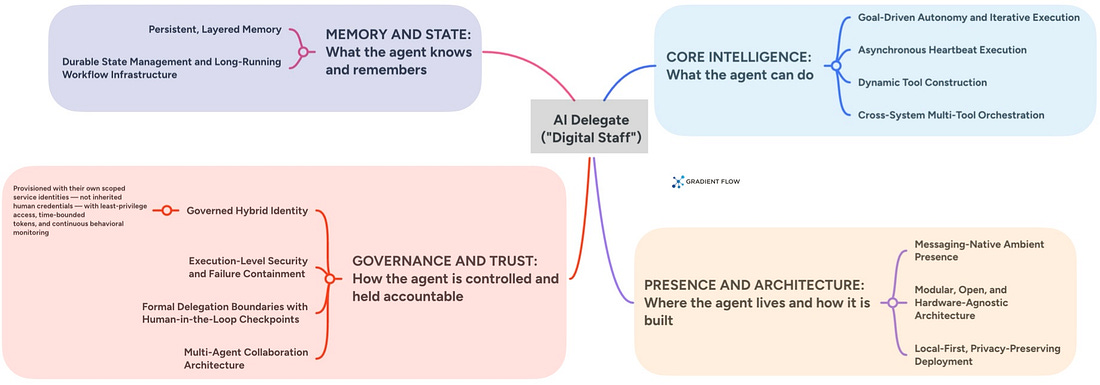 |
An AI Delegate (often functioning as ‘Digital Staff’) is built on the four core pillars of Intelligence, Memory, Architecture, and Governance, and is defined by the following key features:
Goal-Driven Autonomy. Interprets high-level human goals, breaks them into sub-tasks, executes across connected systems, and retries or adapts when steps fail. The unit of value is a completed workflow, not a text response.
Ambient Presence. Lives inside messaging platforms users already use, such as WhatsApp, Slack, Telegram, or iMessage, providing an always-on experience with zero friction or context-switching.
Persistent Memory. Maintains long-term context across all sessions using systems like LanceDB and vector embeddings. Remembers preferences, past decisions, and ongoing projects without being re-instructed.
Proactive Heartbeat Execution. Operates on scheduled cycles without waiting to be prompted: it runs briefings, audits, consolidations, and background tasks autonomously.
Dynamic Tool Construction. Builds its own integrations and scripts on the fly when existing tools are insufficient. Capability surface expands with every new task encountered.
Cross-System Orchestration. Coordinates actions across databases, APIs, file systems, CRMs, and external services within a single workflow, serving as the integration layer so the human doesn’t have to.
Modular, Open Architecture. Separates the reasoning layer (LLM) from the execution layer (tools, APIs), facilitating model swaps, new integrations, and flexible deployment without vendor lock-in.
Local-First Deployment. Runs on the user’s own hardware by default, keeping data under user control. Cloud-managed variants exist but local-first is the defining architectural option.
Governed Identity and Delegation. Operates under its own scoped service identity rather than borrowed human credentials, utilizing explicit handoff maps to define what the agent owns, what requires human approval, and what is never delegated.
Multi-Agent Collaboration. Architected for teams of specialized agents (planner, executor, validator) that delegate to one another, check each other’s work, and operate in parallel.
Crossing the Threshold to Enterprise Operations
The trajectory of these AI Delegates mirrors a familiar pattern in enterprise technology adoption. A tool emerges in the developer community, proves its value through grassroots experimentation, and eventually forces organizations to either adopt it deliberately or manage it as shadow IT. The emergence of managed platforms and no code interfaces signals that this category is moving toward professional users much faster than most organizations realize. The organizations that capture the most value from AI will not be those that ship chatbot wrappers around foundation models, but those that embed agent level autonomy into products capable of handling unstructured cross system tasks at scale.
Consider the work that currently requires a human to manually bridge between a CRM, an inbox, a calendar, and a data warehouse. Managing sales outreach, sorting customer issues, summarizing market research, and setting up new accounts all involve many moving parts, but they follow predictable rules that rarely require constant human oversight. They are e