| | In this edition, a hedge fund pitches a new IPO structure for SpaceX, and TotalEnergies’ CEO warns o͏ ͏ ͏ ͏ ͏ ͏ |
| |  | Business |  |
| |
|
 - Semafor World Economy
- SpaceX IPO idea
- Wheat shocks
- The canaries were chirping
- John Arnold on Compound Interest
- Egypt banks on China
|
|
 Tankers are still on the ocean. Warehouse inventories are dwindling but not empty yet. Markets defying geopolitical dangers and economic warning signs to regain their year-to-date losses. Lazard CEO Peter Orszag told me yesterday at Semafor World Economy that this is “a Road Runner moment,” where we’re already over the cliff, but are suspended for a few cartoonish seconds before gravity kicks in. Citadel’s Ken Griffin warned of a full-on recession if the Strait of Hormuz stays closed for more than six months. The administration is pushing back, unevenly. In an interview with Semafor Editor-in-Chief Ben Smith, Treasury Secretary Scott Bessent acknowledged inflationary pressures from the Iran war — and said the Fed was right to “wait and see” on rates, an implicit concession that cutting in the face of price spikes might be good politics but dicey economics. The administration is confronting both the consequences of its own actions on tariffs and Iran and, as Ben wrote this week, the unshakeable fact of modern politics that “virtually all of the time, most Americans are mad at you about the economy and there’s little you can do about it.” But in the cartoons, Wile E. Coyote only falls when he looks down and notices the void. The Trump administration is not looking down: Bessent conceded the economy would have “some making up to do” after first-quarter growth is expected to fall to 1.3%, but mostly held to the administration’s forecast of 4% growth for the year. The market is not looking down: The S&P 500 is back in the green for the year after Monday’s jump. And CEOs are mostly not looking down, and continuing to press ahead, for now. Neuberger Berman CEO George H. Walker IV said “there are fat left-tail risks” but that the economy is “in a good place,” and Hilton CEO Chris Nassetta said his company is continuing to sign deals — for new hotels in the Gulf, no less. “You’ve got to contend with the fact that the investment cycle is longer than the political cycle,” Fifth Third Bank CEO Tim Spence said. The question is whether consumers look down. |
|
Highlights from the stage |
|
Hedge fund’s pitch on SpaceX’s IPO deluge |
 Lykos Global Management presentation, reviewed by Semafor Lykos Global Management presentation, reviewed by SemaforBankers have been puzzling over how to handle the tsunami of selling that would hit the market six months after the SpaceX IPO, if the company pursued a traditional insider “lock-up.” They are considering ways to have those shares trickle into the market sooner and more slowly, assuming the demand is there. A document prepared by hedge fund Lykos Global Management that was seen by Semafor and shared with some of SpaceX’s underwriters pitches a new IPO structure and games out how it would work for a company SpaceX’s size, though it’s unclear whether SpaceX is considering this structure. If SpaceX’s stock price trades at a five-day average that’s 50% higher than the IPO price, the first gate would lift, allowing employees to sell 15% of their stock, according to Lykos’ presentation. After that, the price thresholds decrease because the market is deeper and can more easily absorb new shares without wild swings. Directors at the company are let out later, then finally CEO Elon Musk, though whether he wants to sell remains an open question. The process — dubbed the Threshold-Indexed Dynamic Exit, or TIDE — is cheekily named to fix the problem it solves: the wave of selling that follows big IPOs and can weigh on the stock price. It’s essentially a rolling IPO, calibrated to the market’s ability to smoothly absorb the largest chunk of stock ever thrown its way. |
|
Food cost warnings as strait remains closed |
  Patrick Pouyanné (L) and Semafor’s Tim McDonnell. Tasos Katopodis/Getty for Semafor Patrick Pouyanné (L) and Semafor’s Tim McDonnell. Tasos Katopodis/Getty for SemaforWarnings are getting increasingly dire from energy and chemical CEOs about higher-for-longer oil and down-chain effects on food supply. “If this war and this blockage last more than three months, we’ll begin to face some serious supply issues” in jet fuel, diesel, and LNG, TotalEnergies CEO Patrick Pouyanné said at Semafor World Economy on Monday a month and a half into the war. “Energy leads to fertilizer, fertilizer is food, food is inflation.” It doesn’t stop there: “You’ll see lower grain yields this year, likely globally, and there should be a price response in grains next year,” CF Industries’ Chris Bohn said, adding that CF was mothballing some factory maintenance to keep production at a maximum and prioritizing US farmers. |
|
Tricolor and First Brands woes |
 Eldridge CEO Todd Boehly. Tasos Katopodis/Getty Images for Semafor Eldridge CEO Todd Boehly. Tasos Katopodis/Getty Images for SemaforThe financial problems that arose at two corporate credit wipeouts last year were “easy to spot” ahead of time, Todd Boehly, CEO of asset manager Eldridge, said. Eldridge considered investing in debt issued by the subprime auto lender Tricolor and auto-parts company First Brands, Boehly said at Semafor World Economy in Washington, DC. Eldridge passed on both. “Tricolor was to us an obvious one that was, not something that we were gonna participate in. We saw the same thing on First Brands,” Boehly said. “The reality is those two were reasonably easy to spot.” Tricolor and First Brands both filed for bankruptcy last fall amid swirling fraud allegations. Their collapses left banks and private credit funds with heavy losses and set off the canaries-and-cockroaches debate that has only intensified. |
|
 (L-R) Liz Hoffman, John Arnold, and Rohan Goswami. Semafor/Youtube (L-R) Liz Hoffman, John Arnold, and Rohan Goswami. Semafor/YoutubePhilanthropist John Arnold has spent his post-Wall Street career tackling broken systems — criminal justice, infrastructure, higher education. His next target, he says, is the explosion of online gambling. He worries it has turned a tolerable-when-contained societal release valve into a frictionless casino — with potentially harmful effects on young men in particular. His message to state officials who have legalized new types of betting: “You have a lot of lobbyists coming into your office every day talking about the benefits, but somebody needs to talk about what the negatives are,” he said on the latest episode of Semafor’s Compound Interest show. Arnold’s problem with betting markets is that they’re too easy. Gambling has historically been “high-friction, high-speed” (you can furiously pull slot machines for hours, but have to go to Las Vegas to do it) or “low-friction, low-speed” (for example, buying a lottery ticket at the grocery store, then waiting a few days to find out if you won.) Prediction markets combine the most pernicious of both, backed up by huge marketing budgets and gamified apps that push multipart bets known as parlays. |
|
China is winning the global energy war |
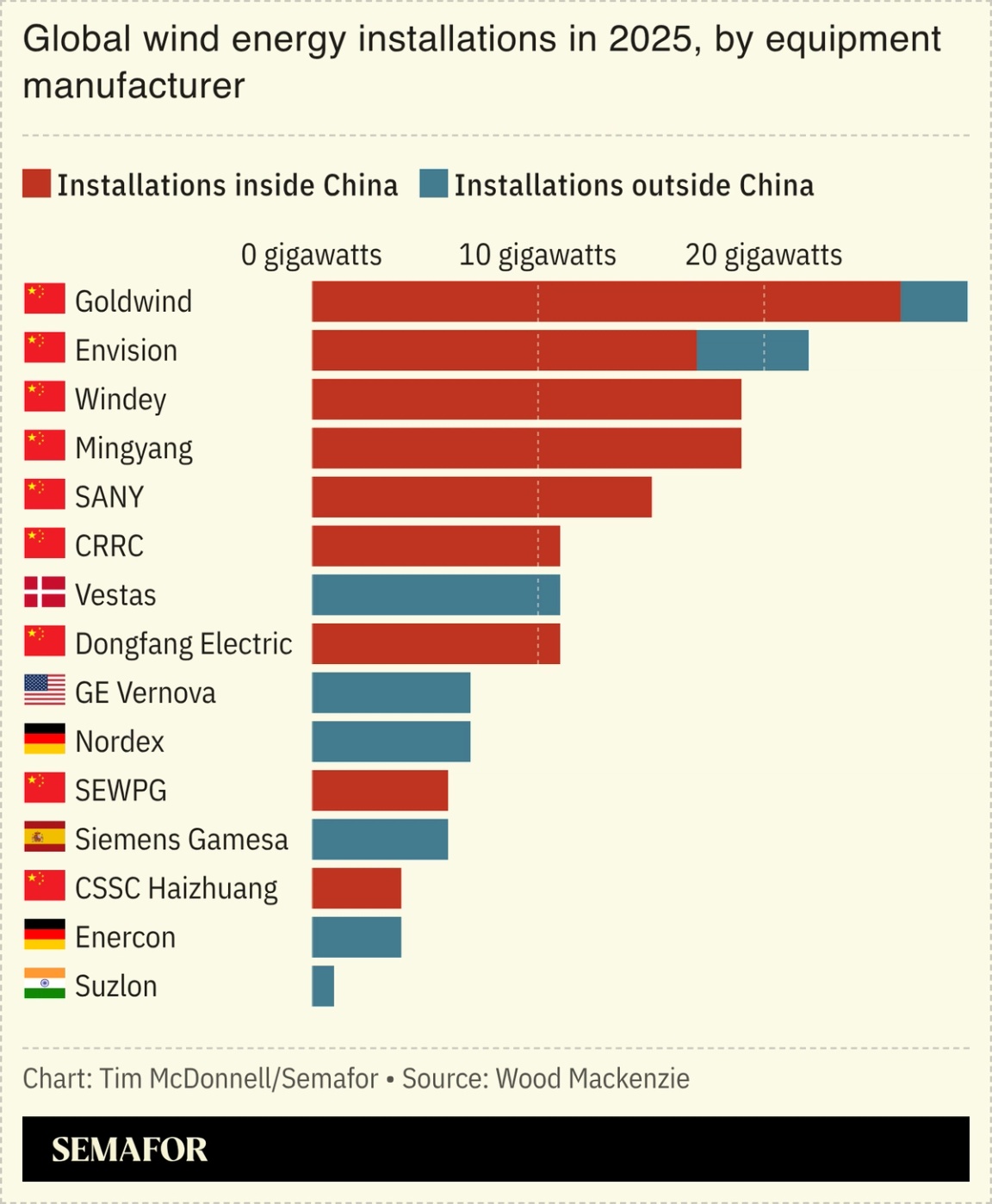 To see how the Iran war is aiding China’s projection of global power, look at wind farms going up on the banks of the Gulf of Suez. Egypt’s energy import bill doubled from January to March as it was forced to compete for scarce LNG shipments; the famously nocturnal megacity of Cairo is forcing shops and restaurants to close at 9 pm to ration power. The country has an ambitious goal to get 45% of its power from renewables within two years, and as Semafor’s Tim McDonnell reports from a recent trip, it can’t get there without China, which is also scrambling to cement new export markets for its vast wind and solar factories. Stepping in as a more reliable partner than the US for countries like Egypt could allow China to gain diplomatic and geopolitical inroads; so, too, will its ability to conduct some Gulf oil transactions in yuan and potentially supply energy-starved South Asian countries with oil. “When it comes to renewable energy, I don’t want to use the word ‘dominance’ or something,” one executive in Cairo said, “but the world is really relying on China.” |
|
➘ SELL: Diamonds. Prices hit a record low as Gen Z-ers put off marriage or opt for lab-grown or colored gems. ➘ SELL: Rough. Golf fans are furious at CBS, whose control room missed Rory McElroy’s final shots and other key moments. The jury is still out on whether Amazon’s early-round coverage was a hit. |
|
 Companies & Deals- Best served cold: United Airlines’ CEO broached the idea of a merger with rival American Airlines to government officials, Bloomberg reported. A deal would combine two of the big three carriers — and give Kirby, famously passed over at American in 2016 and quickly scooped up by United — the ultimate revenge takeover.
- Don’t bank on it: Wells Fargo shares dropped as much as 6% after its lending revenue fell short of expectations.
Watchdogs- Oil rush: At least 150 million barrels of Venezuelan oil have been sold since the US ousted Nicolás Maduro from power, Energy Secretary Chris Wright said Monday at Semafor World Economy.
Markets- Európa to the rescue: Hungary’s currency hit a four-year high and stocks surged to record levels as markets bet on EU aid and an economic reset following the end of Viktor Orbán’s 16-year tenure.
|
|
|


