| | In today’s edition: The UAE sets out its priorities for a postwar settlement, and Saudi Arabia’s big͏ ͏ ͏ ͏ ͏ ͏ |
| |  Washington Washington | Islamabad |  Aqaba Aqaba |
 | Gulf |  |
| |
|
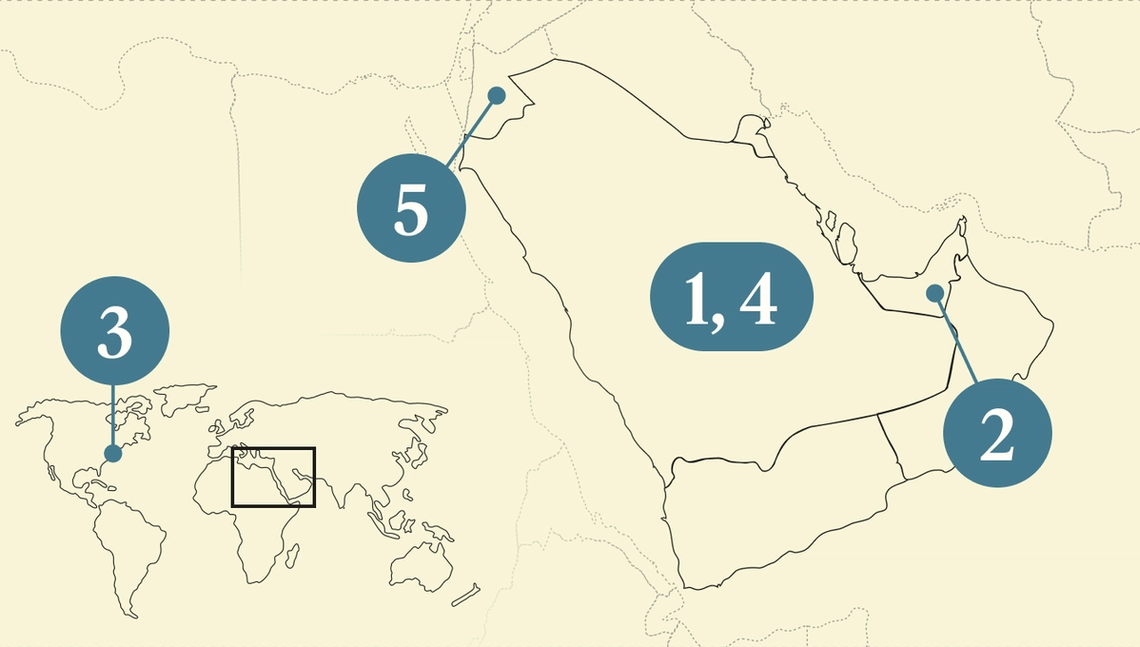 - Saudi-Pakistan alliance
- Abu Dhabi’s peace priorities
- AI for regulated industries
- LIV Golf in the rough
- UAE invests in Jordan rail
 A Saudi artist looks beyond conflict at the Venice Biennale |
|
Saudi and Pakistan cement strategic ties |
 Saudi Press Agency Saudi Press AgencyRiyadh is cementing its alliance with Islamabad, sending financial aid to Pakistan and receiving military assistance from its Asian ally. Pakistan’s Prime Minister Muhammad Shehbaz Sharif met Saudi Crown Prince Mohammed bin Salman in Jeddah yesterday and spoke of Islamabad’s “unwavering solidarity” with the kingdom. Last week, Pakistan sent fighter jets to Saudi Arabia to bolster its defenses against Iranian attacks, even as Islamabad was trying to mediate a US-Iran peace deal. The defense ties go back decades. Riyadh helped fund Pakistan’s nuclear weapons program in the 1970s; last year they signed a mutual defense pact. Saudi has supplied financial aid too, providing $3 billion to Islamabad this week just as a $3.5 billion loan from the UAE is up for repayment. In the past, Gulf loans to Pakistan were frequently rolled over when they matured, but Pakistan’s relations with Abu Dhabi are not as close these days: In January, the UAE signed a letter of intent for a strategic defense partnership with Pakistan’s main rival India. Sharif went on to Qatar today and is due in Türkiye after that, as Pakistan continues in its new-found role of chief regional diplomat. Pakistan army chief Field Marshal Asim Munir was also in Tehran yesterday to push for a second round of US-Iran talks in Islamabad, but no date has been set — Dominic Dudley |
|
UAE sets out Iran deal priorities |
  Annabelle Gordon/Semafor Annabelle Gordon/SemaforThe Strait of Hormuz should not be under anyone’s control, and reopening it is the UAE’s top priority in any security agreement between Iran and the US, Reem Al Hashimy, the UAE minister of state for international cooperation, said at Semafor World Economy. The emirates will also not accept an agreement that does not deliver “a clear and final conclusion” to the threat from Iranian missiles and drones she said, adding that Tehran’s naval and uranium enrichment capabilities need to be addressed as well. Al Hashimy noted that nearly a third of global fertilizer exports and a quarter of oil and gas come from Gulf countries, with much of it passing through the strait to international markets, meaning it is not just a regional issue. “The continuous weaponization of that strait is impacting everybody,” she said. “You’re going to feel that impact if you haven’t already.” — Kelsey Warner
|
|
AI firm Domyn targets regulated industries |
 Uljan Sharka. Semafor. Uljan Sharka. Semafor.Domyn, a European artificial intelligence company backed by Abu Dhabi’s G42, has launched a new model that allows regulated industries to own their AI systems. To support its plans, the company, which has kicked off a new funding round, aims to spend $10 billion over the next three years building one of Europe’s largest AI supercomputers in Italy, in partnership with Nvidia and G42. As with other AI startups, access to compute to train models has been a challenge. But CEO Uljan Sharka and other industry insiders predict that future architectures may allow for less centralized computing power, enabling more companies to compete with smaller, less power-intensive data centers. Before that future arrives, however, Sharka said Domyn still needs to build its own supercomputers because they will define how large the company can become. “$1 trillion is the new unicorn right now,” Sharka said at Semafor World Economy. “If you don’t talk about $1 trillion, you are out of touch.” — Mohammed Sergie |
|
| More from Semafor World Economy |
|
| Gulf connections today at Semafor World Economy |
  - Badr Jafar, CEO, Crescent Enterprises
- Ian Bremmer, CEO, Eurasia Group
- Bob Rubin, Former US Treasury Secretary
- Amos Hochstein, Managing Partner, TWG Global
- Sadek Wahba, Chairman & Managing Partner, I Squared Capital
- Ignacio Madridejos, CEO, Ferrovial
|
|
 Hamad I Mohammed/Reuters Hamad I Mohammed/ReutersThe “Golf, But Louder” league may soon be no more. Four years after Saudi Arabia launched a rival pro tour with mega paychecks that lured some of the game’s biggest stars away from sleepy incumbent the PGA, LIV Golf is facing closure, though no final decision has been made, the Financial Times reported. Backed by the kingdom’s Public Investment Fund, the young league has been beset by spiraling costs — its international business lost nearly $600 million in 2024 — and a mooted partnership deal with the PGA that never materialized. The speculation about winding down the league comes as the sovereign wealth fund embarks on a new five-year strategy, announced this week. A combination of lower oil prices, weaker-than-expected foreign investment levels, and runaway spending on so-called giga projects has led the fund to curtail some of its most ambitious projects. A LIV official told players in an email seen by Reuters: “Our season continues exactly as planned, uninterrupted and at full throttle.” At a tournament in Mexico it appeared to be business as usual, according to The New York Times. — Kelsey Warner |
|
UAE backs Jordan rail project |
 The value of a project backed by the UAE to develop a rail network in Jordan that will focus on fertilizer exports. A deal was signed by the two governments yesterday to set up the UAE-Jordan Railway Company and build and operate a 360-kilometer rail line between Jordan’s Aqaba port and the phosphate and potash mining areas of Al-Shidiya and Ghor Al-Safi. Phosphate and potash are key ingredients for fertilizer and the deal comes at a time when global supplies are being squeezed by Iran’s closure of the Strait of Hormuz, which usually handles around a third of the world’s trade in the commodity. The UAE investment is being channelled through Abu Dhabi sovereign wealth fund L’IMAD Holding Company, while the UAE’s Etihad Rail will help to run the new line. The deal builds on a $5.5 billion investment agreement between the UAE and Jordan signed in 2023. |
|
 Most CEOs have not woken up to the fact that technology is as important as their balance sheet, IBM Chairman and CEO Arvind Krishna says in the latest episode of The CEO Signal. The first technologist to lead the company in its 115-year history unpacks how he approaches high-stakes decision-making in moments of rapid technological change — including the initially controversial acquisition of Red Hat that he thinks landed him his current role. Krishna makes the case for why CEOs need to place bold bets, even when the payoff won’t be quick. And he cautions his fellow CEOs not to wait to start working out what quantum computing will mean for their companies. “You’d better start thinking about it now,” he says. Listen to the latest episode of The CEO Signal now. |
|
 Automotive- Middle East car sales for Nissan and Stellantis (which owns Jeep, Peugeot, and 12 others) have fallen by about half during the war, with lower demand a bigger factor than logistical disruptions. — Financial Times
Energy- Abu Dhabi’s international energy investment arm XRG is looking for more deals in Europe, fresh from its recent creation of petrochemicals giant Borouge Group International. — Bloomberg
Finance- Gulf countries have raised almost $10 billion in private bonds sales this month. It marks a move away from their usual habit of tapping public markets, where pricing can be more volatile. — Financial Times
- Middle East and North Africa startup deals hit a five-year low in the first quarter and international investors are pulling back, though headline funding figures held up on the back of a few large transactions.
|
|
|


