| | Energy policy vacillation in the US is spooking investors and leaving the country less prepared to c͏ ͏ ͏ ͏ ͏ ͏ |
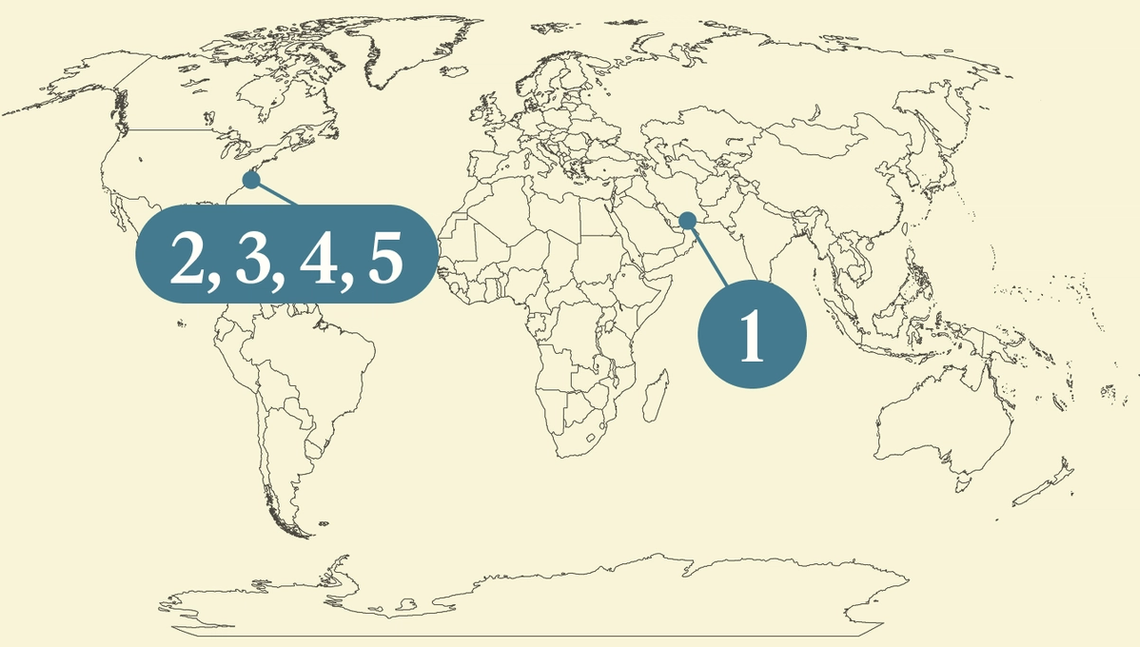
| |  Washington, DC Washington, DC |  Tehran Tehran | Beijing |
 | Energy |  |
| |
|
 - Blockade takes effect
- Redrawn energy map
- Gridlock on the grid
- War bumps EV sales
- Climate tech red tape
 A $58 billion repair bill, and $30 million an hour in new profits for Big Oil. |
|
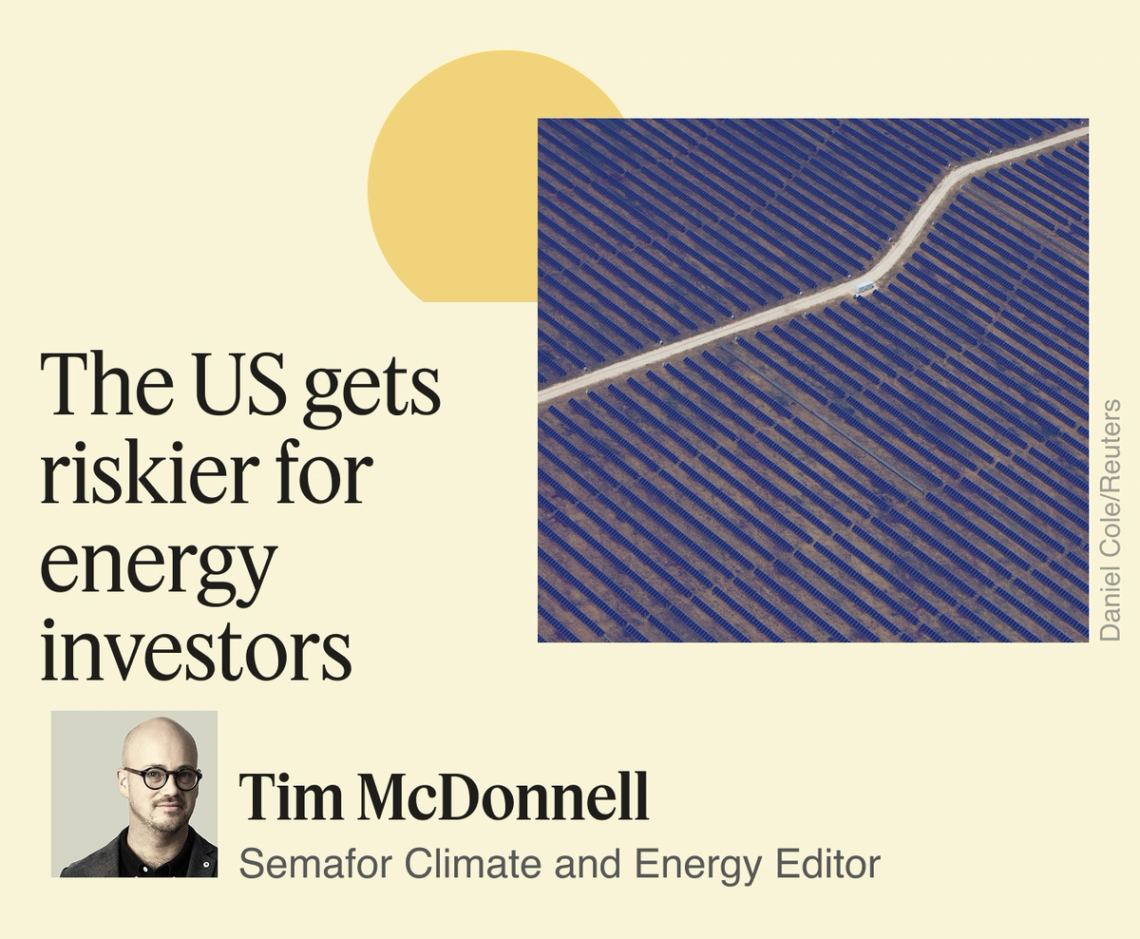 Energy policy vacillation in the US is spooking investors and leaving the country less prepared to compete in the global economy. US oil and gas production has been effective at insulating its consumers from the worst impacts of the Strait of Hormuz closure, global business and government leaders have told me onstage and in closed-door sessions here at Semafor World Economy. But there has also been a consensus that dirt-cheap electricity — put another way, dollars per unit of AI processing power — is the most important metric for future economic competitiveness. China’s edge is already huge: “If this is going to be a race between China and the US to build energy, we might as well call it a day,” Joe Dominguez, CEO of the power company Constellation, said onstage. “We are very far behind.” So how can the US catch up? The data center race looks like a powerful force to drive more investment into the nation’s energy system, and Wall Street types are confident there’s no shortage of capital poised to pour in. But a lot of it is waiting on the sidelines for the mess of US energy bureaucracy to get sorted out: Permits that are granted and withdrawn capriciously, tax credits that come and go, technologies that fall in or out of favor in successive administrations, and endless legal battles all amount to dangerous barriers to investment. Energy executives and policymakers in roundtables I have led — hardly climate activists — widely agreed that political opposition to renewables is shortsighted and counterproductive. The US, one said, had gone from NIMBY (not in my backyard) to BANANA (build absolutely nothing anywhere near anyone). In that sense, the battle between the US and China isn’t only the petrostate-vs-electrostate dynamic, although that is certainly real, but a tussle over which country looks like a more stable investment climate. And I was surprised to hear several times from policymakers and project developers that, in the power sector, the US investment risk profile increasingly resembles that of an emerging market in Africa or South Asia. That may be overstating the case a little, but at this point the US can’t afford any delays — especially as the war in Iran accelerates global demand for Chinese renewables. “The greatest changes in energy have come when there have been the biggest disruptions,” former US climate envoy and Iran negotiator John Kerry told me. “No one really understands how much energy is going to change after this.” |
|
  John Kerry. Tasos Katopodis/Getty Images for Semafor John Kerry. Tasos Katopodis/Getty Images for SemaforThe US blockade on Iran’s oil exports has forced Iran-linked or sanctioned vessels transiting the Strait of Hormuz to stop or turn around, according to shipping data — adding to the stranglehold on the flow of oil to global markets. The US military is enforcing the blockade in the Gulf of Oman, which means that ships leaving the Persian Gulf and passing the strait don’t necessarily beat the blockade. US Central Command said 10 vessels have been turned around and no ships have broken the blockade since it started on Monday. The blockade could be a way for the US to pressure China — Iran’s largest oil customer — to push Tehran to make a deal with Washington ahead of US President Donald Trump’s own summit with Chinese leader Xi Jinping. China, which sources around 40% of its oil imports through the strait, has several months of oil reserves stored on tankers at sea and in onshore stockpiles — but this won’t last forever. Ultimately, the war will likely end with a negotiated settlement that will look much like the 2015 nuclear agreement between Iran, the US, Russia, and other major powers, former US Secretary of State John Kerry said at Semafor World Economy. Oil prices remain below $100 a barrel amid hope that the US and Iran will prolong the ceasefire that is set to end next week and reach a deal to end the war, with stocks reversing their losses from the beginning of the conflict. |
|
 Fatih Birol. Tasos Katopodis/Getty Images for Semafor Fatih Birol. Tasos Katopodis/Getty Images for SemaforThe Iran war will “redraw the global energy map in real terms,” the executive director of the International Energy Agency said Tuesday, as countries scrutinize their energy ties more closely. With tensions in the Strait of Hormuz exacerbated by the US blockade of all Iranian ports this week, Fatih Birol said at Semafor World Economy that “we are not going back to where we were” after the waterway reopens. There will be a global “reaction,” Birol said, similar to the transformations that followed the 1970s energy shocks — which led to a surge in nuclear power and upended the auto industry — and Russia’s 2022 invasion of Ukraine, which led to strong growth in renewables. “The question is, what will be the reaction,” Birol said. He predicted more countries will prioritize energy security by factoring in a risk premium in trade based on the possibility for disruption, and whether countries can use their supply as leverage. “Trustworthiness [and] predictability will be very important in the energy trade and energy security,” he said. |
|
 (L-R) Bob Frenzel, Pedro Pizarro, and Semafor’s Tim McDonnell. Tasos Katopodis/Getty Images for Semafor (L-R) Bob Frenzel, Pedro Pizarro, and Semafor’s Tim McDonnell. Tasos Katopodis/Getty Images for SemaforRed tape for building new power generation and transmission lines is holding back the data center boom, the leaders of three top US utilities warned at Semafor World Economy. Pedro Pizarro, CEO and President of Edison International, said more streamlining of duplicative processes at the state level, “a shot clock” for the appeal process, and adequate government resources to deal with a growing stack of applications for new infrastructure were needed. “We just had a transmission project get its final permit. It took 17 years. We have another one that’s been gone for 20 years. It’s crazy.” Adding new power sources such as nuclear and advanced geothermal to the grid will ensure that the energy transition is affordable and reliable, said Bob Frenzel, president and CEO of Xcel Energy. But permitting processes at all levels of governments have caused “the longest and largest impediment,” slowing down the commercialization of new technologies. In addition, stricter eligibility criteria are needed to obtain a grid connection at a time when underinvestment means “we’re trying to do 20 years of grid work in a few years,” said Larry Coben, chair and CEO of NRG Energy. In Texas, only about 20% of the more than 200 gigawatts of power projects in line to connect to the grid are genuinely viable; the rest are speculative and unlikely to be built. “It’s become too easy to get in line.” |
|
 Increase in Hyundai’s EV sales in the US from February to March, in response to rising gasoline prices, CEO José Muñoz said at Semafor World Economy. The situation has highlighted the back-and-forth nature of EV demand that has plagued car companies in recent years. “One day, [dealers] call you and they say, ‘please stop producing EVs,’” he said. “The day after, they call you and say, ‘why [are you] not producing more?’” EV sales overall have fallen since the $7,500 tax credit to Americans buying the cars ended last year. But in March, Hyundai saw its sales mix return to the same level as before the tax credits, Muñoz said. “So we’re happy with that, but we would like to sell even more.” |
|
 Most CEOs have not woken up to the fact that technology is as important as their balance sheet, IBM Chairman and CEO Arvind Krishna says in the latest episode of The CEO Signal. The first technologist to lead the company in its 115-year history unpacks how he approaches high-stakes decision-making in moments of rapid technological change — including the initially controversial acquisition of Red Hat that he thinks landed him his current role. Krishna makes the case for why CEOs need to place bold bets, even when the payoff won’t be quick. And he cautions his fellow CEOs not to wait to start working out what quantum computing will mean for their companies. “You’d better start thinking about it now,” he says. Listen to the latest episode of The CEO Signal now. |
|
 Kyle Clark (R) and Semafor’s Tim McDonnell. Tasos Katopodis/Getty Images for Semafor Kyle Clark (R) and Semafor’s Tim McDonnell. Tasos Katopodis/Getty Images for SemaforThe regulatory environment needs to expand and adapt to fast moving cleantech start-ups with radical propositions that could change the way we live and consume energy, executives said at Semafor World Economy. “The level of technology that we have access to is always changing,” said Kyle Clark, president and CEO of BETA Technologies, which is developing electric vertical takeoff and landing aircraft. “The next step, ironically, is to continue to expand our regulatory acceptance of new technologies. The physics work. We just need the regulation to really get these things out”. Greg Pfeiffer, founder and CEO of nuclear fusion company Shine Technologies, said “there’s a lot happening on the regulatory reform front that’s really good” but there is always more the government could do. However, “throwing money at the problem is not the solution”, warning it risks creating “very inefficient companies” that can’t make economical products, he said. Baiju Batt, founder and CEO of Etherflux, a space-based solar energy company, said the bigger hurdle holding back faster deployment is that “there’s not enough capitalism in space”. But the intersection of AI and the space industry is “at the early stages of space becoming a more mature category for venture capital, for growth capital”. |
|
 New Energy- China is considering limiting exports of solar panels to the US, which could hurt US companies such as Tesla as they seek to ramp up local production, but also threaten Washington’s place in the race to produce space-based computing powered by solar panels, Reuters reported.
- Despite a boom in solar deployment, only around a quarter of the power generated by new renewable energy sources in India reaches consumers, as a rickety grid and a lack of energy storage keep the country reliant on oil and gas imports.
- German solar power generation is expected to surge 31% this summer and could help curb LNG imports, Bloomberg reports.
- The European Union wants to reduce electricity taxes and present energy ministers with a catalogue of measures to reduce energy demand and incentivise a shift away from oil and gas to offset the energy impact of the Iran war, according to draft plans. The IMF has warned the bloc against responding to the energy crisis by loosening its fiscal rules.
- The need for solutions is getting more urgent: Europe has “maybe six weeks or so [of] jet fuel left,” the head of the IEA told the AP, warning of possible flight cancellations if oil supplies remain scarce.
- The UK released its new fusion energy strategy, which sets out the country’s plan to reach commercial use and aims for the first plant to begin operations in 2040.
Fossil Fuels- Damage to energy infrastructure in the Middle East could cost the region up to $58 billion, Rystad Energy reported, with oil and gas facilities accounting for most of it.
- US oil exports surged to a record high last week as Asian and European markets scrambled to replace fossil fuel imports from the Middle East.
- The world’s top 100 oil and gas companies have also been profiting from the war in Iran: In the first month of the conflict, they raked in more than $30 million every hour in unearned profit, The Guardian reported.
- Meanwhile, Pakistan plans to schedule two hours of daily power outages in the evenings to curb energy price rises for households during peak demand, as the energy crisis shakes a nation which secures nearly all its gas imports from the Gulf.
|
|
|


