| | In this edition: Dangote’s warning on airlines and farmers, BII chief talks of financing ‘reset,’ an͏ ͏ ͏ ͏ ͏ ͏ |
| |  Abuja Abuja | Pretoria |  Addis Ababa Addis Ababa |
 | Africa |  |
| |
|
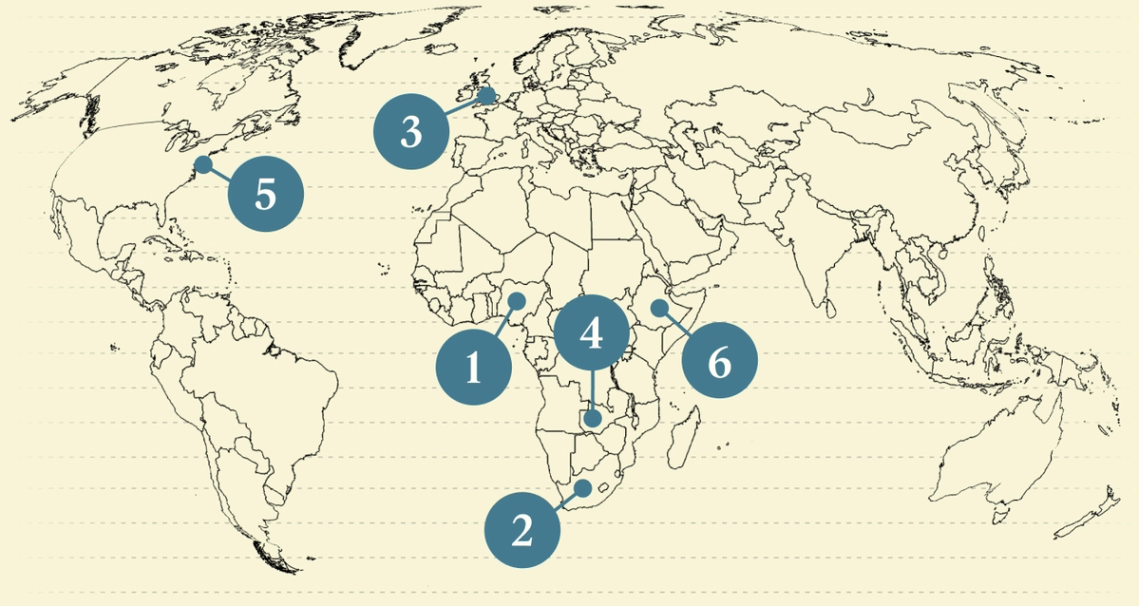 - Dangote warns on fuel
- S. Africa won’t ‘wait-and-see’
- BII chief on finance ‘reset’
- US pressed on Zambia plan
- Heard at SWE
- Weekend Reads
 A fossil found in South Africa casts new light on mammals. |
|
Dangote warns fuel costs threaten airlines |
  Aliko Dangote. Tasos Katopodis/Getty Images for Semafor. Aliko Dangote. Tasos Katopodis/Getty Images for Semafor.Rising oil prices driven by the Strait of Hormuz blockade are threatening to devastate African airlines and farmers, Africa’s richest man Aliko Dangote said at Semafor World Economy. “The majority of African airlines won’t be able to survive” the current surge in fuel prices, the Nigerian industrialist warned at the event in Washington, DC. Dangote, who owns the continent’s biggest oil refinery, noted that Nigerian carriers have already announced they will suspend operations by April 20 if prices are not reduced. “Between morning and night, you see the oil moving up and down $10. I’ve never seen it like that. Never,” he said. Dangote was equally stark about fertilizer, saying that two months ago it was selling for about $400 and today it is at $850. “This farming season the governments have to actually give subsidies.” Dangote said a best-case scenario would be a US-Iran agreement to ease fears over the fate of the critical Hormuz waterway. But he cautioned that even a deal would leave “another two, three months before we go back to normal” due to supply chain backlogs. Dangote made his comments shortly after a 10-day ceasefire between Israel and Lebanon took hold on Thursday, boosting hopes for progress in peace talks between the US and Iran — and ultimately the reopening of the strait. — Adrian Elimian |
|
S. Africa central bank won’t ‘wait-and-see’ |
| | Tiisetso Motsoeneng and Alexis Akwagyiram |
| |
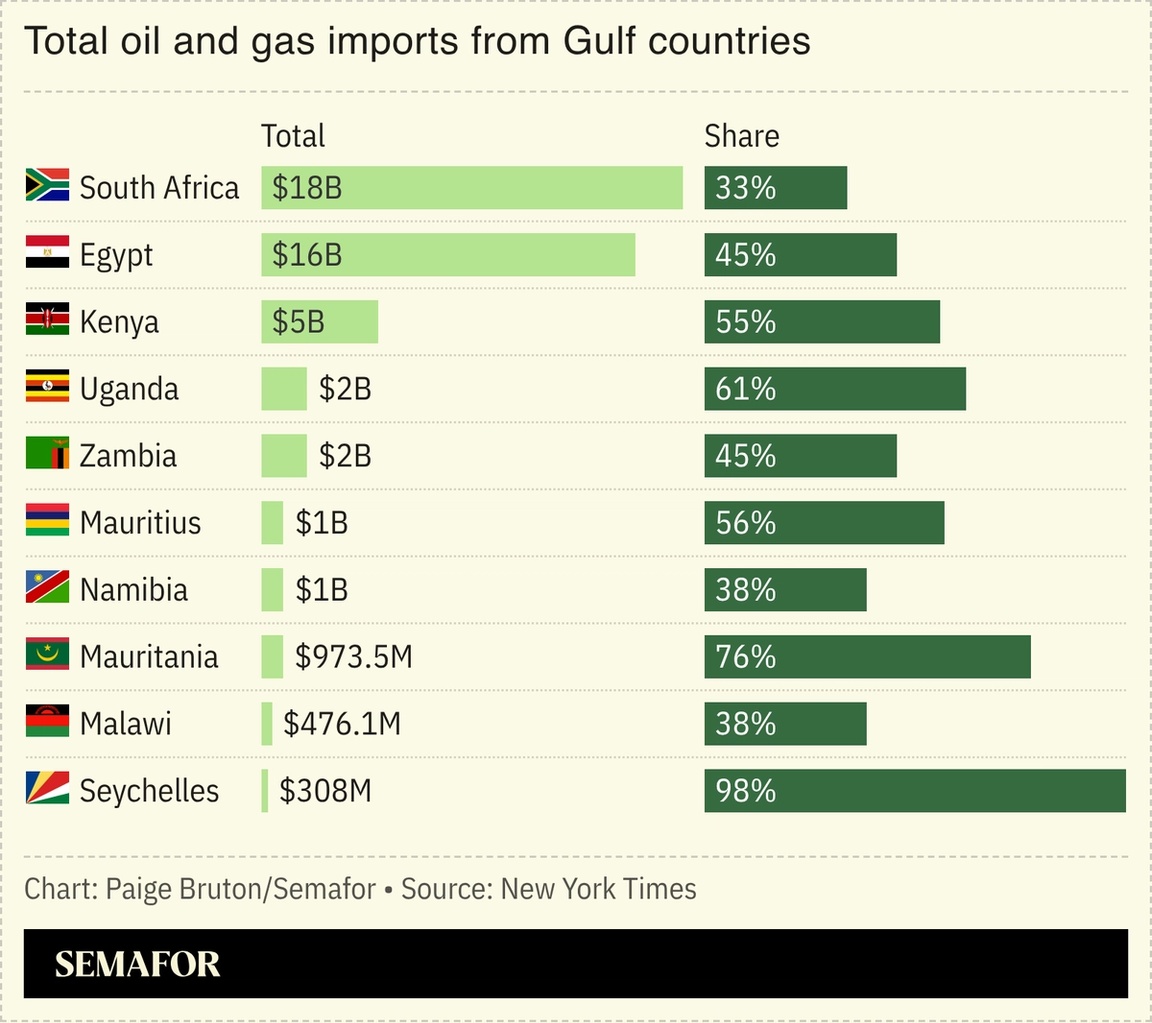 South Africa’s central bank governor broke sharply with the global “wait-and-see” mood about the impact of the Iran war, saying the bank cannot be “complacent” and will not wait for early price shocks to filter through Africa’s biggest economy. Lesetja Kganyago’s comments at Semafor World Economy in Washington, DC, open up the possibility of interest rate hikes before fuel and fertilizer shocks bleed into wages, transport, and broader price-setting behavior. “It is important to anticipate any evidence that will start emerging that would suggest that the second-round effects could kick in and you react to that,” Kganyago said. “You don’t wait for the second-round effects to arrive; by that time it’s too late.” Kganyago said the current inflation environment was more complicated than a typical one-off shock, describing it as a sequence of shocks hitting South Africa through fuel and fertilizer markets. The South African Reserve Bank is also among the first emerging market central banks to signal that cuts are not guaranteed and hikes remain possible. |
|
 Semafor World Economy is well underway with over 500 CEOs and government leaders — including US Cabinet secretaries, central bank governors, finance ministers, and Fortune 500 executives — joining us for on-the-record conversations about the forces shaping the global economy. Today’s sessions include discussions on The Next Era in Innovation and Reimagining Global Economic Levers. All sessions will be livestreamed on Semafor’s YouTube channel — watch here. |
|
BII head on finance’s ‘structural reset’ |
 BII chief Leslie Maasdorp. Tasos Katopodis/Getty Images for Semafor. BII chief Leslie Maasdorp. Tasos Katopodis/Getty Images for Semafor.The international development sector is undergoing a “structural reset” amid shrinking Western aid budgets and the fallout of the Iran war, the head of the UK development agency said at Semafor World Economy. The UK government this year announced cuts to its overseas aid budget, amid increased defence spending, mirroring similar shifts by France and Germany. The US Agency for International Development, which disbursed around $40 billion annually to some 130 countries, was shuttered last year. “The development finance system has been in need of a sort of structural reset,” British International Investment CEO Leslie Maasdorp said in Washington, DC, arguing that the previous model no longer fits the moment. “A lot of the countries have been uncomfortable with almost a paternalistic donor-recipient relationship,” he said. Maasdorp called for a pivot toward investment, capital mobilization, and regional integration, saying BII was looking to forge partnerships that de-risk investment in markets long dismissed as too volatile. — Adrian Elimian and Alexis Akwagyiram |
|
US State pressed on Zambia plan |
| |  | Adrian Elimian |
| |
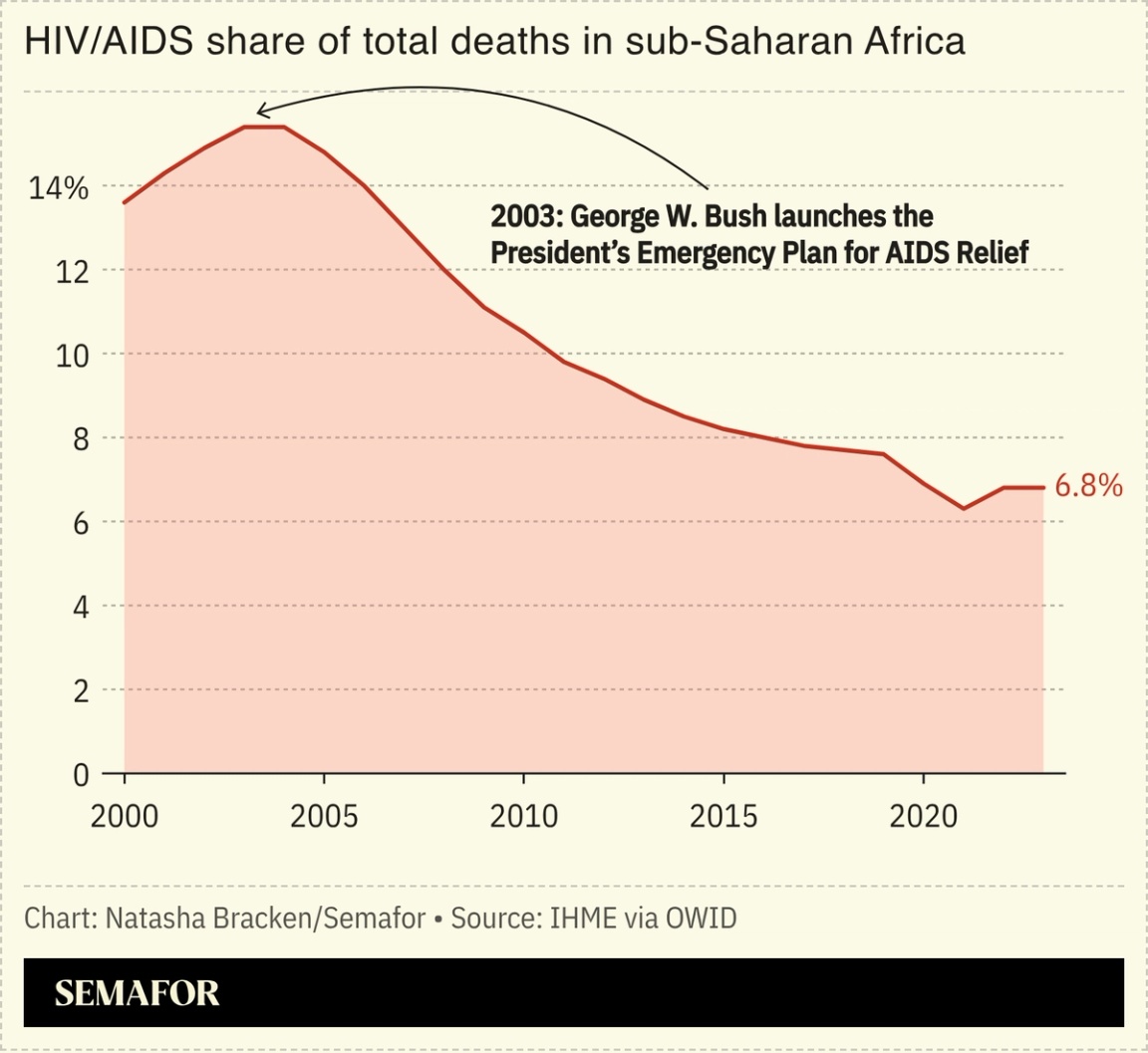 Three Democratic US senators are demanding that Secretary of State Marco Rubio reject plans to withhold lifesaving HIV treatment from over a million Zambians unless the African nation agrees to grant American businesses favorable access to its copper mines. Jeanne Shaheen, the top Democrat on the Senate Foreign Relations Committee, along with Sens. Chris Coons and Brian Schatz, wrote in a letter to Rubio that they are “alarmed by reports” about US State Department officials proposing to condition both HIV aid funding and previously pledged economic assistance on Zambia agreeing to economic reforms that will benefit US businesses. “We urge you to reject this tactic of economic coercion,” they wrote in the Thursday letter, which was shared first with Semafor. It follows reporting that the State Department had crafted a plan to pressure Lusaka on mining policy by threatening to end health support “on a massive scale.” The senators called the reported approach “a disturbing break from the long-held bipartisan support for PEPFAR,” an HIV prevention and care program that has enjoyed rare bipartisan backing in Congress. |
|
Heard at Semafor World Economy |
|
 On this week’s episode of Mixed Signals, Patrick Radden Keefe joins the show to talk about page-turning journalism, his own celebrity, and the humanity behind his work. Patrick discusses his new book, London Falling, how he finds stories that pull readers in, and the balance between mystery and resolution. He also touches on his unexpected celebrity, the shift from page to screen, and why real people and messy emotions make the best stories. Listen to the latest episode of Mixed Signals now. |
|
 - Turkey is waging a high-risk, high-reward wager in the Horn of Africa, writes an analyst in World Politics Review. Turkish President Recep Tayyip Erdoğan recently visited Ethiopia to sign new economic agreements that pave the way for future energy and infrastructure deals. But behind the photo op, writes Elfadil Ibrahim, “a much more complicated game is unfolding” in the region, as Ankara also supports Ethiopia’s neighbor Somalia in its fight against insurgent groups, making security cooperation key too.
- The trade in live birds from Africa to Asia is booming. Nearly a million live wild birds from Africa were exported to Hong Kong and Singapore between 2006 and 2020, according to new analysis of customs data. Canaries, including species declining in the wild, topped the list. With few regulations in place, the trade in wild birds is “harming biodiversity in Africa,” Mongabay reported, threatening more than 200 avian species with extinction.
- Africa’s manosphere is growing. Some experts say the loose network of online influencers who claim to address men’s problems but instead promote misogyny is on the rise on the continent, as it is in the West. The Guardian profiles seven men who are gaining traction online from Ethiopia, Kenya, Nigeria, Somalia, South Africa, and Zimbabwe. However, one feminist studies professor notes that the falsehoods peddled against women in Africa predate the proliferation now seen online.
|
|
 Business & Macro
|
|
|


