Jack's Flight Club ✈️ Travel News & Inspiration |
|
|
Hey there, Travellers,
This week's news has been nothing short of alarming ahead of summer travel. Airlines everywhere are cutting flights, and experts are warning that Europe only has six weeks of jet fuel left. So should we expect to be grounded?
In short: it's unlikely. Although much of the world's jet fuel usually passes through the Strait of Hormuz, only around a quarter of Europe's supply tends to come from the Middle East. North America's supply is relatively unaffected, and the US has upped exports of jet fuel to Europe to help compensate.
What we will all likely continue to notice is price. Higher fuel costs mean airlines may charge more, and they'll slim down their services to maximise efficiency. Less popular routes could face the chop, and you might have to look for alternative flights to reach your destination. So where possible, bake in some flexibility to your plans, and always make sure you have travel insurance.
Happy travels and safe landings, |
|
|
|
|
Katy - Editor of The Detour |
|
|
|
Cathedrals, Canyons, and Crimes: Wild West Mythos from the Nevada Desert
|
|
A San Diego native, Olivia left home two years ago to live on the road. Since then, she's had homebases everywhere from Quebec to England to New Orleans, but she always ends up back on the West Coast. When she's not hiking through the desert or the woods, she can usually be found exploring her current city and scoping out the best bars and coffee shops. |
|
|
|
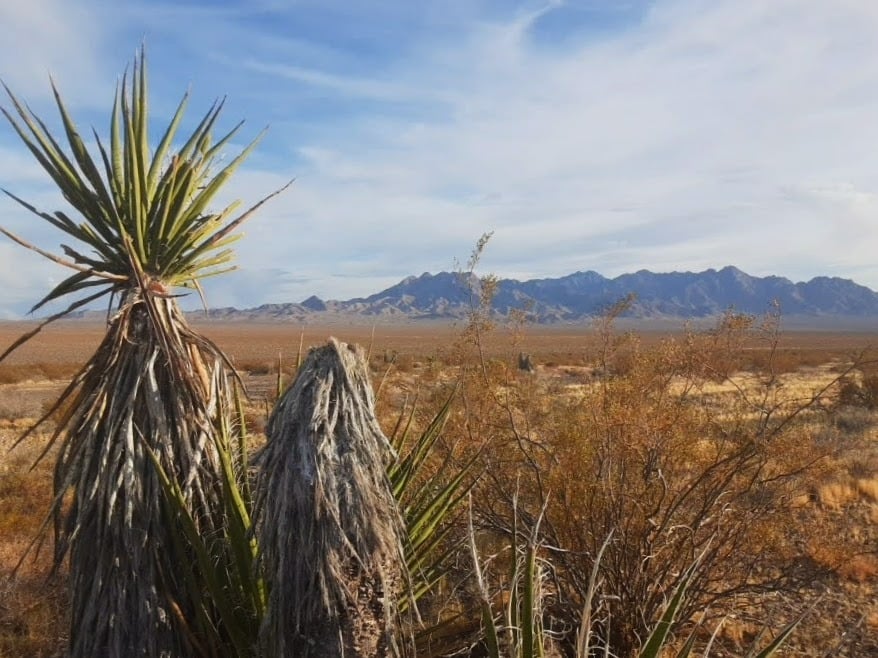
If you’re a regular reader of The Detour, you’ve probably heard at least one or two of my tales from the American deserts. I’ve got a lot of fun stories about Southeast California and Southern Nevada in particular — that’s one of my favorite areas, and I’ve spent a lot of time out there. At this point, I’m practically an evangelist for the Mojave and Colorado deserts. There’s simply nowhere else like it.
Growing up near the edge of that unbelievably vast, often inhospitable landscape sometimes felt like being at the edge of an enchanted forest. While I’m familiar with the region, I’m always going to be an outsider, just a kid wandering through the woods and trying to make sense of what they find. The more you stray from the towns and drive out into the wild valleys and canyons, the fewer rules seem to apply. |
|
|
|
|
There’s a deep-rooted cultural idea that people take their worst secrets out of the city and into the dirt. After all, every crime thriller set in SoCal or Vegas has a scene where someone drives out to the desert to meet a shady contact or bury some evidence.
The darker tales are particularly common in rural areas of Southern Nevada, which has a century-long reputation of absorbing any actions too sinful even for Sin City. While Vegas has long since left its mafia heights in the rearview, there’s a reason no one was shocked when the receding water of Lake Mead reopened some old missing persons cases. Everyone knows that some pretty shady stuff has happened outside the reach of those casino lights.
If you repeatedly stick your nose into anything that looks interesting (and there are a lot of interesting, oddball things in Nevada), you might stumble upon the remnants of that darkness yourself. That’s what happened to me when I drove out to an unassuming canyon off the highway, and I couldn’t believe how much lore I learned in the process.
This is a story about one man’s attempt to build something beautiful out in the dirt, the Wild West legend connected to it, and how, sometimes, you never really know what horrible things have taken place on the ground beneath your feet.
What I found
This adventure started like most of my desert adventures: learning about some funky landmark off in the dirt somewhere, and deciding to try and find it. In this case, my target was a hole in the ground called “Cathedral Canyon,” which I knew absolutely nothing about, besides the fact that it was notable enough to be labeled on Google Maps.
An hour from Vegas and just barely inside the state line, the canyon is actually pretty easy to reach. You only make a couple of turns off the highway south from the town of Pahrump, head deeper into the valley backroads, then park in the dirt once you notice the ground opening up beside you.
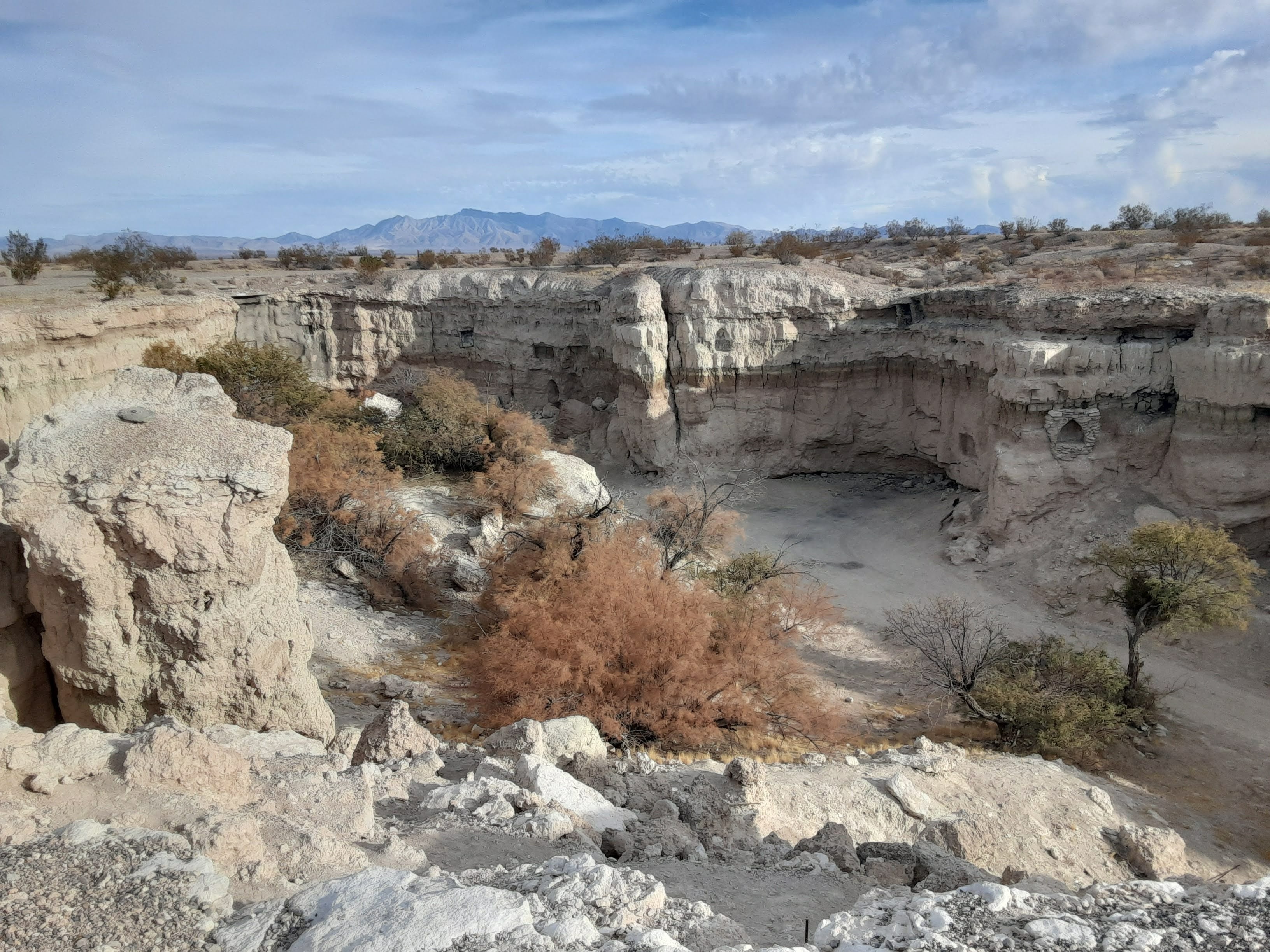
As usual for spots like this, it was dead quiet when I got out of the car. Not a soul for miles. Just me and the rocks, the rustle of wind through the creosote, and the giant ditch I was about to enter: |
|
|
|
|
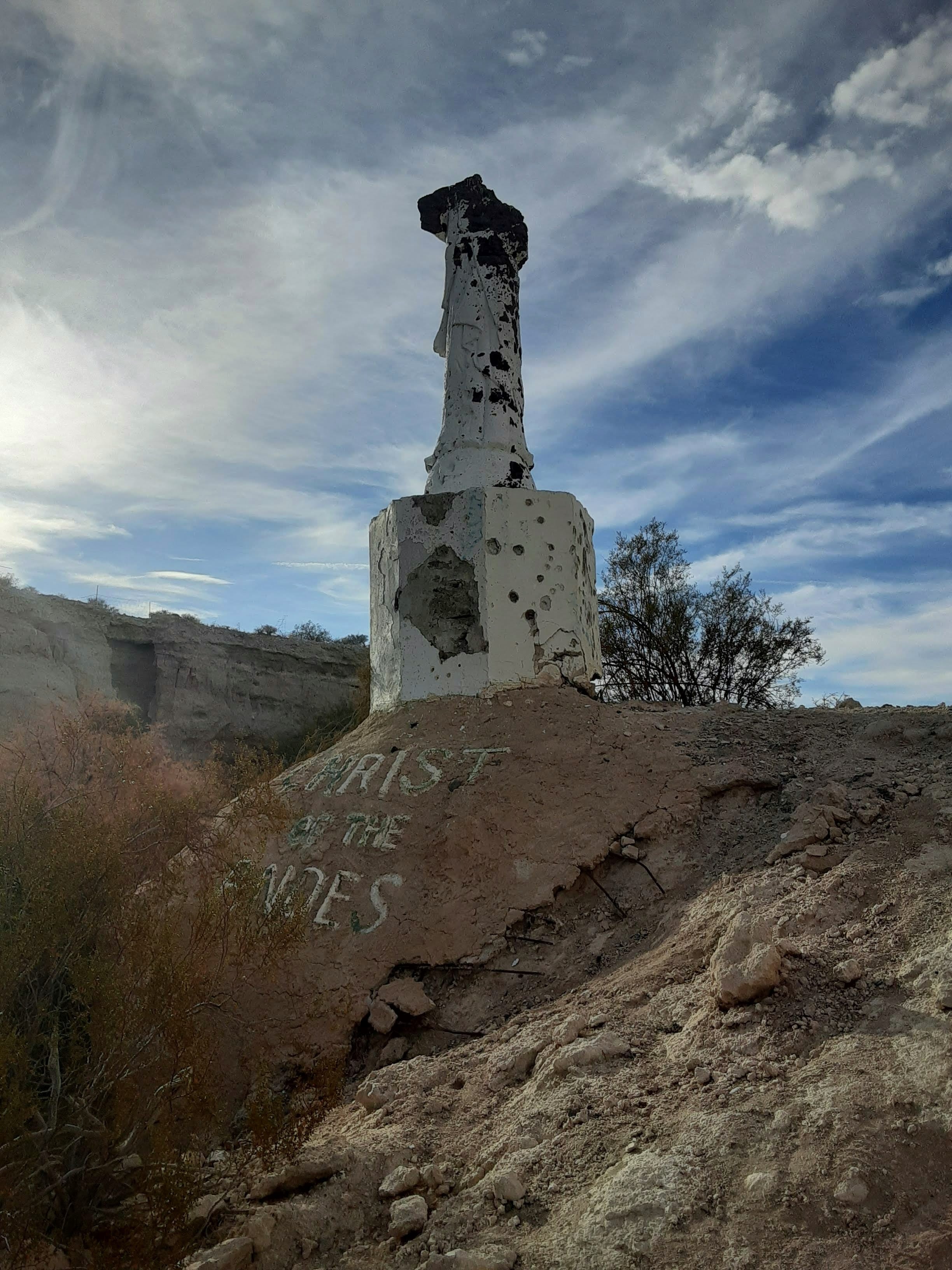
As I started climbing down into the canyon, my first thought was, “This place used to be something.” A crumbling plaster statue with a missing head, decorative brick frames built into the cliffs, doors carved into the canyon walls that led to nowhere and contained nothing, random sets of concrete steps — all worn down and clearly abandoned, but intentional. Someone tried to build something here.
A theme quickly became apparent. The brick frames seemed to be shrines. A few crosses had been left behind. The plaster statue above me, desiccated beyond recognition, was labeled “CHRIST OF THE ANDES.” Okay, someone tried to build something religious here. |
|
|
|
|
There’s a decent bit of overlap between desert hippie culture and Christian hippie culture (Salvation Mountain is a prime example) so this made total sense. Still, it’s easy to catch the heebie-jeebies when you’re poking around abandoned stuff in the desert, and the contextless, decomposing religious artifacts didn’t exactly help.
I felt like I was intruding. I was clearly alone, and in a spot labeled as open to the public by Google Maps! But I couldn’t shake the feeling that I was breaking that cardinal rule and sticking my nose in someone else’s business. It felt like someone was about to pop out of one of those strange door holes and fire a shotgun over my head. I’ve felt that way in the desert before, but it was particularly strong this time.
When I was finished investigating all the nooks and crannies, I walked under the rusted metal archway at one end of the canyon, and hopped back up to the surface.
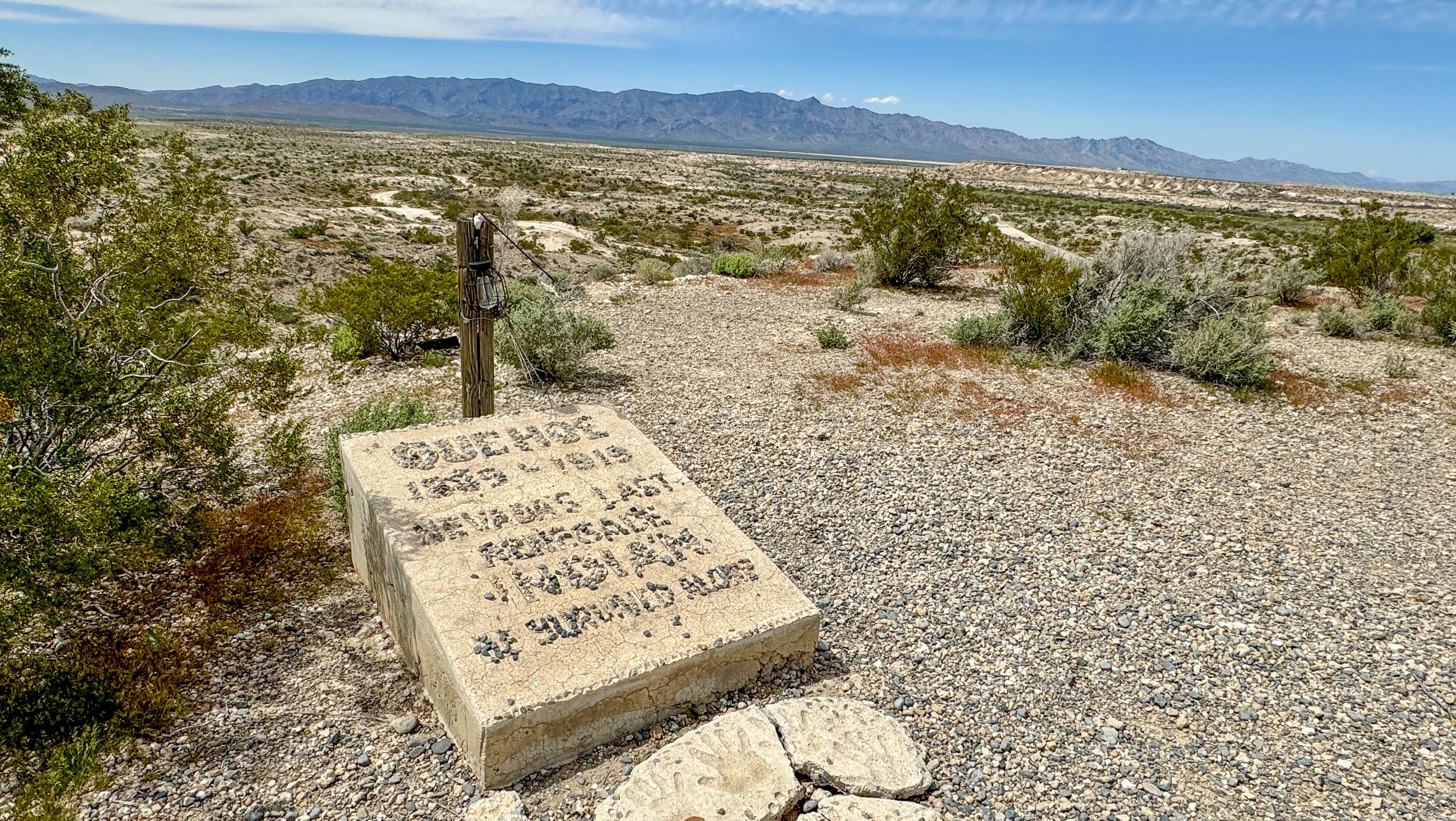
If I believed in ghosts (and I very much do not), I might have attributed my heebie-jeebies to the tombstone I noticed on the way back to my car: |
|
|
|
|
Image by Tami Force of nvtami.com
The inscription read:
“QUEHOE
1889-1919
NEVADA’S LAST RENEGADE INDIAN
HE SURVIVED ALONE”
I made a mental note of the name “Quehoe” and headed on home, head full of questions to research when I got there.
Here’s what I learned.
What is this place? Who built it?
The story of Cathedral Canyon begins with a man called Roland Wiley, who moved to Las Vegas in 1929 to find work as a lawyer. This turned out to be a smart career move, because he was elected as the Clark County District Attorney less than a decade later. You can read his entire fascinating story in this interview (featuring a cameo by infamous mobster Bugsy Siegel!), but our story is about the land he purchased with his DA earnings.
In 1936, Wiley bought a large swath of desert outside the city and began to develop a ranch. Decades into that process, in 1972, he experienced a vision. Some sources call it a “vision from God”; others say he simply had a fever. One very old blog post claims it was brought on by infected rabbit meat.
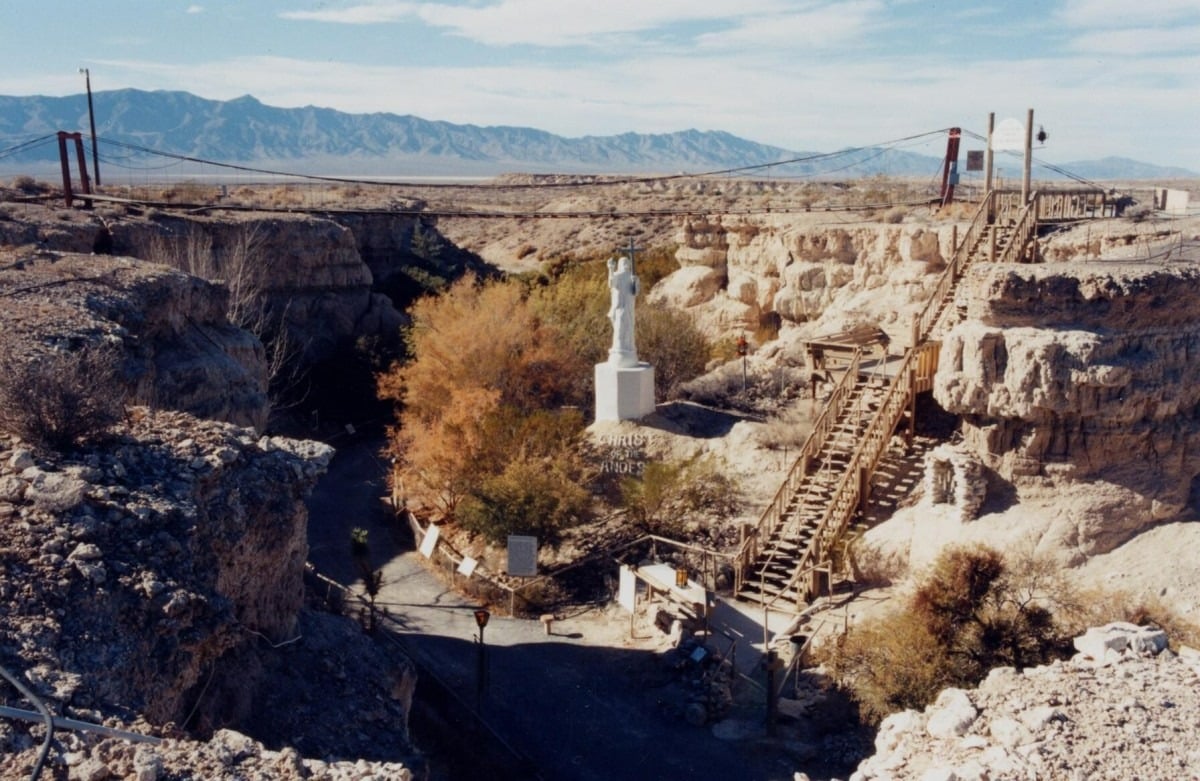
Whatever the cause for this vision, Wiley began building his masterpiece immediately afterwards. Using a natural gorge on his property and spending exclusively his own money, he constructed a suspension bridge, a stairway, a network of paths, and dozens of artworks across the canyon. He even wired it all for electric power so it could be lit up at night and stay accessible to visitors 24/7. He called his project “Cathedral Canyon” and wanted it to be a peaceful place where folks could enjoy the beauty of the desert along with their spirituality. |
|
|
|
|
Cathedral Canyon during its heyday. Image from the Center for Land Use Interpretation.
For the next 22 years, Wiley and his canyon hosted regular church services and various events, including a wedding and a rock concert.
In 1994, Roland Wiley passed away at the age of 90, leaving no instructions or resources for the canyon’s preservation. Since then, the canyon has been slowly settling into disrepair. Artifacts and structural pieces disappeared one by one, and his artwork faded and was covered by graffiti. What I encountered on my trip in 2024 was all that’s left behind of Wiley’s masterpiece.
So that’s the rise and fall of Cathedral Canyon: one man’s mark on the desert, an attempt to turn an ordinary gorge into a place of reflection. And like most things that get abandoned in the desert, its bones will rest quietly in the sand for decades to come, occasionally hosting curious visitors like me. This story ought to end there, on a melancholic but tranquil note.
But we still have a tombstone to talk about... |
|
|
|
|
The Detour Editor Katy is a budget travel aficionado who has already travelled to more than 50 countries. Whether she's at home or on a foreign adventure, she has a particular talent for stumbling upon tasty Georgian restaurants. |
|
|
|
It’s marathon season around the world. Each weekend seems to reveal a new crop of very sweaty, healthy folk wondering if their knees will ever be the same again. And if you’re one of them — well done!
But once you’ve done a few of these, surely you need a change of pace; a new incentive or a change of scenery, perhaps. Good news: I have just the suggestion for all you fit foodie travellers! Bake a tasty race into your future trips, combining local delicacies with your athletic endeavours, and see somewhere new along the way.
From ultramarathons involving tacos, to downing vintage wines in French vineyards on the trot, there’s something for every (slightly crazy) runner. Here are our top picks for food-and-drink-themed races around the world.
NYC Pizza Run, New York |
|
|
|
|
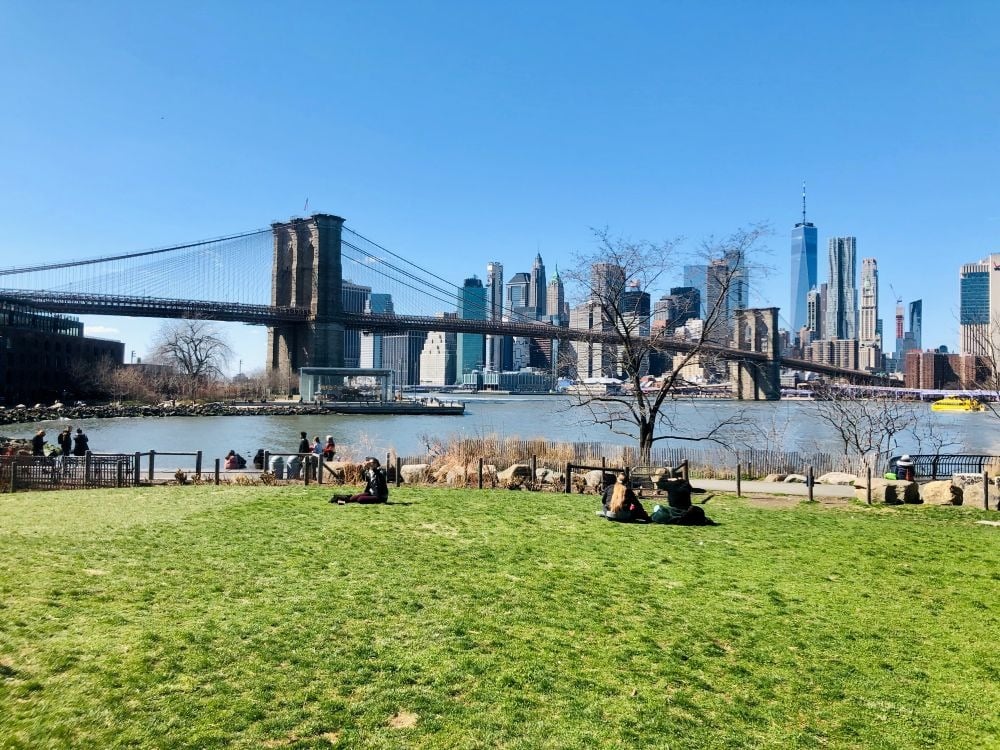
“New York’s Sauciest Run” sounds a little messy to us, but in the best of ways. The 5k race involves three laps around a city park, with scoffing a slice of essential for passing “Go” each time around.
2025 saw the 15th edition of the race, which took place in Brooklyn’s Forte Green Park in September. The 2026 race hasn’t been announced just yet, but keep your eyes peeled for updates on the race Instagram page (or their website).
Treviso Tiramisu Run, Italy |
|
|
|
|
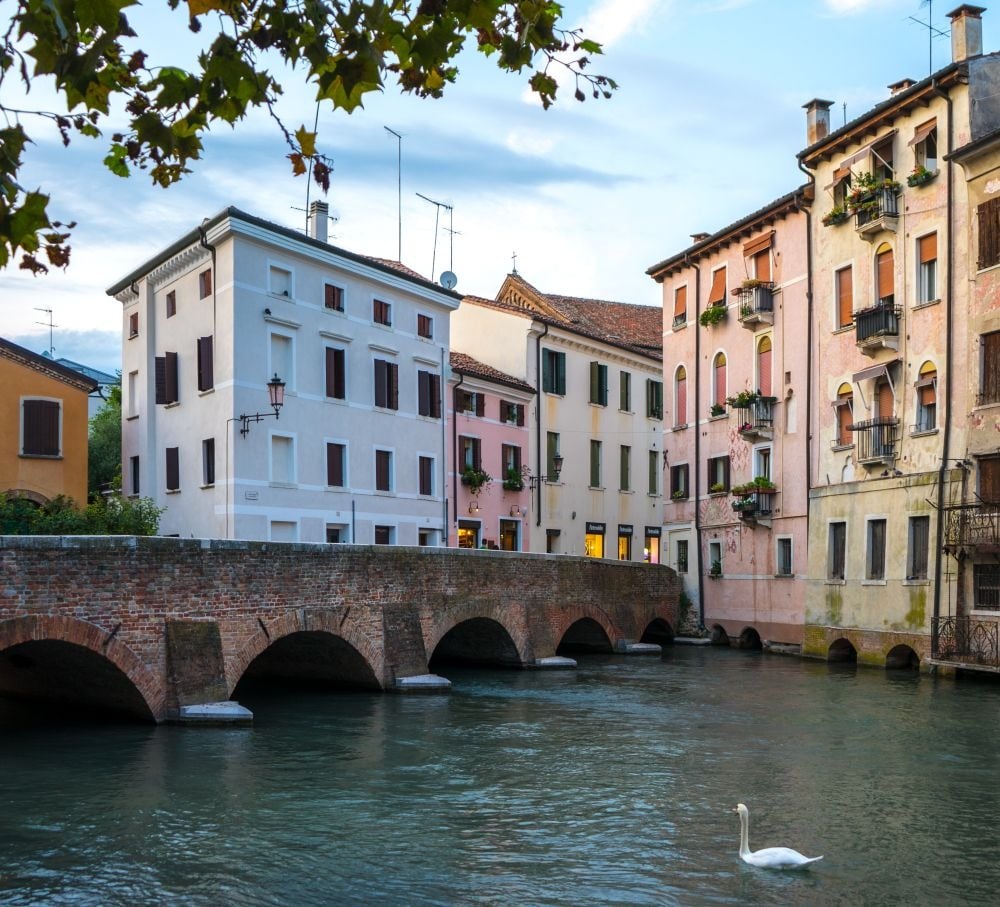
In under half an hour by train from Venice, you can be in Treviso, the home of tiramisu. Each October, dessert makers and tasters from all over the world converge on Treviso to compete for the crown in the Tiramisu World Cup. And the cocoa-dusted icing on the cake is a sweet 10k.
You can work up a hunger running through the ancient canal-lined city, before settling into that creamy coffee hit when you’re done. Top it off with a spritz in a peaceful piazza, and it sounds like a pretty good weekend, if you ask me.
However, if you’re less into the race and more into the recipes, judging the World Cup may be more your speed. Applications haven’t opened yet, but you can subscribe to their newsletter to get updates.
Marathon du Médoc, France |
|
|
|
|
|
|
|