What I came to understand is that knowing what is wrong is only part of the equation.
In many complex chronic cases, the real issue is knowing:
what needs attention first
what can wait
and what the body is truly ready for at that
moment
Whether you are newer to functional medicine or have already spent years studying it, many clinicians eventually run into this same frustration.
If you are newer, this may explain why complex cases can start to feel overwhelming.
If you already have training, this may explain why some layered cases still do not feel as clear as they should.
And this is important:
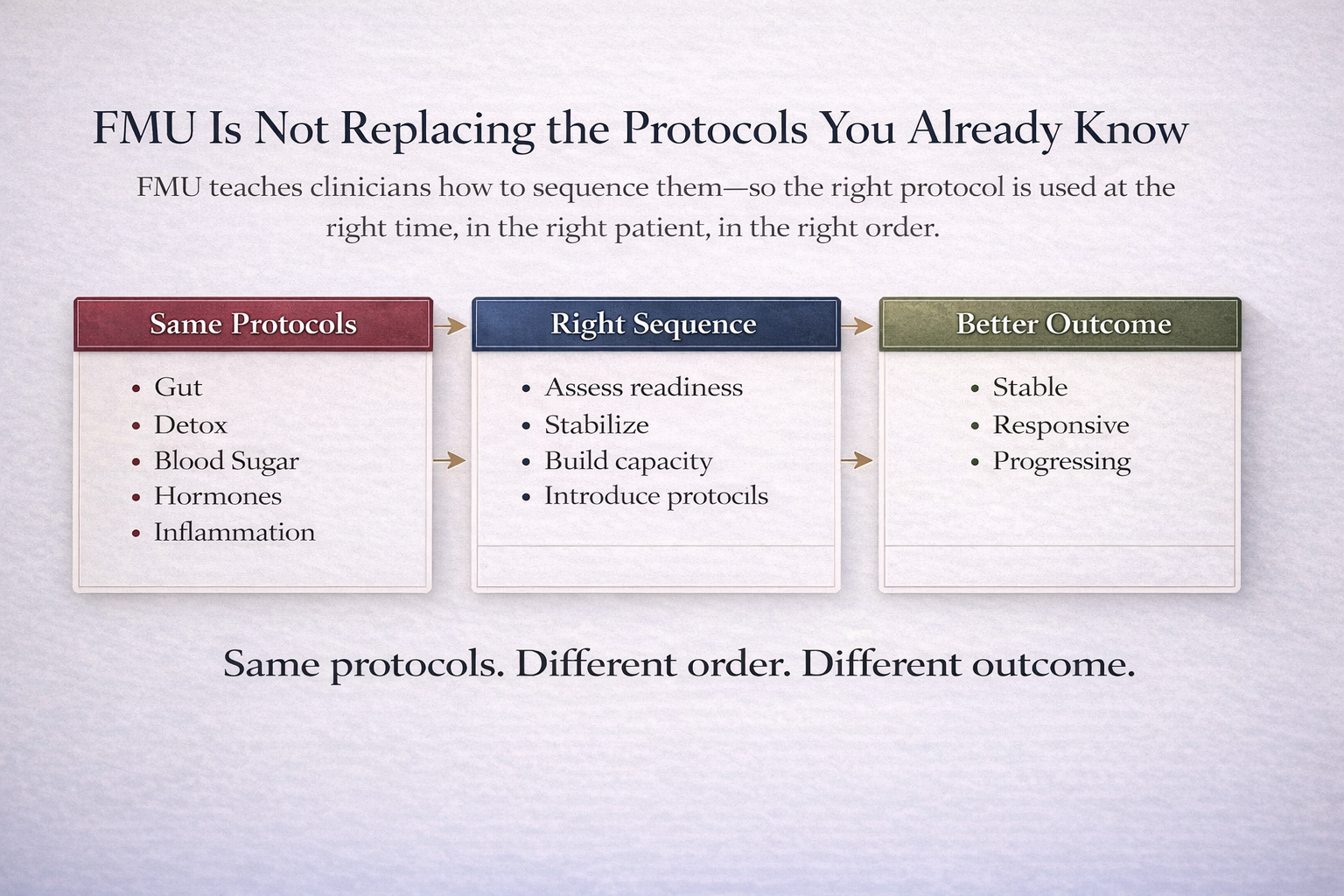
FMU was not built to replace functional medicine.
FMU was
built to solve the missing clinical gap between knowing functional medicine and applying it in the right order.
That is why, at FMU, we do not just teach concepts, protocols, and labs.
We also teach
clinicians how to think through a case, how to determine readiness, how to prioritize what deserves attention first, and how to avoid overloading the system too early.
One FMU clinician shared this with me:
“I had studied functional medicine for
years, but I still had cases where the labs made sense, the plan made sense, and the patient still did not respond the way I expected. FMU helped me understand that I did not just need more tools. I needed a better way to think through the opening phase of care.”
That is one of the central reasons FMU exists.
FMU was built for clinicians who want to practice with deeper responsibility, stronger judgment, and a better order of operations in the kinds of cases that too often become confusing, reactive, or stalled.
If that kind of clinical thinking is what you have
been missing, this is the time to take a closer look at FMU:
Enrollment is open now, and once this cycle closes, the next opportunity to join will not be until the next enrollment
period in July 2026.
To your growth and success,
Dr. Ron Grisanti Founder, Functional Medicine University
P.S. If you have ever had a case where the labs made sense, the plan made sense, and the patient still did not improve the way you expected, that is exactly the kind of clinical gap FMU was built to address.