
|
 |
Welcome to Popular Information, a newsletter dedicated to accountability journalism.
No corporate overlords. No B.S.
The media blackout of Jared Kushner’s historic, ongoing corruption scandal
As Trump's son-in-law returns to Pakistan for more talks with Iran, major news outlets are largely ignoring an egregious conflict of interest.
| |||||||||||||||


 |
Jared Kushner, President Trump’s son-in-law, is leading U.S. diplomatic efforts with Iran while engaged in a lucrative, ongoing, multi-billion-dollar business relationship with the Saudi government. This brazenly corrupt arrangement is being completely ignored by most major media outlets.
In 2021, Kushner raised $2 billion from the Saudi government’s Public Investment Fund (PIF) for his private equity fund, Affinity Partners. Since that time, Kushner has collected more than $110 million in management fees from the Saudi government, according to calculations by Senator Ron Wyden (D-OR) and Congressman Robert Garcia (D-CA). Even as he has assumed a central diplomatic role in negotiations with Iran, Kushner has reportedly sought billions more from the Saudis.
Accepting payments from a foreign government while leading diplomacy for the U.S. would be a glaring conflict of interest under any circumstances. But in this case, Kushner was on the Saudi payroll as Saudi Crown Prince Mohammed bin Salman (MBS), the de facto ruler of the country, reportedly lobbied Trump both to initiate and continue the war.
Popular Information analyzed coverage of Kushner’s diplomatic role from the outset of the war with Iran on February 28 to April 19. During that period, 202 articles mentioning Kushner’s role representing the U.S. in negotiations with Iran were collectively published by The New York Times, The Washington Post, The Wall Street Journal, The Associated Press, CNN Wire, The New York Post, The Chicago Tribune, The Boston Globe, and The Los Angeles Times.
Only six of the 202 articles covering Kushner’s diplomatic role mentioned his financial conflict of interest with the Saudi government. That means more than 97% of the coverage ignored Kushner’s conflict. Of the six articles that covered the conflict, five appeared in the New York Times. The other article originally appeared in Foreign Policy and was republished by the Washington Post.
The Wall Street Journal, The Associated Press, CNN Wire, The New York Post, The Chicago Tribune, The Boston Globe, and The Los Angeles Times collectively published dozens of articles about Kushner’s diplomatic role in the war with Iran but never mentioned the conflict.
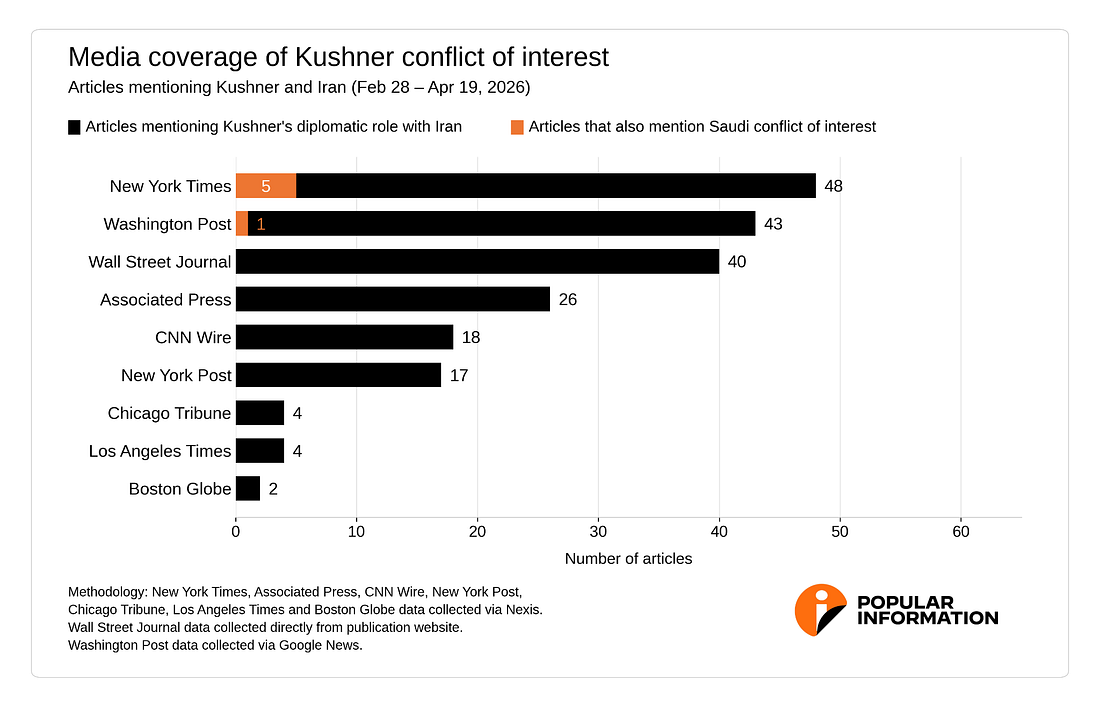 |
Among the publications analyzed, The New York Times has had the most substantive coverage of Kushner’s conflict. Still, the vast majority of the New York Times coverage of Kushner’s diplomatic role does not even briefly mention his financial conflict.
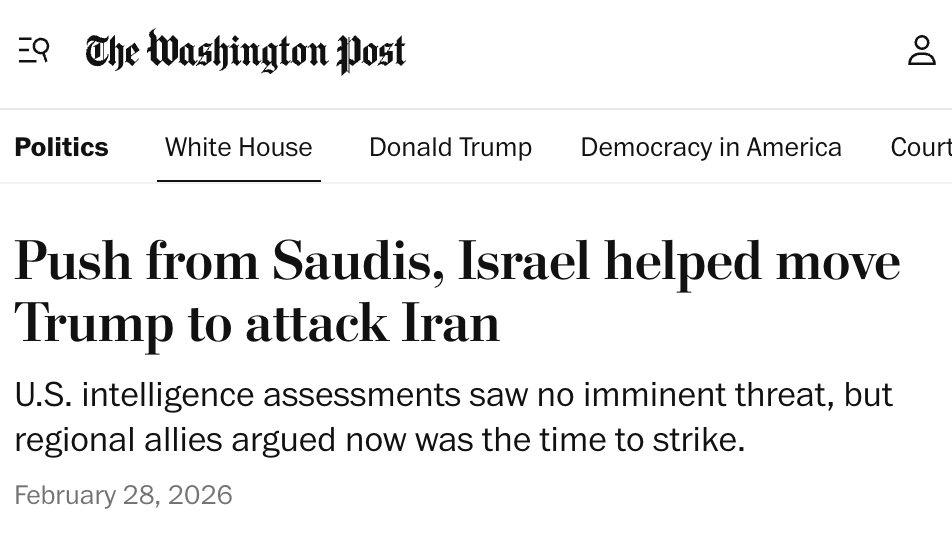
Notably, some publications that have completely ignored Kushner’s conflict produced the reporting that established the factual predicate. For example, The Wall Street Journal produced the foundational reporting on how Kushner raised billions from foreign governments to fund Affinity Partners, including $2 billion from the Saudis. The Washington Post, meanwhile, broke the story on MBS lobbying Trump to initiate the war in Iran, but did not mention Kushner’s financial relationship with the Saudis — even though MBS controls the Saudi PIF.
 |
Kushner is expected to return to Pakistan today for further talks with the Iranians. Will the news media continue to ignore or downplay his financial conflict?
The Congressional investigation
As the media largely ignores the Kushner corruption scandal, Congressman Jamie Raskin (D-MD), the ranking member of the House Judiciary Committee, just launched an extensive investigation.
In an April 16 letter to Kushner, Raskin writes, “your decision to act in these two roles—one public for the government and one private for personal profit—creates a glaring and incurable conflict of interest.” Raskin argues that MBS’s “desire to prolong the war imposes obvious financial pressure on you to prolong this war of choice, risking further harm to American servicemembers, deepening the military morass and draining tens of billions from American taxpayer dollars each week on behalf of your investor and benefactor.” Raskin argues that Kushner “cannot faithfully represent the United States with billions of dollars in Saudi and Emirati cash burning a hole in every pocket of every suit you own.”
Raskin informs Kushner that the investigation seeks “information critical to reforming our bribery laws, conflict of interest provisions, other statutes and rules governing the conduct of government and special government employees, and [the Foreign Agents Registration Act].” The letter demands Kushner supply detailed information including, “[a]ll communications between you and any Saudi official, intermediary, or agent— including state-linked investment funds or businesses—between January 2022 and the present day” and “[a]ll communications with the White House and Trump campaign, including your father-in-law, regarding your role within the government from July 1, 2024, to the present day.”
Should Democrats retake control of the House next year, the investigation could gain more teeth, as Raskin would become chairman and have the ability to issue sub