And India's intant home-help apps proliferate.
 

India File

India File

By Blaine Rodrigues, Editor Online Production, with global Reuters staff

Top Indian information technology firms are back in the spotlight as they report fourth-quarter earnings, with analysts predicting another lacklustre quarter.

War in the Middle East and weak discretionary spending by clients are expected to affect their earnings, which will be offset to a significant extent by a weaker rupee.

And that is before the sword of Damocles - concerns around artificial intelligence - is even mentioned.

Is the Indian IT sector in trouble or is there still reason to be optimistic? That is our main focus this week. Share your views at blaine.rodrigues@thomsonreuters.com.

Plus, instant home-help apps are the newest consumer craze. Scroll down for more on that.


This week in Asia

  • IMF warns of Asia's vulnerability to war-induced energy shock
  • India fails to pass parliament expansion bill linked to quotas for women
  • Iran war drives up costs, spoils the mood at China's largest trade fair
  • China turns Taiwan’s own voices against it in information war
  • North Korean leader Kim oversaw test of missiles with cluster warheads
 

Revenue growth under strain


People walk near a sign for an artificial intelligence chip company, at the Mobile World Congress in Barcelona, Spain, February 27, 2024. REUTERS/Bruna Casas

Investors are trying to read the tea leaves of IT companies' fourth-quarter results. Brokerages predict that for the top six firms - TCS, Infosys, HCL Tech, Wipro, Tech Mahindra and LTM - revenue and profit will likely rise about 10% year-on-year but that would be based largely on a weaker rupee than on underlying growth factors.

The $315 billion sector is a major contributor to India's economic growth and a top driver of its export earnings. It last reported double-digit revenue growth in the March 2023 quarter.

What will also interest investors is what the top firms forecast for the year.

Last week, Wipro forecast a weak current quarter citing muted demand as its U.S. banking and financial clients cut spending.

That forecast by India's fourth-largest IT firm overshadowed a record share buyback of up to $1.61 billion and it wiped out $670 million in its market capitalisation.

Meanwhile, India's top software-services exporter TCS reported better-than-expected quarterly results including $12 billion in deal wins. However, analysts were disappointed with the 2.4% drop in full-year dollar revenue.

Jefferies analysts said ⁠the results offered limited evidence of any meaningful uptick in demand and that an uncertain growth outlook could drive underperformance in the stock.

You can read more in this analysis on how foreign investors have grown wary of India and the cascading effect it is having on earnings and equities.


The AI question

If this were a gameshow, the multibillion-dollar question would be - what is the impact of generative AI on the Indian IT sector?

Investor concerns about AI disrupting the Indian IT sector's traditional labour-heavy operating model wiped off about $68.6 billion in market value in February.

Comments from TCS management would seem to show no cause for concern at the moment. They said new artificial intelligence models and tools in the market did not hurt demand for its offerings.

TCS and Wipro have also sought to assure investors. In February TCS CEO K Krithivasan told a forum that they were encouraging employees to use AI and not to resist the change that it brings even if it cannibalises revenue.

TCS, which also provides AI services to its clients, said its annualised AI revenue crossed $2.3 billion in the fourth quarter, driven by accelerated deployments across industries, up from $1.8 billion in the third quarter.

Analysts however say that TCS still has some ground to cover on the AI front.

In February, Wipro also maintained that they expect rapid AI adoption to boost rather than shrink demand for software service providers.

Brokerages predict that Infosys and HCL Tech, which are reporting this week, are likely to provide revenue forecasts of a rise between 2%-4% and 4%-6%, respectively, for the fiscal year 2027.

HSBC analysts say that even a modest revenue forecast could support stock prices, noting valuations currently reflect only low-single-digit growth.


Market matters

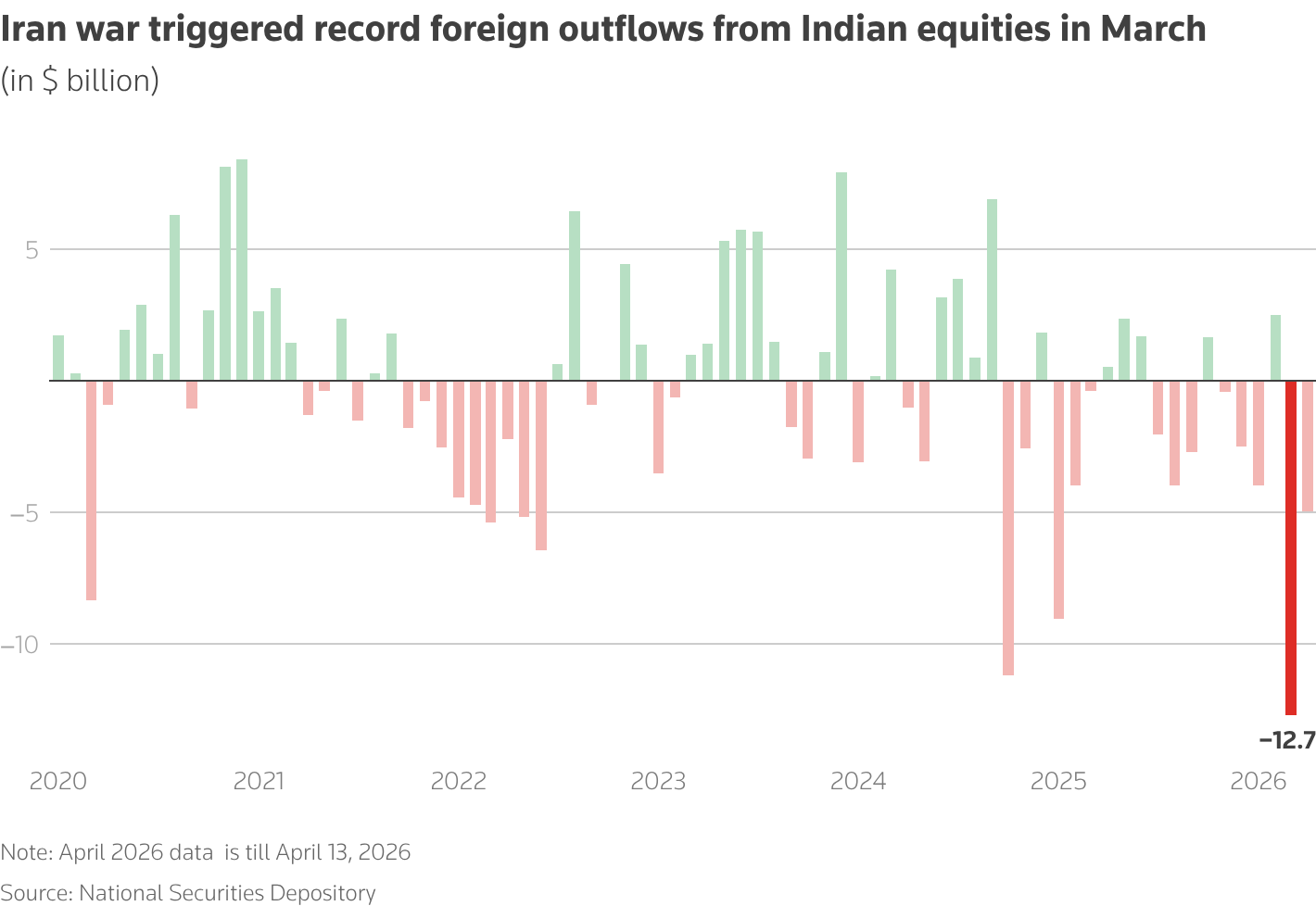
Equity investors have sold about $38 billion of Indian shares since the start of 2025. Foreign outflows stood at $12.7 billion in March alone.

The Iran war has hit earnings, adding fresh pressure on equities and has amplified concerns among equity investors.

Brokerages have begun cutting earnings forecasts, with Goldman Sachs lowering its earnings forecast for India by a cumulative 9 percentage points over the next two years.

Nomura has cut its December 2026 target for the Nifty 50 by 15% to 24,600.


This week's must read

India has a new obsession: a domestic helper at your door in minutes for just $1 an hour. Companies are training thousands of workers and fighting for a slice of a $9 billion market where customers are booking maids to peel potatoes and sort LEGO blocks by colour.

The catch? The startups fuelling the frenzy are losing $4 on every order, leaving both worker safety and profitability as problems no one has cracked yet.

Read the full story here.


In pictures


Workers shout slogans demanding wage hikes amid rising costs linked to the U.S.-Israeli conflict with Iran, in Noida, India, April 14, 2026. REUTERS/Anushree Fadnavis/File Photo

The state of Uttar Pradesh raised workers' minimum wages following days of protests in an industrial hub, government sources said, becoming the second state to do so in less than a week amid rising ‌costs fanned by the Iran war.

Protesters in Noida, where industrial units including that of Samsung Electronics are housed, demanded higher pay, with police lobbing tear gas shells to quell the demonstrations.

Read more