| | Oil prices whipsawed on fast-moving expectations surrounding a fresh round of peace talks between th͏ ͏ ͏ ͏ ͏ ͏ |
| |  | Energy |  |
| |
|
 - Talks in the balance
- US losing fusion race
- Climate-neutral meat
- Renewable records
- Climate VC shifts
 China revives some long-dormant coal plants, and EV sales surge worldwide. |
|
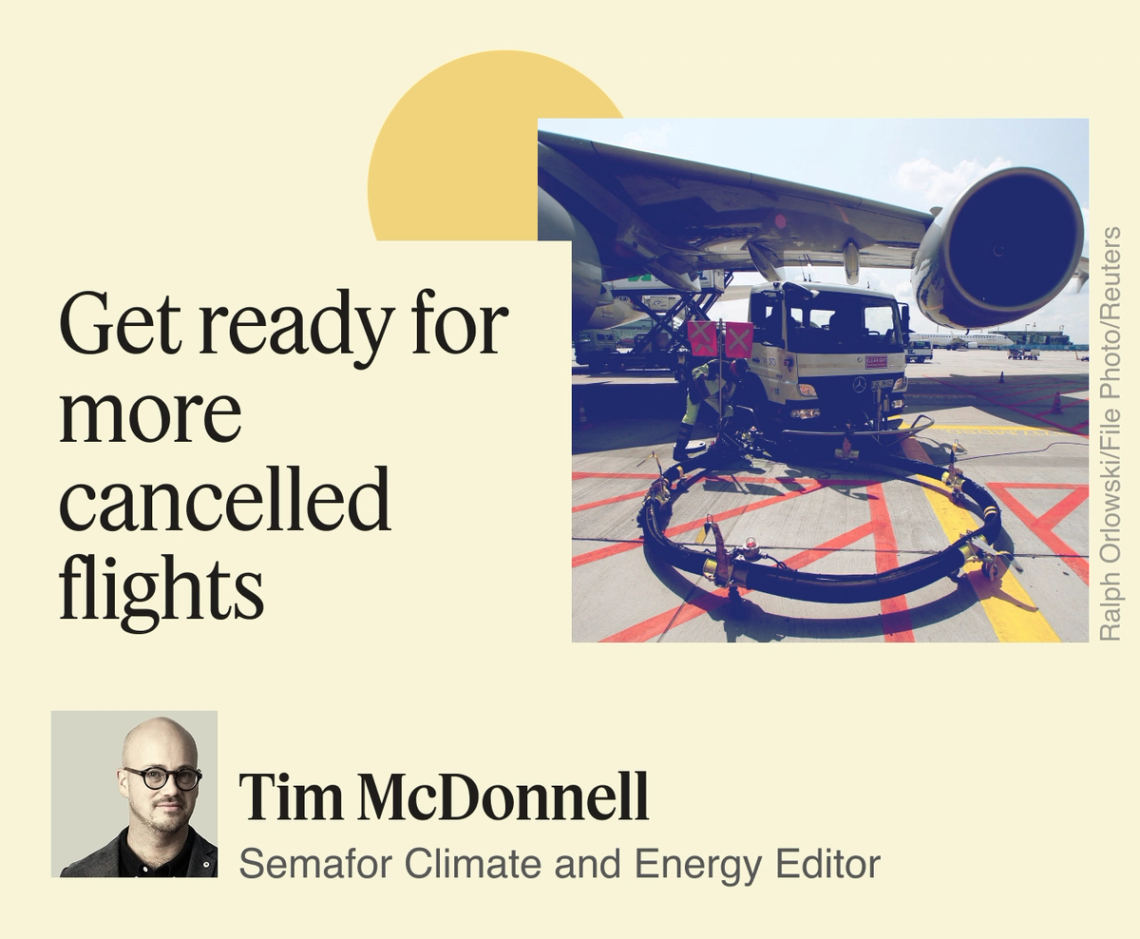 When the Italian town of Codogno became the first in Europe to enter a COVID-19 lockdown in Feb. 2020, the disease outbreak that Europeans and Americans perceived as someone else’s faraway problem suddenly hit home with more speed and force than anyone could anticipate. I wouldn’t sleep on the chance that we may hit a Codogno moment in global energy markets soon. Canceled flights across Asia are a warning to Western markets that they are still severely underpricing the risk of a massive, pandemic-like disruption to the global economy in the coming months. In addition to Asia, flights are already being canceled around Europe. International Energy Agency chief Fatih Birol warned recently that Europe could run out of jet fuel in “six weeks or so.” One well-placed industry source told me backstage during Semafor World Economy that they recently sold several cargoes of jet fuel for more than twice their normal price, and that if the Strait of Hormuz isn’t reopened within a week or two, the situation could become “very, very bad.” One effect of the short-lived “opening” of the strait on Friday was to further erode insurers’ ability to trust future proclamations of progress; rates are rising again, and in general “oil flows out of the strait are diminishing rather than increasing,” Rystad Energy’s chief oil analyst Paola Rodriguez-Masiu wrote in a note. Crude prices are poised to spike higher around mid-May, when OECD countries’ strategic reserves begin to run low. Already, refineries across Asia and Europe are cutting their production of jet fuel and other specialized products, unable to charge consumers enough to make their operations worthwhile. US President Donald Trump’s decision on Monday to invoke special war powers to boost domestic refining might help buffer domestic travel, but won’t help US planes return home from long-haul flights abroad. And while renewables might work for some energy-importing countries as a solution to high natural gas prices, there’s no green alternative for jet fuel — or fertilizer, or any number of other critical refined products — at scale. It’s impossible to say for sure how this war will pan out, but the lesson from the pandemic is to prepare for the worst and hope for the best — and that means getting cancellation insurance on any flights you have coming up. |
|
 Akhtar Soomro/Reuters Akhtar Soomro/ReutersOil prices whipsawed on fast-moving expectations surrounding a fresh round of peace talks between the US and Iran, with questions over who will attend, and whether they will deliver a lasting truce. The two-week ceasefire is entering its final hours, and US President Donald Trump again threatened to “knock out every single Power Plant” if an agreement was not reached, while later adding that he considered an extension “highly unlikely.” The White House announced Vice President JD Vance will lead the US delegation for negotiations to be held in Islamabad; Iranian officials — reportedly wracked in a divisive power struggle between the government and military — have yet to provide a clear update on who will go. The prospect of a new round of talks follows a dramatic weekend in which Iran once again closed the Strait of Hormuz and US forces struck and seized an Iranian vessel. Trump vowed to maintain a blockade of Iranian ports if Tehran refused to reach a deal; the effort has so far turned back 27 ships bound for or departing Iranian ports. At home, meanwhile, Trump invoked wartime powers in a bid to accelerate the production of natural gas, coal, and oil, and to fast-track new energy infrastructure. |
|
  Darío Gil. Tasos Katopodis/Getty Images for Semafor Darío Gil. Tasos Katopodis/Getty Images for SemaforThe US official overseeing research on nuclear fusion and quantum computing defended proposed funding cuts to federal science programs, even as the country’s top fusion CEO warned the US was losing the race with China. A White House budget proposal released this month called for deep cuts to the National Science Foundation and to research programs at the Department of Energy and elsewhere. DOE Undersecretary Darío Gil said the cuts wouldn’t derail US efforts on cutting-edge tech, both because AI itself is making research more efficient and because more private capital is covering the gap. And at least one program, the Genesis Mission, which aims to support fusion and other select technologies, will see its budget grow, Gil said, adding that the effort is expected to draw a record number of applicants when its first funding deadline closes this month. But Bob Mumgaard, CEO of Commonwealth Fusion Systems, cautioned onstage that while the US has done a good job funding basic fusion science, it is now lagging far behind China in backing for construction of the first generation of commercial-scale plants. “You can tell where countries are going to end up on [fusion] by where the investments are going today,” he said. And as for the risk of losing that race to China, “not only are we at risk, it is actively happening.” |
|
 Semafor’s Prashant Rao (L) and Elanco CEO Jeff Simmons. Tasos Katopodis/Getty Images for Semafor Semafor’s Prashant Rao (L) and Elanco CEO Jeff Simmons. Tasos Katopodis/Getty Images for SemaforClimate-neutral meat farms “can be a reality in the next 10 years,” the CEO of one of the world’s biggest animal medicine manufacturers said in an interview. Speaking at Semafor World Economy, Elanco Animal Health’s Jeff Simmons argued that agricultural firms were making significant progress in vaccinating animals to reduce their methane emissions, capturing the emissions that do occur, measuring how much they have retained, and selling them to major retailers such as Nestlé for up to $20 per cow. The purchasing company tracks those payments as part of a program of “insets” to reduce emissions within its supply chain, as opposed to the purchase of “offsets” from external projects. Beyond seeking to reduce emissions, the push is part of efforts to court younger consumers who, Simmons noted, were put off by the environmental impact of eating meat as well as concerns surrounding animal welfare. “I could take you to a farm in Kansas right now with 10,000 dairy cows that will be climate neutral by the end of the decade,” he said. — Prashant Rao |
|
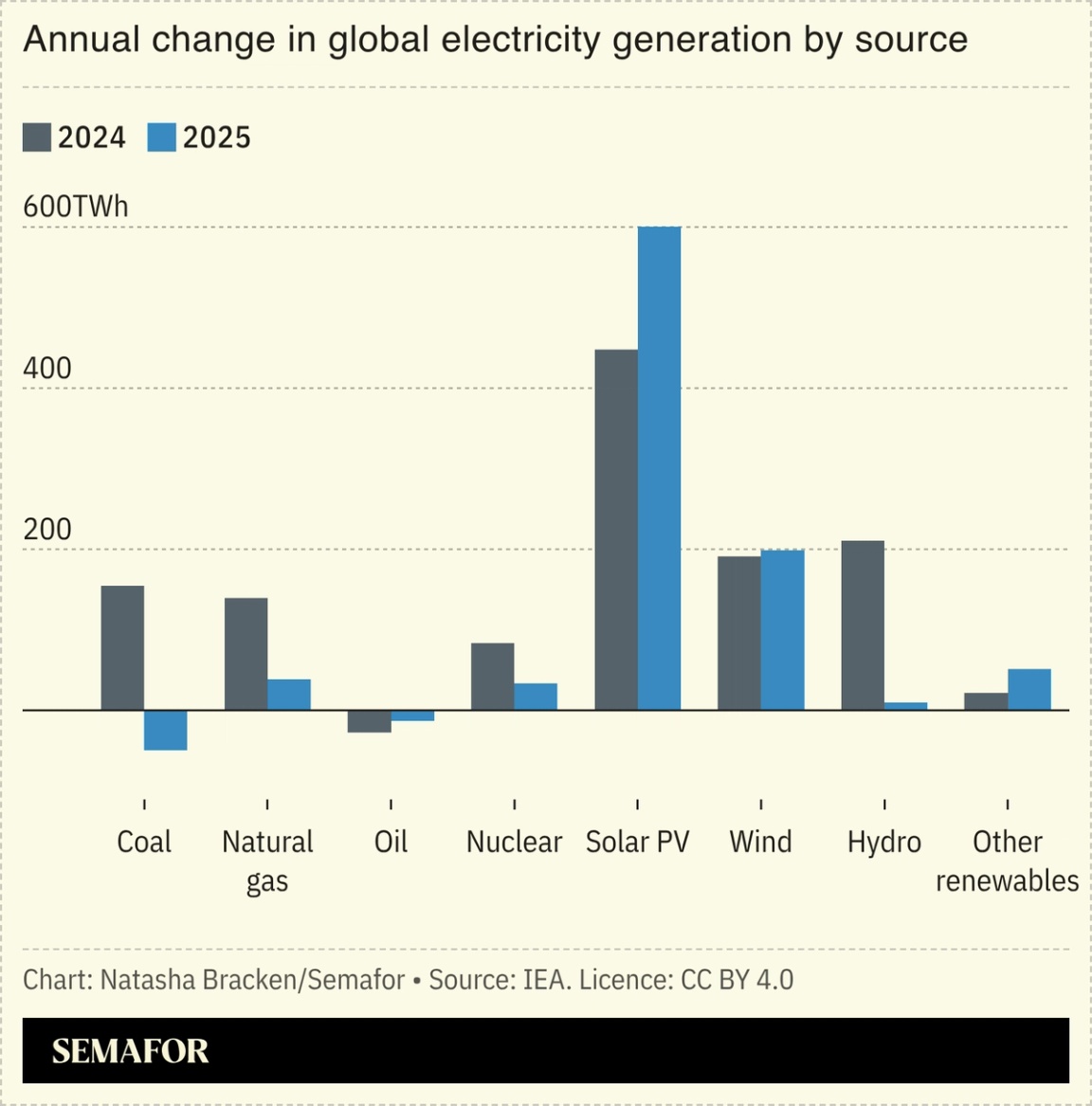 As global energy demand growth accelerates, renewables are covering a greater share of that growth, according to two new reports, pointing to a structural shift away from fossil fuels in the global power system. Solar met 25% of new demand in 2025, the first time on record for a renewable source to outpace fossil fuels on that metric, according to the International Energy Agency. Renewables also generated more power globally over the course of the year than coal-fired power plants, another first, according to Ember. Demand for coal, oil, and gas all slowed in 2025, meanwhile. These data points indicate that renewables are not just supplementing fossil fuels in the power sector, but actively supplanting them. And as a result, the IEA report concluded, emissions are also growing at a slower rate — and even declined in China “due to the boom in renewables, structural declines in energy-intensive industry, and overall slower demand growth.” |
|
 The amount of climate dry powder remaining in this year’s first quarter, down from a $112 billion peak in the same period last year, according to a new Sightline Climate report. The recent figures don’t represent a retreat for the sector; on the contrary, 2025 was a record year for climate fund closes. Instead, deployment simply outpaced fundraising. What is shifting, though, is the nature of the investments, as capital increasingly moves away from experimental, higher-risk bets towards mature technologies deployed by established players. That’s partly because capital is increasingly locked up in older funds for longer due to stretched exit timelines, making investors cautious about committing fresh capital. For example, infrastructure funds — whose returns from mature technology deployment are slow but steady, and whose appeal has only grown in response to rising power demand from the AI boom — captured 77% of new capital raised. But that renewed focus on infrastructure and stability is causing venture capital dry powder to deplete faster than it is being replenished, which could ultimately hurt early-stage climate tech startups. — Natasha Bracken |
|
 Colossal — the divisive startup that brought back Tom Brady’s dead dog and which wants to revive the woolly mammoth — has big goals, and almost none of them have to do with consumers. On this week’s Compound Interest, presented by Amazon Business, Liz and Rohan talk with Colossal’s Ben Lamm about building a bioscience empire serving governments — from drought-resistant crops to plastic-eating microbes, and much more (some of it classified!). Listen to the latest episode of Compound Interest now. |
|
 New Energy- UK households will be encouraged to boost their energy consumption this summer to help balance the power grid and reduce energy bills amid a record renewable energy deployment.
- The global wind industry installed a record 165 GW of new capacity in 2025, a 40% increase from 2024, with China and India accounting for 80% of the global total.
- Private renewable-energy investments are set to increase in Africa as the Iran war is pushing countries to try and reduce their dependence on oil and gas imports.
Fossil Fuels- Big oil companies are increasingly focused on searching for new oil-and-gas prospects in non-Middle Eastern countries: Exxon is looking to Nigeria’s deep-water oil fields, Chevron is still focused on Venezuela, while TotalEnergies signed an exploration deal with Türkiye.
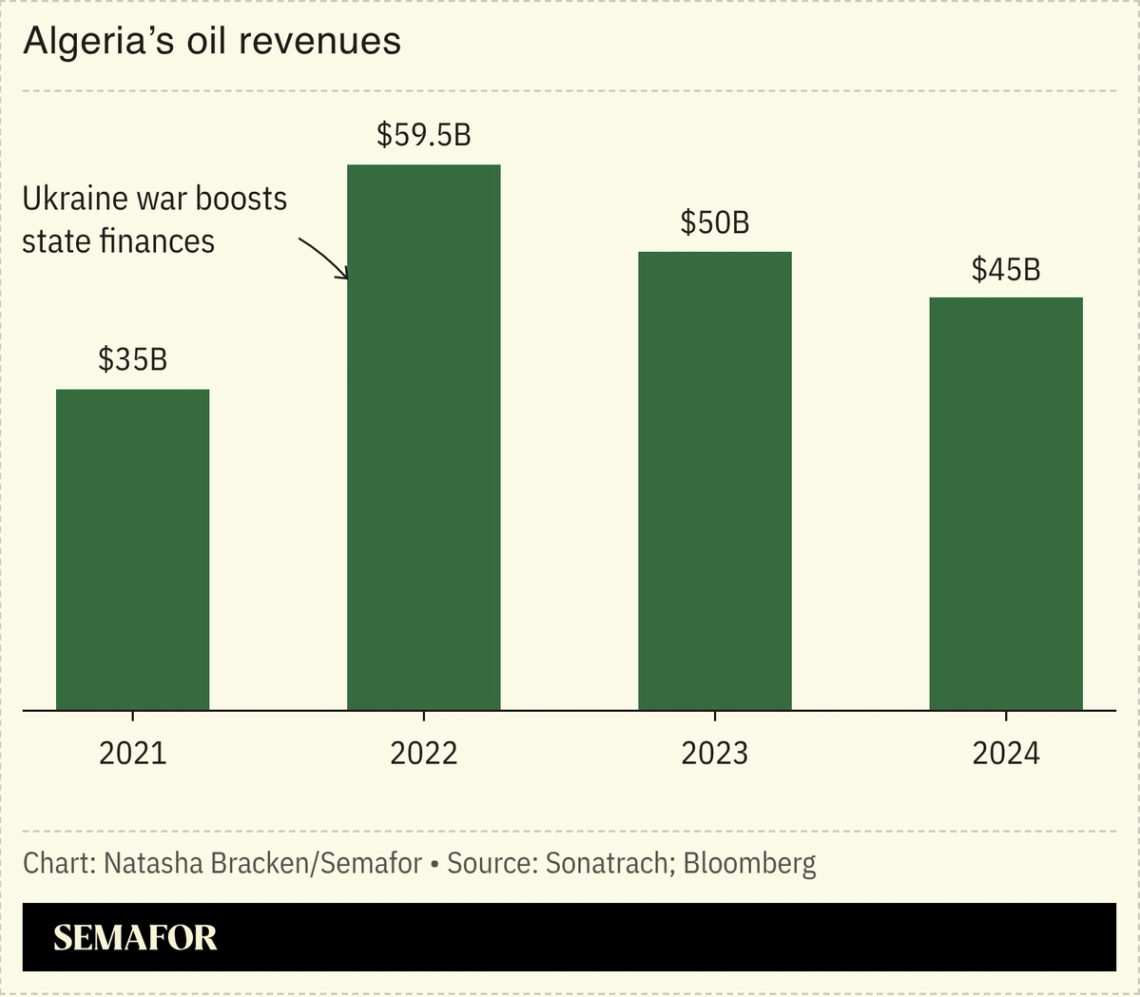
- Algeria seems hopeful it can bank on that, as it recently launched an oil and gas licensing round to boost output and attract investors.
 Tech- A Trump-backed data center project, hailed as the largest in the world, is facing increasing hurdles, including its CEO abruptly quitting on Friday. He had said just last week at Semafor World Economy that the project would cover an area half the size of Manhattan, and require three times the power demand of NYC.
Politics & Policy- Brussels is prepared to require jet fuel stocks to be shared across the EU, as the energy crisis in the bloc is moving from one of high prices, to a “crisis of supply,” the energy commissioner told the FT.
|
|
|


