| | In today’s edition: Iran-backed militias in Iraq are more involved in the war than previously though͏ ͏ ͏ ͏ ͏ ͏ |
| |  | Gulf |  |
| |
|
 - Eyes on Islamabad
- China-Gulf diplomacy
- Bahrain’s AI oilfields
- Oil market disconnects
- Saudi renewables boom
- Iranian cell in the UAE
 Andre Young (aka Dr. Dre) now has a Semafor Gulf connection! |
|
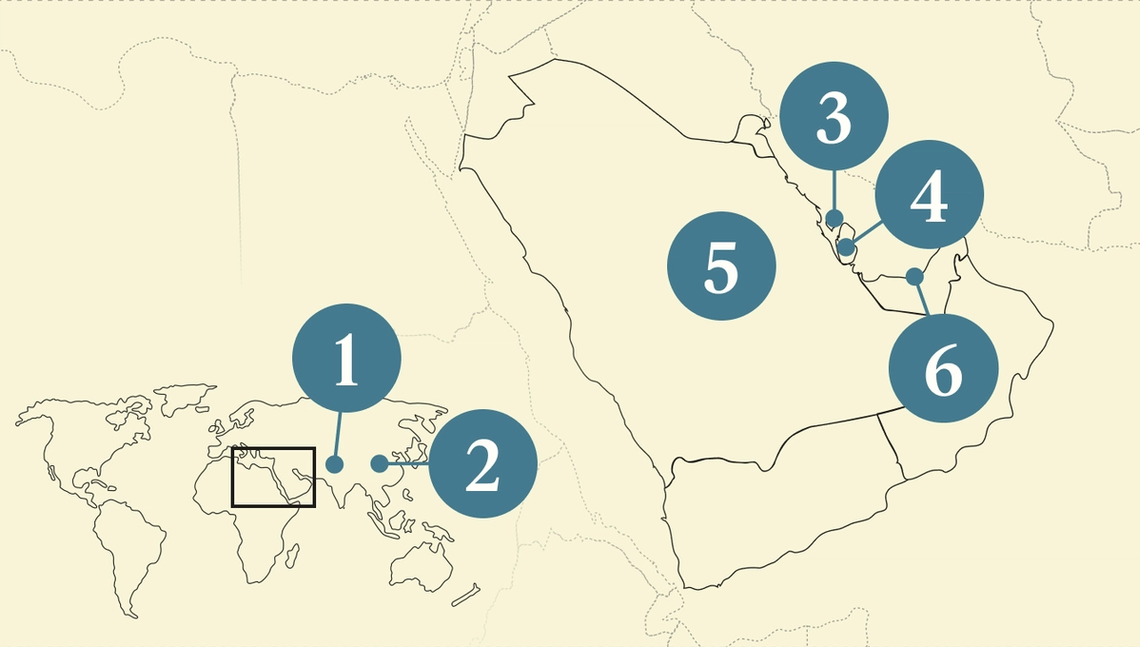
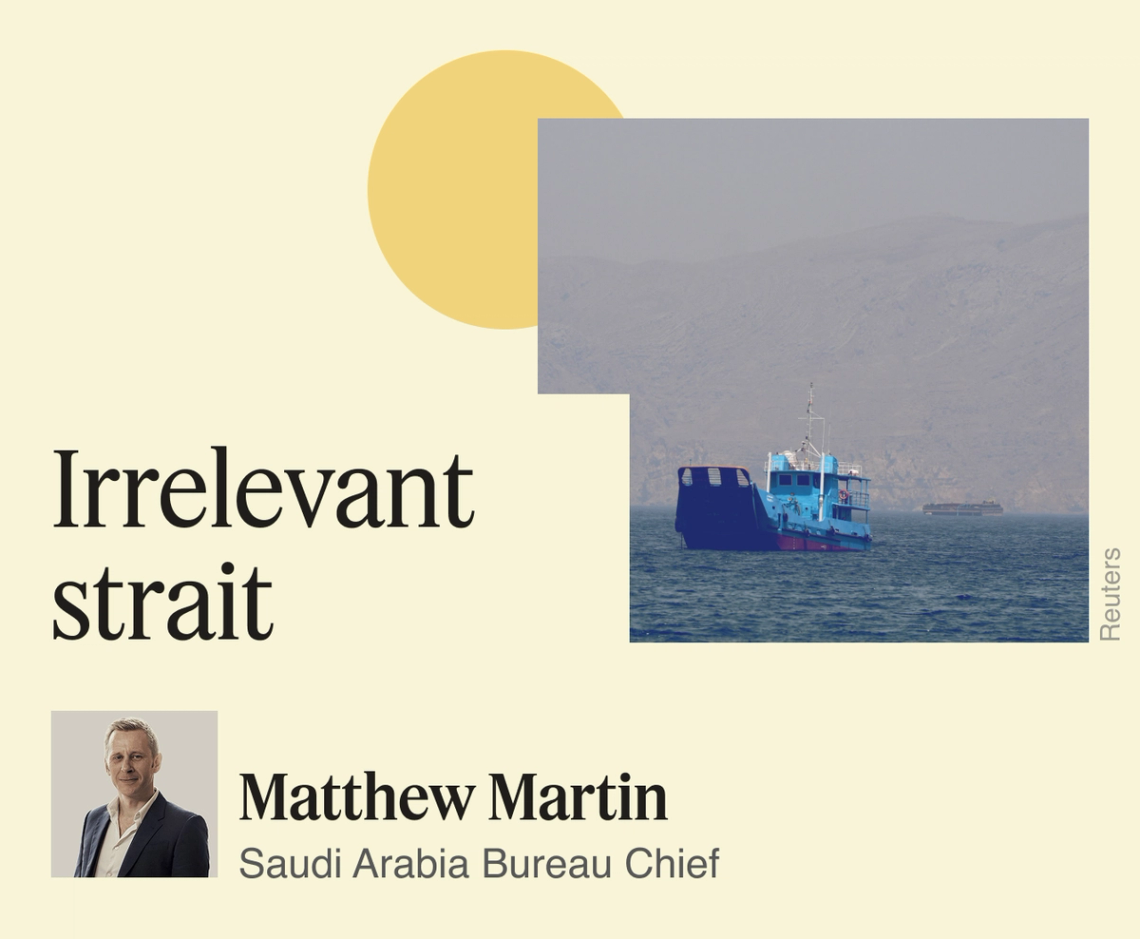 If I had one takeaway for the Middle East from last week’s meetings at Semafor World Economy, it is that it is impossible to overstate how much Gulf trade will be reshaped by the crisis in the Strait of Hormuz. The narrow waterway has served as the region’s main artery for commerce since the dawn of major seaborne traffic in the 1960s, but Iran’s closure of it has demonstrated the reality of a long-threatened nightmare scenario. Now that Tehran has proven it can bring regional trade to a halt, and that the US and the Gulf’s other allies have been unable to prevent it, a scramble is underway for alternatives. In closed-door conversations with Gulf diplomats and government officials at Semafor World Economy in Washington, DC, I saw a growing resolve to build new trade routes. Iran has overplayed its hand, they argue. Some even talk of a long-term goal to make the Strait of Hormuz irrelevant. That may be an overreach, but it indicates the direction in which the region is heading. The UAE is set to boost the capacity of oil pipelines that take crude to Fujairah’s port, which lies outside the Gulf. The port of Khor Fakkan, which also sits outside the strait, could see a wave of investment to diversify the UAE’s trading capacity further. Bahrain will start trucking aluminum exports through Saudi Arabia to regional customers, and on through the kingdom’s western ports to international markets. A plan for a second causeway between the island nation and Saudi Arabia may be accelerated. A long-discussed Qatar-Bahrain route may also finally get moving, along with further momentum for a region-wide rail network. At the center of it all is Saudi Arabia. The kingdom has used this moment to rapidly move forward on its goal of becoming an international logistics hub. Forty years ago, it built an underground pipeline to allow it to move oil from its Eastern Province fields to the west coast for export. The heavy investment involved seemed an unnecessary luxury until last month, when it suddenly became essential. Saudi Arabia has also launched a raft of new shipping lines through its west coast ports since the war began. A port constructed at NEOM — intended to bring in goods for construction of the nascent region — is now a crucial lifeline for regional trade. Riyadh has also liberalized rules to ease overland trade, for example allowing foreign-owned empty trucks to enter the country to pick up goods for export. The kingdom will not easily let go of its new status. It will look to invest further in new oil export pipelines, cross-border cables for data centers, and shipping lines to bring in goods and ensure its growing non-oil exports have a route to market. The India-Middle East-Europe Economic Corridor (IMEC), a Biden-era plan to build new trade routes through the region, is also back on the agenda. Diplomats tell me the proposal is once again getting attention from policymakers in the Gulf as well as in Washington. None of these initiatives will solve today’s problem with the Strait of Hormuz closed. Some may fall victim to regional political rivalries and never materialize. Even so, the region will never be the same again. |
|
Pakistan prepares US-Iran talks |
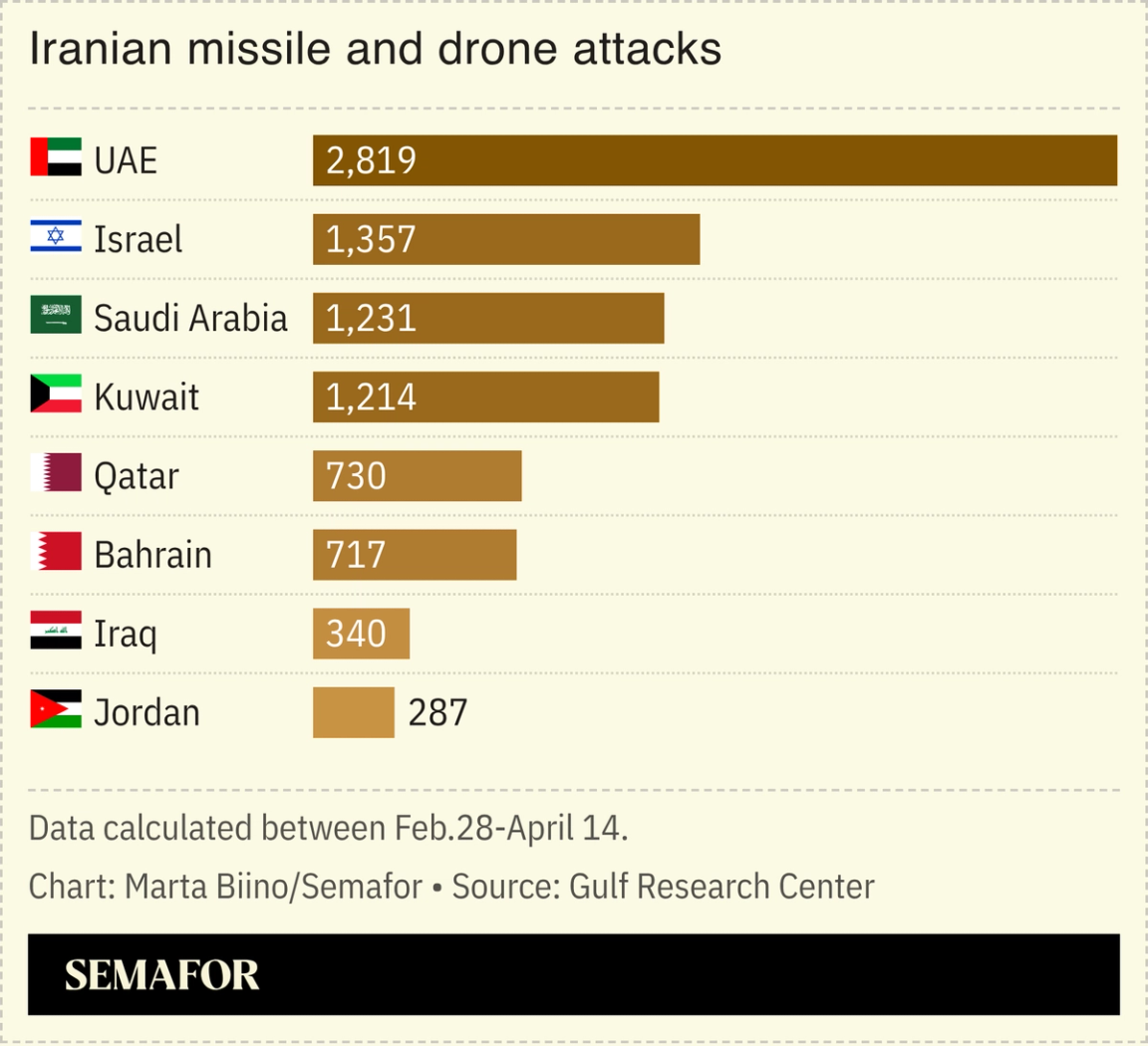 Iran is reportedly planning to send negotiators to Pakistan for a second round of talks with the US, with just one day to go before the expiry of a two-week truce. The American delegation will once again be led by US Vice President JD Vance, and at least nine US military cargo planes arrived in Islamabad ahead of the meetings, The National reported, but Tehran appears wracked by regime infighting between the government and the military, the latter of which is apparently playing for time. US President Donald Trump has once again threatened to “knock out every single Power Plant” if an agreement was not reached, while later adding that he considered an extension “highly unlikely.” Meanwhile, there have been accusations that Iraqi militias backed by Tehran played a far larger role in the war than previously known, with Saudi officials estimating that up to half of the nearly 1,000 strikes on the kingdom originated in Iraq. Bahrain and Kuwait were also hit by the Iraqi groups, highlighting the threat to Gulf states from Tehran’s proxies, which are unlikely to be a direct party to any peace deal. |
|
Xi ramps up Gulf diplomacy |
 cnsphoto via Reuters cnsphoto via ReutersChinese leader Xi Jinping stepped up his Gulf diplomacy in an apparent sign of Beijing’s increased interest in ending the impasse over control of the Strait of Hormuz. This week’s call with Saudi Arabia’s ruler came on the heels of talks with Abu Dhabi’s crown prince in Beijing; Xi has made ever-more pointed remarks calling for a reopening of the strait. China playing any role in the conflict’s ultimate resolution could potentially strengthen its reputation as a “backdoor power broker,” Lazard’s CEO said at Semafor World Economy, but Beijing nevertheless faces “a genuine geopolitical conundrum,” a leading analyst noted: It has historically been cautious in intervening in faraway crises, but faces long-term risks from prolonged conflict in the Middle East. |
|
Bahrain bets on AI to boost oil output |
 Bapco pipelines near Manama, Bahrain. Hamad Mohammed/Reuters. Bapco pipelines near Manama, Bahrain. Hamad Mohammed/Reuters.Bahrain’s state energy company Bapco is working with two US partners — oilfield services giant SLB and AI startup Geminus — to squeeze more oil out of its existing wells and pipelines. The deal will see machine learning used in conjunction with SLB’s Pipesim flow simulator, which engineers use to predict how oil, gas, and water will move through wells and pipelines. This system can run optimizations across Bapco’s upstream network in real time, and a pilot run produced measurable results within 12 months, the companies said. “Every barrel of additional production you unlock from existing infrastructure is the cheapest barrel you’ll ever produce,” Geminus Managing Director Chad Harkness told Semafor. — Manal Albarakati |
|
Hormuz closing distorts oil markets |
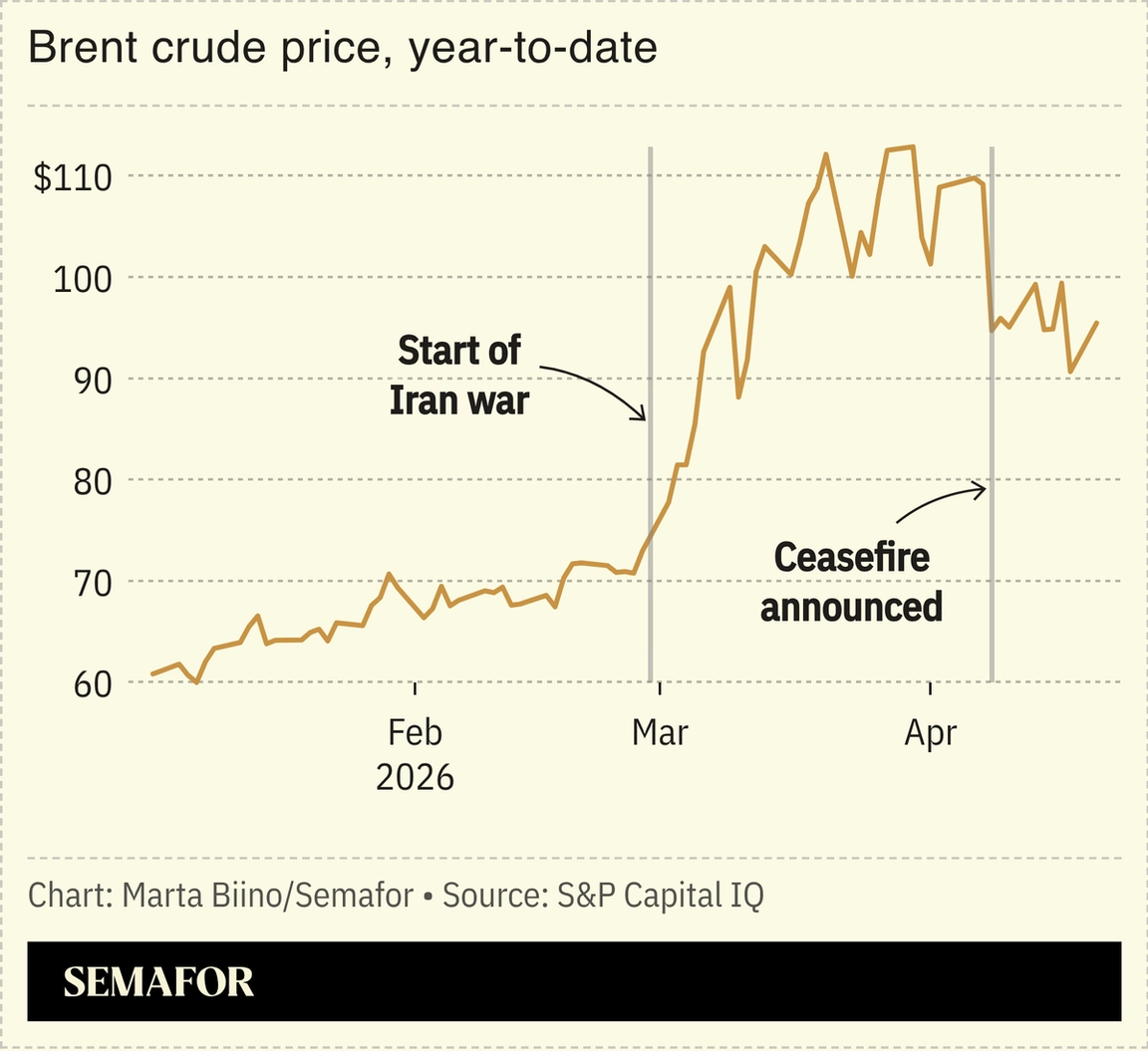 The gaps in global oil markets are widening: Futures, driven by events and Trump tweets, are trending down, while physical barrels trade at huge premiums as refiners scramble for immediate supply. Saudi Arabia’s Arab Light is selling to Europe at a $27.85 premium to the Brent benchmark price for May delivery, versus a 65-cent discount last month; at the extreme, “you can pick up a barrel of crude for $78 in Kansas or $286 in Sri Lanka,” according to Bloomberg’s Javier Blas. The disconnect reflects supply disruptions from the Gulf and statements and posts by US President Donald Trump that have calmed his domestic market even as they left commodity traders guessing. When this gap narrows depends on the outcome of talks to end the war. If Hormuz remains shut, Qatar’s finance minister warned that today’s premiums are only “the tip of the iceberg,” with the biggest impact likely to be felt in another two months. While the world waits for a resolution, scammers are doing what they do. Some have tricked stranded ships — including the one Iran fired on this week — with an offer of “safe passage” in exchange for crypto. — Mohammed Sergie |
|
Saudi speeds up renewables push |
 Fahad Shadeed/Reuters Fahad Shadeed/ReutersSaudi Arabia nearly doubled its renewable energy capacity in 2025, according to data from the International Renewable Energy Agency. The kingdom was able to produce 12,332 megawatts at the end of 2025, up 87% from the year before. Almost all of that increase came from solar power. However, while the pace of new projects is accelerating, the kingdom is still some way off its target of producing 50% of electricity from renewables by 2030: renewable energy made up 12% of total electricity production in 2025. The jump last year made Saudi Arabia the biggest renewable energy producer in the Gulf, although as a portion of total electricity production it lagged behind Oman, Qatar, and the UAE, where power demand is much smaller. — Matthew Martin |
|
UAE arrests Iran-linked terror cell |
 A screenshot from the arrest video. Courtesy of Emirates News Agency-WAM. A screenshot from the arrest video. Courtesy of Emirates News Agency-WAM.The UAE State Security Department arrested 27 men it accused of terrorist activities and links to Iran. There have been similar arrests across the Gulf since the US-Israel war with Iran began — including five men detained in the UAE last month, said to have been working with Iran and its Lebanese ally Hezbollah — but this is the largest of its kind to date. Emirati authorities said the latest group to be arrested was preparing to carry out sabotage and other terrorist activities aimed at undermining national unity, adding that they had held meetings inside and outside the country with unnamed “terrorist elements and suspicious organisations” and tried to recruit young Emiratis. This month, the UAE banned most Iranians from entering or transiting the country. On several occasions in recent years, the UAE has rounded up large groups of people and accused them of terrorist offenses; their trials have been criticized by human rights groups over unfair processes and convictions. |
|
 Colossal — the divisive startup that brought back Tom Brady’s dead dog and which wants to revive the woolly mammoth — has big goals, and almost none of them have to do with consumers. On this week’s episode of Compound Interest, presented by Amazon Business, Liz and Rohan talk with Colossal’s Ben Lamm about building a bioscience empire serving governments — from drought-resistant crops to plastic-eating microbes, and much more (some of it classified!). |
|
 Checking In- Qatar has reopened Hamad International Airport to foreign airlines for the first time since the Iran war began, the last major Gulf hub to do so. Most international airports in the region are now running, but Kuwait remains an exception, amid ongoing work to repair the damage caused by Iranian attacks. — Doha News
|
|
|


