
|



MongoDB Monitoring Cheatsheet (Sponsored)
 |
Skip the guesswork with this MongoDB cheatsheet from Datadog. You’ll get a quick, practical reference for monitoring performance and diagnosing issues in real systems.
Use it to:
Track key metrics like latency, throughput, and resource utilization
Monitor MongoDB and Atlas health with the right signals
Set up dashboards to quickly identify bottlenecks and performance issues
When DoorDash needed to launch Dasher onboarding in Puerto Rico, it took about a week. That wasn’t because they cut corners or threw a huge team at it. It took a week because almost no new code was needed. The steps that Puerto Rican Dashers would go through (identity checks, data collection, compliance validation) already existed as independent modules, battle-tested by thousands of Dashers in other countries. The team assembled them into a new workflow, made one minor customization, and shipped.
And it wasn’t just Puerto Rico. Australia’s migration was completed in under a month. Canada took two weeks, and New Zealand required almost no new development at all.
This speed came from an architectural decision the DoorDash engineering team made when they looked at their growing mess of country-specific if/else statements and decided to stop patching.
They rebuilt their onboarding system around a simple idea. Decompose the process into self-contained modules with standardized interfaces, then connect them through a deliberately simple orchestration layer.
In this article, we will look at how this architecture was designed and the challenges they faced.
Disclaimer: This post is based on publicly shared details from the DoorDash Engineering Team. Please comment if you notice any inaccuracies.
The Cost of Country-Specific Logic
DoorDash’s Dasher onboarding started simple, with just a few steps serving a single country through straightforward logic. Then the company expanded internationally, and every new market meant new branches in the code.
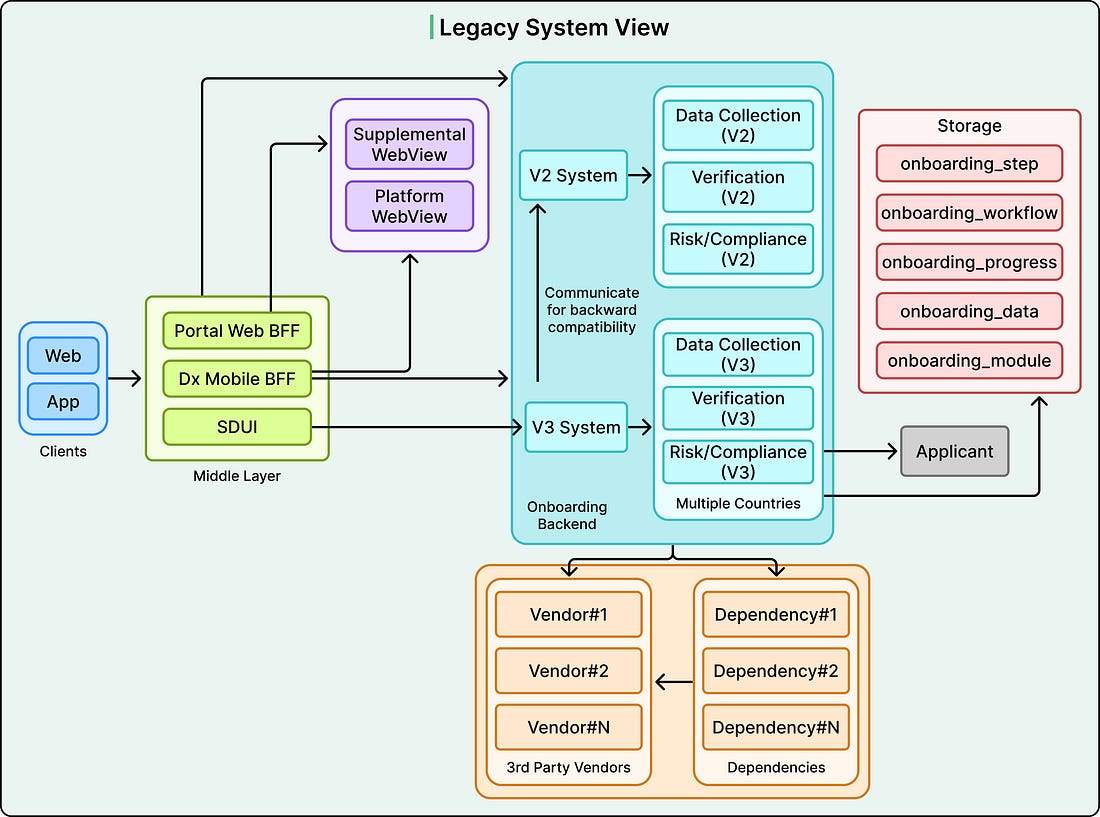
At one point, three API versions ended up coexisting. V3, the newest, continued calling V2 handlers for backward compatibility and also continued writing to V2 database tables. The system literally couldn’t avoid its own history. All developers have probably seen something like this before, where nobody can fully explain which version handles what, and removing any piece feels dangerous because something else might depend on it.
See the diagram below that shows the legacy system view:
 |
The step sequences themselves were hard-coded, with country-specific logic spread throughout. Business logic started immediately after receiving a request, branching into deep if/else chains based on country, step type, or prior state. Adding a new market meant carefully threading new conditions through this maze of conditions.
Vendor integrations followed no consistent pattern either. Some onboarding steps used internal services, which called third-party vendors. Other steps called vendors directly. This inconsistent layering made testing and debugging unpredictable.
And then there was also the state management problem. Onboarding progress was tracked across multiple separate database tables. Flags like validation_complete = true or documents_uploaded = false lived in different systems. If a user dropped off mid-onboarding and came back later, reconstructing where they actually stood required querying several systems and inferring logic. This frequently led to errors.
The practical cost was that adding a new country took months of engineering effort across APIs, tables, and code branches. Every change carried the risk of breaking something in a market on the other side of the world.
Orchestrators, Workflows, and Steps
DoorDash’s rebuild was organized around three distinct layers, each with a single responsibility. It’s easy to blur these layers together, but the separation between them is where the real power lives.
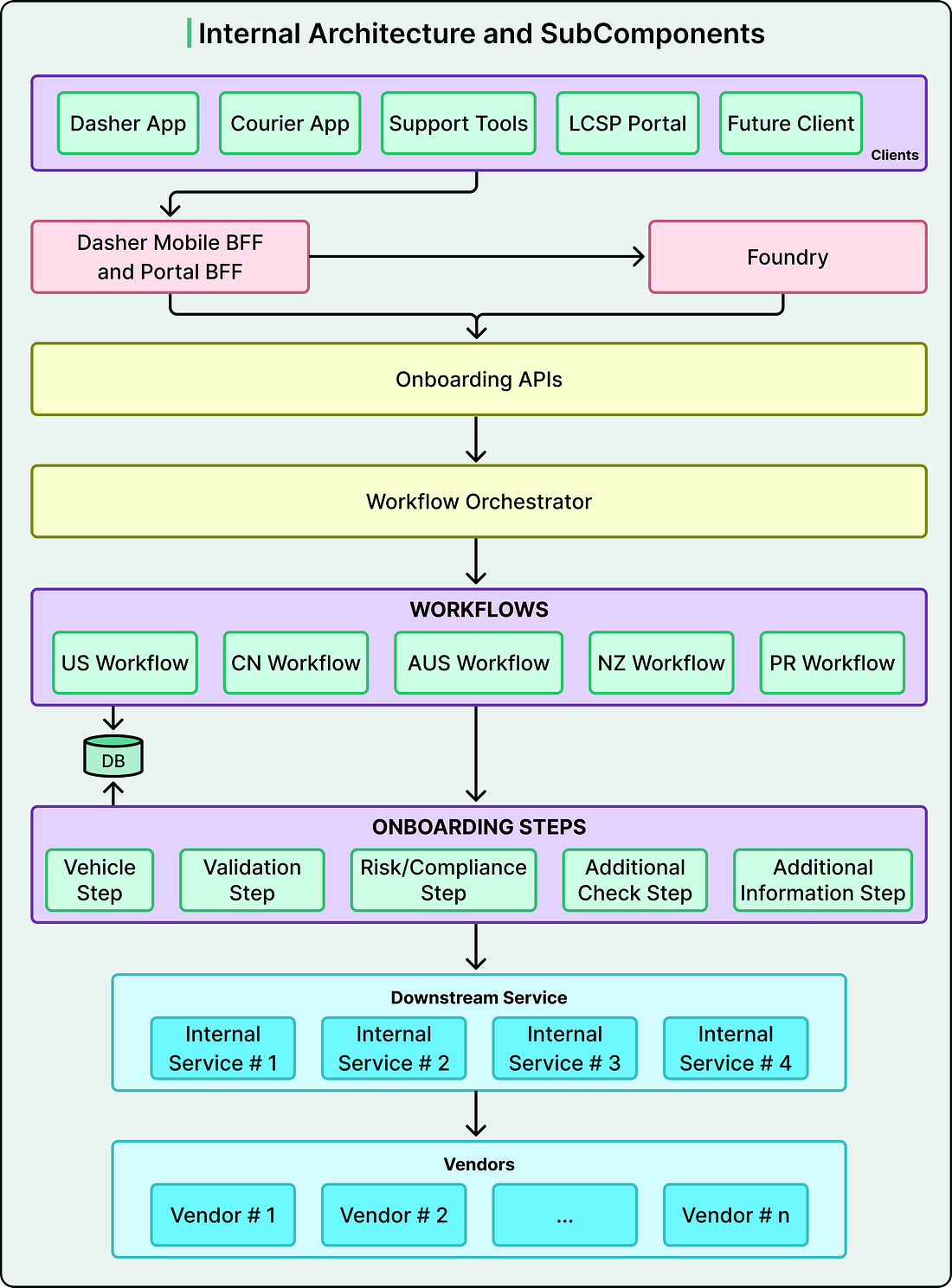 |
The Orchestrator sits at the top. It’s a lightweight routing layer that looks at context (which country and which market type) and decides which workflow definition should handle the request. That’s all it does. It doesn’t execute steps or manage state. It doesn’t contain business logic either. The main insight here is that the smartest thing about the orchestrator is how little it does. Developers tend to imagine the central controller as the brain of the system. However, in this architecture, the brain is distributed, and the orchestrator is just a traffic cop.