| | In this edition, Kevin Warsh commits to Fed independence in his hearing for Fed chair, and an interv͏ ͏ ͏ ͏ ͏ ͏ |
| |  | Business |  |
| |
|
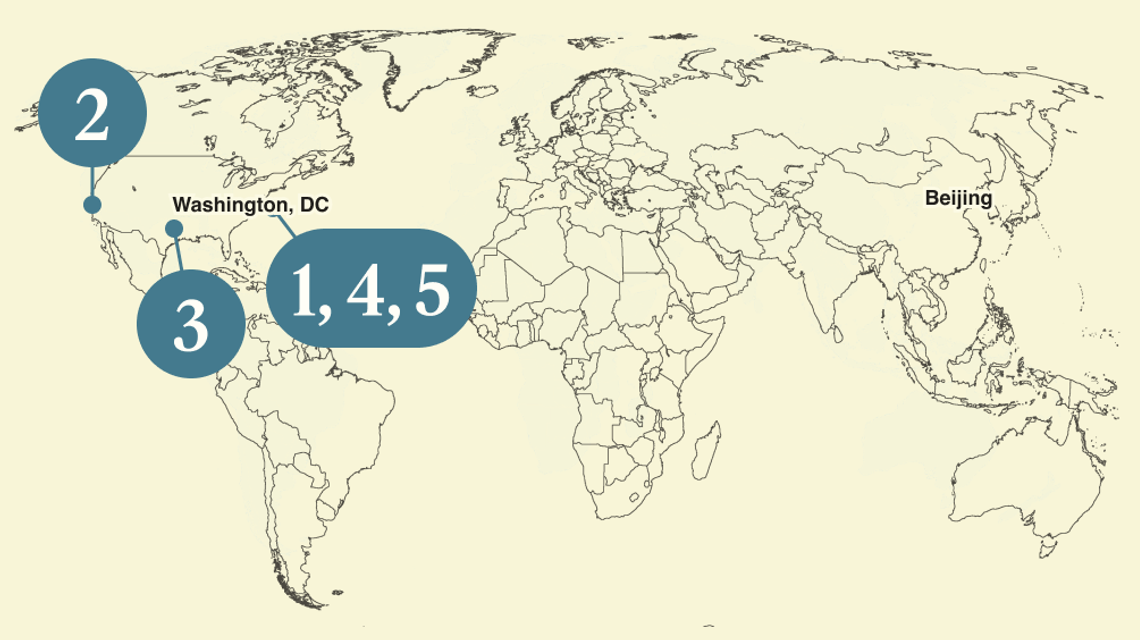 - Warsh testifies
- Apple’s new CEO
- Woolly mammoths on Compound Interest
- AI apprenticeships
- States fill antitrust vacuum
 Endless shrimp recurring nightmare … Citadel’s head of commodities has a screen dedicated to Trump’s social-media posts |
|
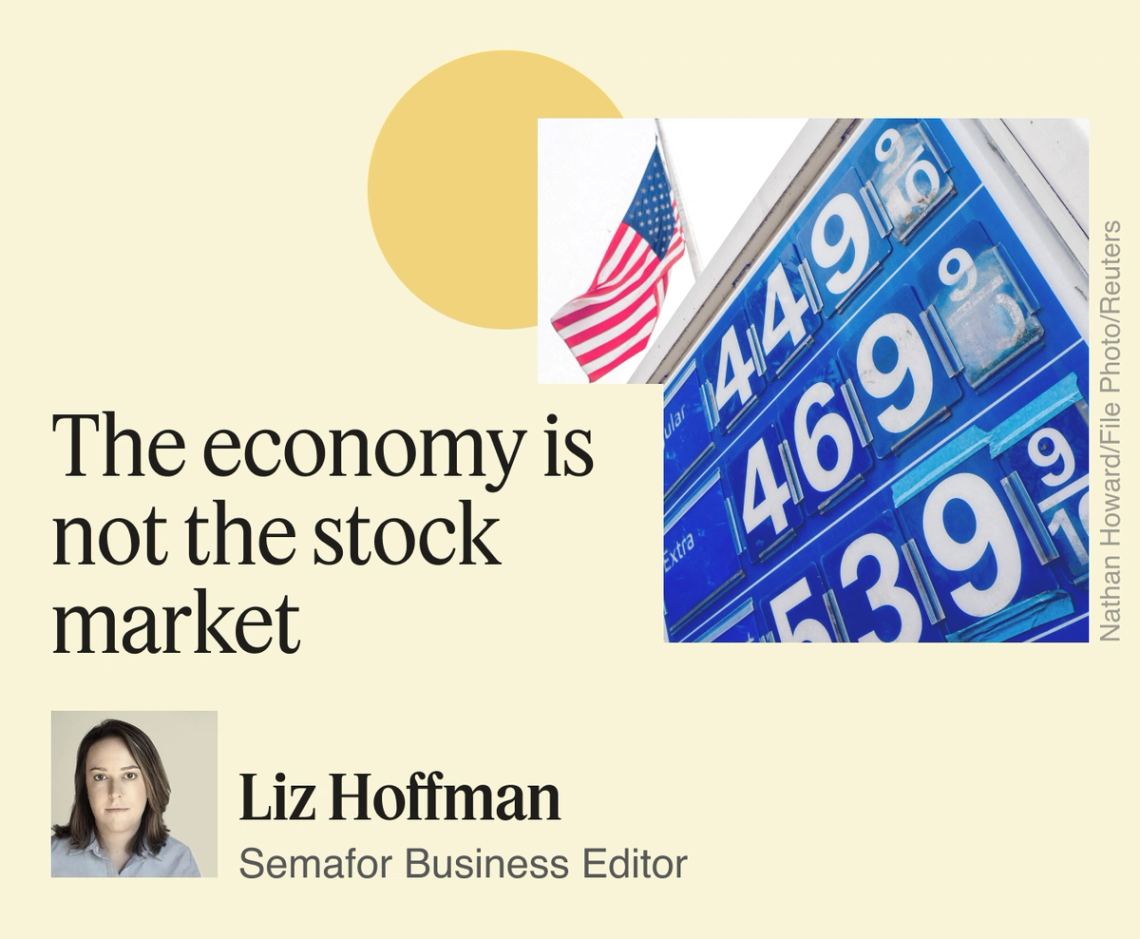 Main Streeters are sanguine. The money men are sounding alarms. The gloomiest voices at Semafor World Economy in Washington, DC, last week belonged to the financiers. Citadel Securities President Jim Esposito, whose firm facilitates one in four US stock trades, warned of a “breakdown in discipline.” His diagnosis: “We’ve raised a generation of investors that really never learned the price of being wrong.” They bought the dip, and were either rewarded for their pluck or bailed out when bets went wrong. That learned dependency traces back to the Greenspan Put of the 1990s, and it’s now threatening to “tip over into irrational complacency,” in the words of London Stock Exchange Group CEO David Schwimmer. The worry: Investors are treating this economic moment — physical supply disruptions, geopolitical fracturing, tariff whiplash — like the liquidity crises of the past, which were solvable with enough government cash. This one might not be. The photo-negative of complacency is, of course, resilience. CEOs in the real economy — manufacturing, consumer goods, the stuff you can drop on your foot — remain as bullish as ever. Corporate profits are at record highs. Americans are still, historically speaking, fully employed. And global fracturing, for all its chaos, favors the US. Hyundai CEO José Muñoz, reopening a Georgia plant hamstrung last year by a botched ICE raid, listed his top three priorities: “U, S, A.” Despite all the economic shocks hurtling their way, CEOs feel big and battle-tested enough to absorb most anything. Usually the gap between Wall Street and Main Street cuts in one direction: Financiers party while those tethered to corporate investment and consumer spending worry. When that happens, it’s easy to dismiss Wall Streeters as bacchanalian doofuses or, worse, leeches. But when the gap goes the other way, it’s worth paying attention to. It could be a leading indicator that this crisis is taking longer to filter through to the real economy than we think. |
|
Warsh commits to Fed independence |
 Kevin Lamarque/Reuters Kevin Lamarque/ReutersKevin Warsh, President Donald Trump’s nominee to lead the Federal Reserve, said he would resist pressure from the president to cut interest rates while reiterating that the central bank needs reforms. “Absolutely not,” Warsh says when asked if he would be Trump’s “sock puppet,” adding that the president hasn’t asked him to commit to a specific move on borrowing costs “nor would I ever agree to do so.” (Just this morning, Trump said he would be disappointed if Warsh did not cut.) That’s what Wall Street wants to hear. “What we care most about is the independence of the Federal Reserve,” Goldman Sachs President John Waldron told Semafor last week. But it didn’t sway the senator who will decide whether Warsh gets a vote before the full Senate: Sen. Thom Tillis, R-N.C., reupped his call for the Justice Department to drop its investigation into Chair Jerome Powell, which is related to cost overruns at the new Fed building, before he’ll advance Warsh’s nomination. Tillis told Semafor on his way out of the hearing that he is “constantly” in communication with Treasury Secretary Scott Bessent, reiterating that he would support a Senate investigation into the renovation — but only once DOJ drops its probe: “Once a year, if we want an oversight hearing on capital projects, I think it’d be a great idea.” While promising not to yield to incessant White House pressure, Warsh has been laying out an economic case for lowering rates, saying AI might justify them by making goods cheaper to produce. |
|
Apple’s safe choice in a dangerous moment |
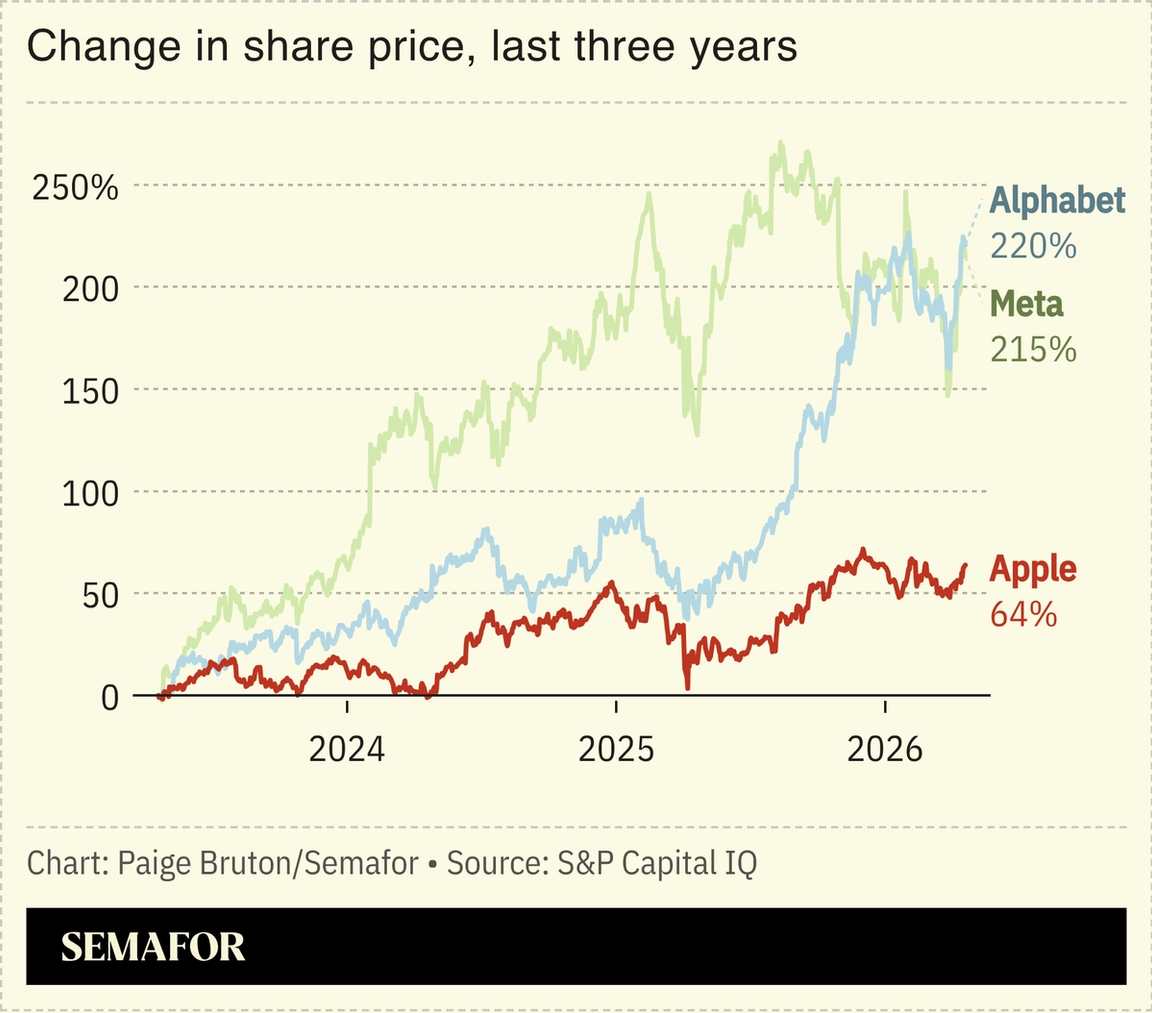 Apple’s choice of John Ternus to replace CEO Tim Cook signals the company’s plan to stay its cautious and lucrative course — even as AI reshapes the world, Semafor’s Reed Albergotti writes. Ternus is an Apple lifer who hails from the Steve Jobs era and is, notably, a hardware guy — suggesting that Apple sees its future in much the same way as its recent past: as a fast adopter, and ruthlessly beautiful manufacturer, of essential devices paired with exquisite operating ecosystems. He is not an AI guru, nor does he hail from the all-powerful marketing division of the company. The race is on to win AI hardware and create the device that will be to the AI era what the iPhone was to the mobile era. OpenAI’s Sam Altman and Jony Ive, the creative mind behind Apple’s iconic hardware, are working on … something. Rings, glasses, wristbands, earbuds, and brain implants are all in the mix, and engineers are working on new operating systems to power them all. Cook, who took over as Apple CEO in 2011 from Jobs, followed a spiritual giant. Ternus will follow an operational guru who squeezed Apple’s suppliers, pushed its services, charmed a US president — he’s staying on as Apple’s executive chairman to “engag[e] with policymakers around the world,” the company said — and protected its brand on key issues like consumer privacy. But the world is changing fast: “By the time it comes into focus, it could be too late for Apple to recapture what it once had,” Reed writes. |
|
Will cloning woolly mammoths be profitable? |
 Semafor/YouTube Semafor/YouTubeWhen asked how much revenue there was in bringing back extinct animals, Ben Lamm doesn’t hesitate: $1.7 trillion. Add in the ability to protect sensitive ecologies and map the evolution of species and diseases, the CEO of biotech startup Colossal said on Semafor’s Compound Interest show, and the money-making potential is “immeasurable.” It’s less Jurassic Park than you’d think — Colossal has no plans to build a theme park for dire wolves, which it successfully revived last year to the frustration of some pedantic biologists. Instead, the money will come from where it always does: selling services to big companies and governments. Colossal is working with the Emirati government to protect native species, licensing its gene-editing technology to other biotech labs, and sees promise in mining its treasure trove of elephant DNA for clues about cancer prevention. He also hinted at some classified bioweapons work for the US government “that may not have made it into a press release.” Even in the buzziest and most futuristic corner of tech, B2B still reigns. |
|
Apprenticeships in the age of AI |
  Lazard’s Peter Orszag. Tasos Katopodis/Getty Images for Semafor. Lazard’s Peter Orszag. Tasos Katopodis/Getty Images for Semafor.Whatever junior workers survive the automation of the knowledge economy will be scaling a pyramid that is steeper and sharper-elbowed. It also rewards EQ over IQ, finance executives said at Semafor World Economy last week. “The faster that we can get them to master those skills and move up the value chain more into direct interaction with clients and thinking creatively, the better,” Lazard CEO Peter Orszag said. AI will lead to more fulfilling work, if not better work-life balance, for young bankers, he said. As for lower fees for clients? “I hope not,” Orszag said when asked whether M&A fees would come down if models do much of the spreadsheet and PowerPoint grunt work. AI is already challenging the billing models of software firms, which are rethinking per-seat models in favor of contracts that capture some of the cost savings they generate, and law firms, which are rethinking the holiest of cash cows, the billable hour. “If AI can do 90% of it in 15 minutes, you’re not charging for the full 12 hours” of work, Kate Barton, CEO of Dentons, one of the world’s largest law firms, said. “There will be a hybrid” model that combines “the billable hour as well as some kind of value-based [fee] where the technology costs are incorporated.” — Rohan Goswami |
|
US states reassert their antitrust muscle |
 Antitrust chief Omeed Assefi. Kris Tripplaar/Semafor. Antitrust chief Omeed Assefi. Kris Tripplaar/Semafor.States are increasingly becoming the arbiters of antitrust, stepping into a void left by Trump’s Department of Justice. That’s creating a more complicated world for companies, who are now having to navigate a patchwork of state interests. Take Live Nation. More than 30 states banded together to win a case that deemed the ticketing giant a monopoly, following what critics called a lightweight settlement by DOJ. When asked if he was comfortable with that outcome, antitrust chief Omeed Assefi didn’t bat an eye: “Absolutely,” he told Liz Hoffman at Semafor World Economy last week. “We have our settlement that we’re very proud of at DOJ, that we think brought really historic relief.” Corporate America may be less pleased: Many have grown used to being able to tap a stable of Trump advisers to ease the antitrust review process for otherwise contentious mergers. Devolving those powers to the states, which tend to have more parochial interests (see: deep-red Tennessee’s anger at Live Nation, given how many venues power Nashville’s economy) and deal calculus becomes a lot more complicated. — Rohan Goswami |
|
➚ BUY: Prophylactics. The world’s largest condom maker is raising prices by 20% as the Iran war hits synthetic rubber and packaging materials. ➘ SELL: Pro Phil’s LIV sticks. The collapse of the Saudi-backed LIV golf tour could be a “sad end,” one trade publication writes, to the career of Phil Mickelson, who was one of the breakaway league’s big gets. |
|
 Tracking trends isn’t enough anymore — so what is? In a must-hear episode of Masters of Scale, futurist Amy Webb explains what leaders across industries and geographies should be paying attention to now. As AI and geopolitics reshape markets, her framework for navigating convergences is essential for any leader who needs to be ready for what’s next. Find this episode of Masters of Scale wherever you get your podcasts. |
|
 Companies & Deals- Pasta-nopticon: Pasta sauce-maker Prego is making an Alexa-like device to record dinner table conversations. Be careful what you say to mom.
- Bid-ask spread: KKR will lend against the unpaid auction invoices of Sotheby’s, another brick in Wall Street’s asset-backed loan wall.
- GLP-1 spoils: Eli Lilly will spend up to $7 billion on a cancer biotech company, using some of its GLP-1 windfall to hedge its bets and rebuild its drug pipeline. Biotech M&A is off to its
|
|
|


