|
|
|
|
Good morning. For Earth Day, we wanted to remind you that not all climate news is bad news – more on that below, along with the future of drug therapy and what’s next for Canadian space exploration. But first: |
|
|
|
|
|
|
|
|
|
|
|
|
|
|
|
|
|
|
|
|
|
|
|
|
|
|
|
Prime Minister Mark Carney, right, in Wakefield, Que., March 31. Sean Kilpatrick/The Canadian Press
|
|
|
|
|
|
|
|
|
|
|
Your Earth Day reading list |
|
|
|
|
Hi there, I’m Sierra Bein, newsletter editor at The Globe and Mail. You will recognize me from the Monday edition of the Morning Update, but some of you might also know my byline from the Globe Climate newsletter, which I started in 2020. |
|
|
|
|
We wanted to meet you in your inbox to draw attention to the growing green economy, policies and all the real ways climate change affects Canadians. Between the pandemic, wars, and new governments, the world looks a lot different now. Today for Earth Day, we wanted to highlight stories that show some things are still moving in the right direction. |
|
|
|
|
|
|
|
|
|
|
|
|
Data show that nature matters |
|
|
|
|
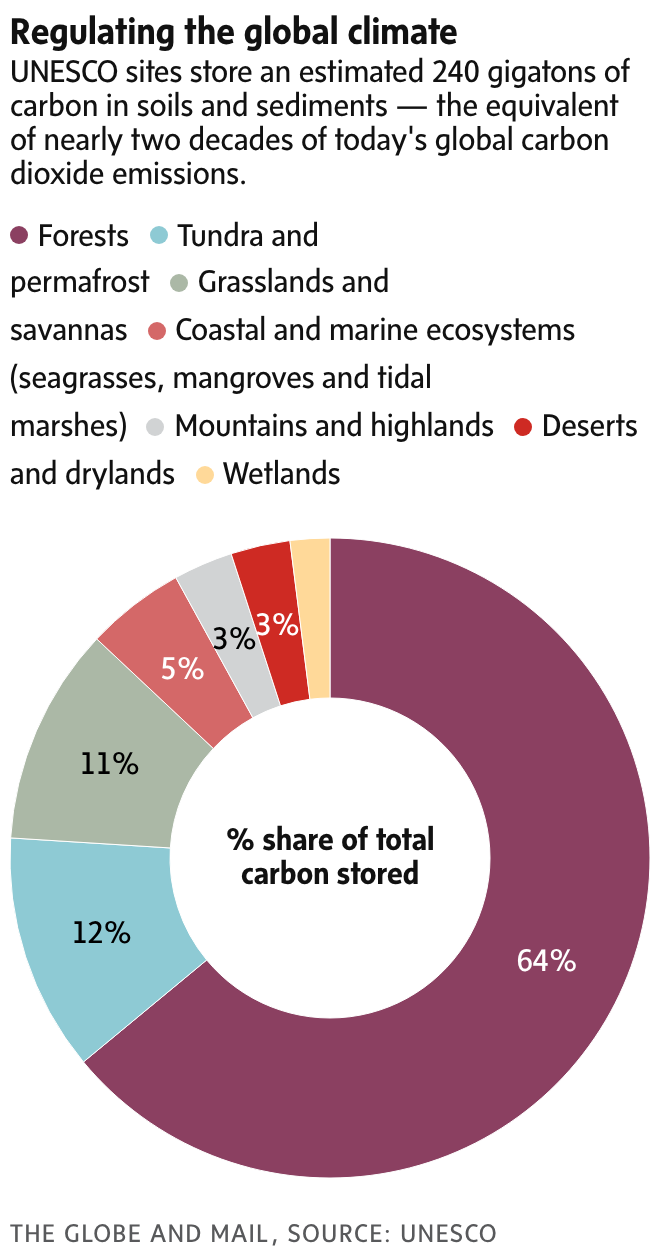
Two major studies warn that nature is not a resource to exploit or a luxury to preserve, but the system on which everything else depends – our economy, our culture, ourselves. A first-of-its-kind UNESCO assessment, People and Nature in UNESCO Sites: Global and Local Contributions,
released for Earth Day, and a peer-reviewed study released in early April in Frontiers in Science are at the centre of Jenn Thornhill Verma’s recent story explaining how everything depends on nature. |
|
|
|
|
|
|
|
|
Drawing on satellite data, geospatial analysis and peer-reviewed research to examine all the agency’s designated sites, the UNESCO report found that while global wildlife populations have declined by 73 per cent since 1970, populations within UNESCO-designated sites have remained comparatively stable. Canada has 46 UNESCO-designated sites and 10 more are on the tentative list awaiting nomination. |
|
|
|
|
The clean energy conversation is back |
|
|
|
|
Did Donald Trump accidentally help fuel the clean energy transition? The man who has called climate change a scam might be helping prove a point for renewables. The U.S. President has been aggressively rolling back his country’s green agenda, forcing the world’s biggest economy to remain reliant on fossil fuels.
Canada and the EU have been following in Trump’s footsteps of dropping environmental, social and governance practices to a lesser degree. |
|
|
|
|
But since the blockade of the Strait of Hormuz, a lot of the world has realized how exposed
they are to an energy shock – and are interested in ways to be more sustainable (and less reliant on oil). For Canada, that includes pursuing a green taxonomy
to support an energy transition. “The sun doesn’t flow through contested waterways. The wind can’t be sanctioned. Renewables aren’t just clean – they’re sovereign,” writes Paul Kershaw, a policy professor at UBC. |
|
|
|
|
|
|
|
|
|
Don Brown, wearing a sign promoting clean energy, speaks to people on the street in the Westdale neighbourhood of his hometown of Hamilton, on April 10. Nick Iwanyshyn/The Globe and Mail
|
|
|
|
|
Seniors are using their power |
|
|
|
|
You most often see young people speaking on climate change, talking about what they want to see in their future and what they hope to change in their lifetimes. But seniors around the world are also going to bat for the planet. Contrary to a common depiction of boomers as entitled or clueless, some of them are spending their twilight years fighting for the cause. Members of these movements believe that climate action should not fall to young people alone. From taking to the streets to risking jail time, Naomi Buck wrote about six Canadian activists who are taking a stand for the environment. |
|
|
|
|
Canada has a nature strategy |
|
|
|
|
Less than a month ago, Canada released a $3.8-billion nature strategy, laying out a path to nearly double the share of the country’s lands and waters under protection by the end of the decade. The plan is called A Force of Nature: Canada’s Strategy to Protect Nature,
and the goal is to protect 30 per cent of the country’s lands and waters by the end of the decade – a target known as 30x30 – which was born from a landmark deal reached at COP15,
the United Nations biodiversity conference in Montreal. Now, an Indigenous-led initiative called First 30x30 Canada
has also been set up to help the country achieve its target. Stewart Elgie, Jarislowsky Chair in Clean Economy and Innovation at the University of Ottawa, shared with us five things that he likes about the strategy. |
|
|
|
|
|
|
|
|
|
Zach Galifianakis in his new series This Is a Gardening Show. Uncredited/The Associated Press
|
|
|
|
|
|
|
|
|
|
|
During the height of the COVID-19 pandemic, it wasn’t just bread that got us excited while we were at home – gardening also really popped off. In fact, it was deemed an essential service.
The Globe even had a gardening beat during the 2020 growing season. We’ve still been sharing our growing advice through the seasons, most recently with tips to start your own edible garden. |