It can sometimes be difficult to be a woman in journalism. But today’s White House is making it harder than it’s been in decades.
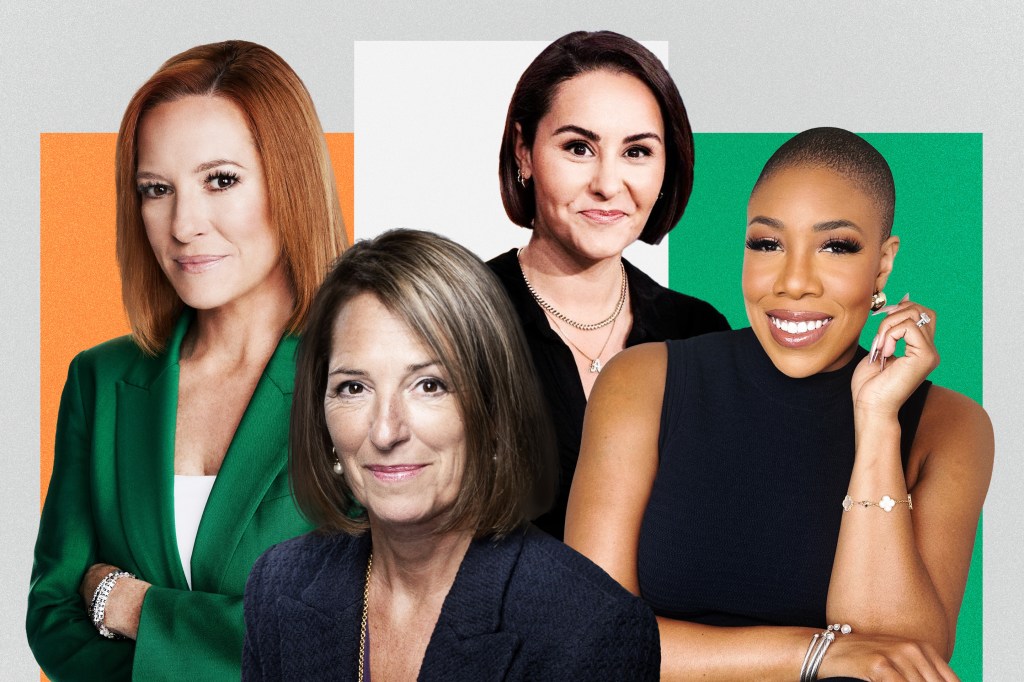
I recently sat down with four of MS NOW’s most prominent women journalists: senior investigative reporter Carol Leonnig,
The Briefing host and former Biden White House press secretary Jen Psaki,
The Weeknight co-anchor and
Clock It with Symone & Eugene co-host Symone Sanders Townsend, and
Way Too Early anchor Ali Vitali. We talked about what it’s like to be a woman in media right now—especially at an outlet founded with a left-wing lens, making it an almost automatic Trump target.
It looks something like President Donald Trump calling female reporters “
piggy,” “
ugly,” and “
stupid.” His administration has also filed
billions in lawsuits against news organizations. The FCC has opened
investigations into multiple outlets.
“This administration is taking it to a new level,” Leonnig, a five-time Pulitzer Prize-winning journalist who spent more than two decades at the
Washington Post before joining MS NOW, told me. “So many of our amazing female anchors are being bullied right by this administration, one way or the other, and hate mail or stuff from Trump administration aids is coming at them so publicly and so personally.”
The White House didn’t immediately respond to
Fortune‘s request for comment.
MS NOW is barely five months old, having rebranded from MSNBC in November after parent company Versant split from Comcast and NBC News, forcing the channel to build its own newsroom. MS NOW posted double-digit ratings growth in the first quarter of this year, has added hundreds of jobs while other newsrooms cut them, and it stands out on YouTube, where its channel has more views than those of ABC, CBS, and NBC News combined.
So with this group of journalists, I expected a serious conversation about a pivotal moment in media history (which I got). But this was also a group of women who genuinely couldn’t stop hyping each other up. (They even—several times—launched an informal campaign to get Leonnig a raise.)
“This is a moment where women all across the media apparatus are navigating through the sexism and rising to the occasion,” Sanders Townsend said. Psaki and Leonnig highlighted
CNN anchor Kaitlan Collins; Mary Bruce, the chief White House correspondent for ABC News; and MS NOW’s Laura Barrón-López for not backing down. In February, Collins asked Trump during a presser what he’d say to Jeffrey Epstein’s survivors, and instead of answering, he called her “the worst reporter” and told her as a “young woman”
she should smile more. Collins responded that smiling isn’t appropriate when discussing a sex trafficker’s victims.
But Psaki said women journalists aren’t engaging in a battle by highlighting the Trump administration’s attacks. Rather, “they are doing their jobs and they are pressing the administration for answers, and they’re not backing off.”
The women of MS NOW aren’t dwelling on the Trump administration’s tactics, either. They’re too busy breaking news.
“Nobody is giving an inch to that kind of sexism…especially in prime time when so many of our amazing female anchors are being bullied by this administration,” Leonnig said. “Nobody’s changing course on good reporting and good breaking down of what’s important.”
Covering Trump’s second term has forced sharper editorial instincts. Leonnig described an administration that generates “a tsunami of information,” requiring difficult choices about what matters most. Sanders Townsend talked about connecting stories back to viewers’ lives: “This is a foreign policy story as much as it is a democracy story, as much as it is a story about the economy.” And Vitali, who started covering Trump as a 25-year-old campaign embed in 2015, said the experience has given her “greater clarity” about separating distraction from substance because “we’ve dispensed with the notion of, ‘oh my God, he’s posting on social media.’”
They credit much of that resilience to MS NOW President Rebecca Kutler, who has been leading the organization while undergoing breast cancer treatment. Leonnig recalled that the day before Kutler publicly disclosed her diagnosis, she called Leonnig in for a face-to-face—not to discuss her health, but to congratulate her on a story.
“That was your priority the day before and amidst these treatments,” Leonnig said. “That blew me away.”
Sydney Lakesydney.lake@fortune.comThe Most Powerful Women Daily newsletter is Fortune’
s daily briefing for and about the women leading the business world. Subscribe here.