What3words is a completely free-to-use platform that’s literally saved lives, but it may have the worst business model we’ve ever seen. The app, which maps every 3-by-3-meter square in the world onto a unique address made up of three random words (you might find New York City’s mayor at order.most.limes, for example), is just one of those very good, very simple, and therefore very rare ideas. But right now the three words pinned to it are needs.more.money.
Stocks fell from record highs on Thursday as investors digested a report that Iranian Parliament Speaker Mohammad Bagher Ghalibaf has resigned from Iran’s peace talks team.
❓ Can you ace our Snacks Seven Quiz? Here’s a sample question: |
|
|
|
There’s no margin for error in software |
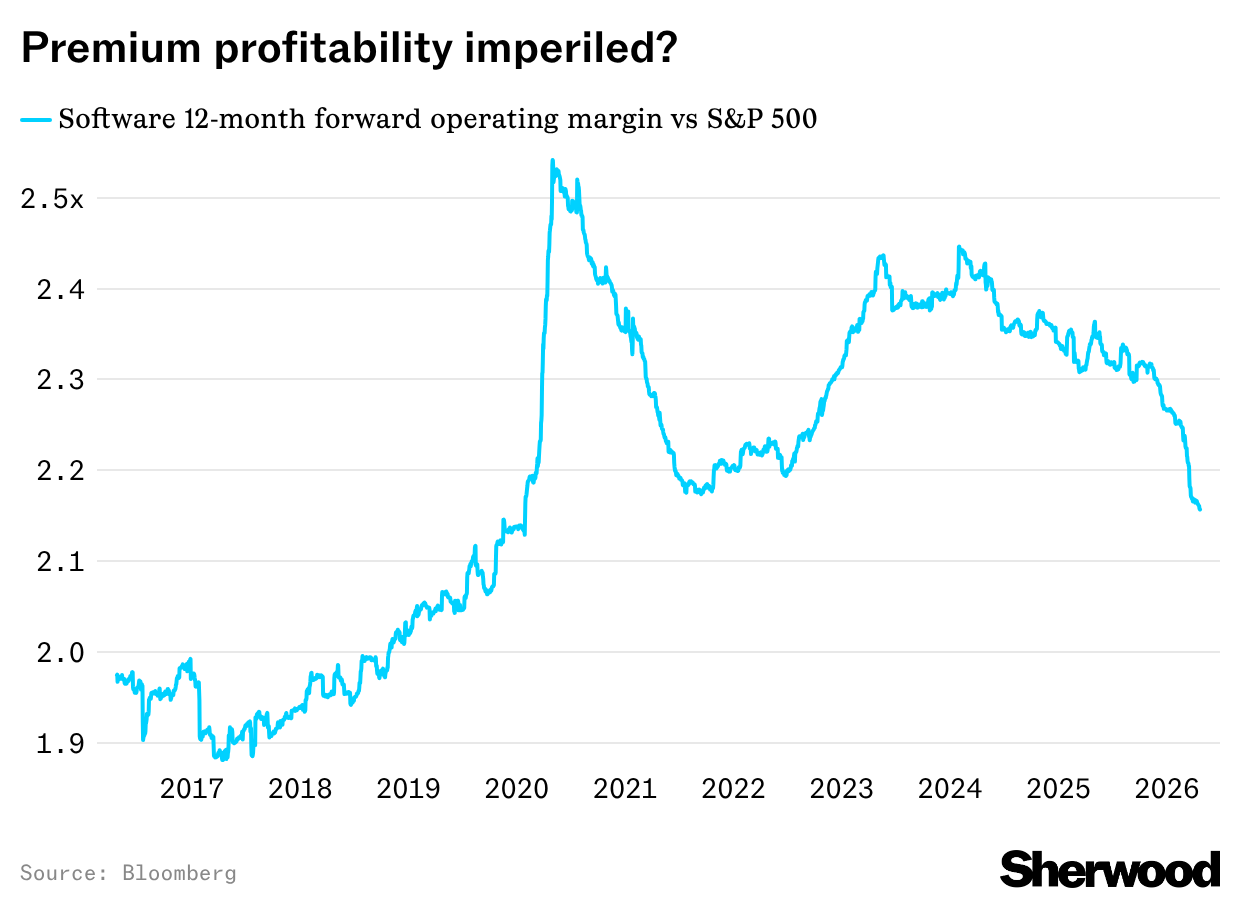
Why do investors like software stocks? Because they have high recurring revenues and extremely high margins. Why are investors worried about the impact of AI on software stocks? At the most basic level, AI tools reduce the barriers to entry and the cost of creating software.
Nothing shows traders’ willingness to shoot first and ask questions later (or not bother to ask questions at all!) when the crux of the case for owning software seemingly shows cracks more than the reaction to ServiceNow’s Q1 results and updated outlook. |
- ServiceNow cratered over 17% after the software company’s Q1 margins came in shy of estimates. Full-year guidance for ServiceNow’s gross and operating margins was revised lower, while subscription revenues got a big bump.
- There are some extenuating circumstances that cut both ways: integrating recently acquired businesses is the proximate cause of the expected sales bump and operating margin pressure, according to management.
- But given how important margins have been to the investment case for software stocks — and the significant profitability premium they’ve enjoyed relative to the S&P 500 as a whole — details don’t seem to matter.
|
In early February, Nvidia CEO Jensen Huang called the idea that the software industry would be replaced by AI the “most illogical thing in the world,” arguing that AI agents will leverage existing software tools rather than reinvent them.
|
|
|
|
The bear case for software is that AI tools render many established giants obsolete. But going the way of the woolly mammoth isn’t something that happens overnight. You won’t be able to find any of them to ask, obviously, but I’m told it was a 10,000- to 16,000-year process.
Well before obsolescence comes the threat of incremental substitution. And margin pressure would be one way you’d expect competitive pressures to be absorbed. At the surface level, ServiceNow is affirming a base case for software stocks that traders have spent months fearing, which still apparently hasn’t taken the industry to levels where it’s viewed as attractively valued.
|
|
|
|
Position Your Portfolio For Gold’s New Paradigm |
Central banks are getting hotter on gold. In a recent World Gold Council and YouGov survey, a record 95% of representatives expected global central bank gold reserves to increase from 2025 to 2026. Persistent central bank buying is just one factor indicating long-term, structural momentum behind gold’s price — but most investors haven’t considered all the options for capitalizing on it.
With a royalties-based model like Versamet’s (NASDAQ: VMET), investors get a stake in the ownership portion of gold mining. By helping to provide capital to world-class mining projects around the world, Versamet stakeholders receive a percentage of their gold production typically for the life of the mine.
The upside? Versamet's cut remains inflation-protected and generates consistent cash flow. Having executed nearly $750 million in acquisitions, the Versamet portfolio is anchored by high-growth assets across all stages of the business cycle. By prioritizing returns and diversification over rigid structures, Versamet offers a high-margin gateway to gold’s new era.
Get a prime cut of gold’s new growth, with Versamet. |
|
|
|
Avis’ announcement of Q1 earnings may portend an imminent share offering |
A lack of rental cars was a big issue for American travelers in 2021.
A fresh supply of rental car company shares may become a big issue for fans of the Avis short squeeze. |
- After the close on Wednesday, following its whopping 38% plunge, the company announced that it would be releasing its Q1 results on April 29. Why is that important?
-
It would seem prudent for Avis’ management to take advantage of its richly valued shares to raise money. Its forward price-to-earnings ratio has spiked to above 135x during this parabolic advance, and analysts at JPMorgan just downgraded the shares to “underweight,” citing an “unsustainable valuation.”
- A share offering would alleviate one of the presumptive factors behind the ferocity of Avis’ 427% gain from March 30 through Wednesday’s close: that its two biggest holders dominate the float, and as such, it may be difficult for short sellers to extricate themselves from their bets against the stock.
-
That angle may have already passed its best-before date, however, as trading volumes in excess of $19 billion this week somewhat undermine the argument that short sellers struggling for liquidity are locked into losing positions.
|
|
|
|
Share offerings are what companies that benefit from big spikes out of nowhere tend to do (ask AMC!), unless they can’t. And if they can’t, they aim to find a way around that (ask GameStop!).
About two years ago, during the return of Roaring Kitty meme mania 2.0, the video games and collectibles retailer was seemingly constrained from offering shares because it was in a “blackout period” ahead of earnings (which had been scheduled for June 7). As such, management released preliminary results on May 17 along with plans to sell up to 45 million shares on the open market.
|
|
|
|
2 truths and a lie from Tesla’s earnings call |
|
|
|
-
⚽️ Spursy: Markets are pricing in a 58% chance* that Tottenham Hotspur defeats Wolverhampton this weekend in the English Premier League, yet another in a sequence of close calls that is truly a must-win for the beleaguered Spurs. Wolverhampton is already a lock to face relegation, but Tottenham is currently contending with a humiliating 48% chance that it’ll be relegated down.
-
|
|
|
|
|